ENEnglish
 LTLietuviškai
 DEDeutsch
 FRFrançais
 RUРусский
 ESEspañol
 PLPolski
 ITItaliano
 UKУкраїнська
 CSČeština
 PTPortuguês
 JA日本語
 LVLatviešu valoda
 ETEesti
 HUMagyar
 IDBahasa Indonesia
 TRTürkçe
 HIहिन्दी
 ELΕλληνικά
 ARالعربية
 THไทย
 VITiếng Việt
 RORomână
 MSBahasa Melayu
 BNবাংলা
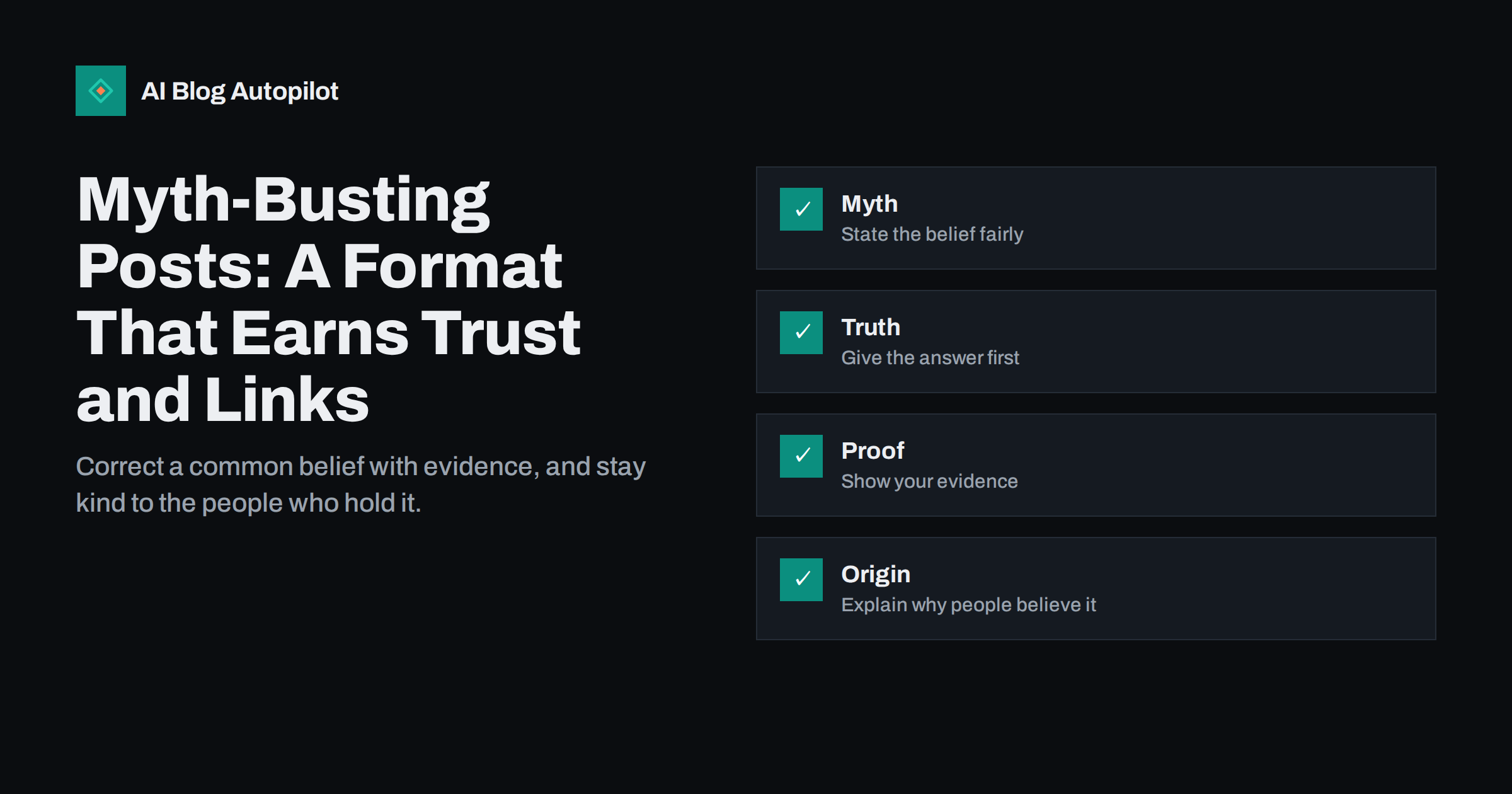
Short answer: a myth-busting post takes a belief that your customers really hold, states it fairly, gives the correct answer in the first lines, shows the evidence and explains why the myth is popular. It works because it answers a real question, builds trust through proof and invites links and shares. Pick myths from customer conversations, not from your imagination, and stay respectful of the people who believed them.
Almost every field has beliefs that sound sensible and are wrong or only half true. Customers repeat them, competitors sometimes exploit them and you spend hours correcting them one conversation at a time. A well-written post lets you do that once, in public, in a form that people and search engines can find. Done badly, the same format sounds smug and invites arguments, so the method matters.
Why the format works
A myth is a question in disguise. Someone who believes that “you must publish every day to rank” is really asking how often to publish. A post that names the belief matches the way that people think and search, and it gives you a natural opening: many readers will recognise themselves in the first sentence.
The format also builds authority. Correcting a belief with evidence shows that you know the subject, which supports the signals of experience and expertise that are described in E-E-A-T for automated blogs. Because the page makes clear claims that can be quoted, it may be used by assistants that answer questions, as long as the answer is easy to find and well supported.
Finally, it is a tidy structure for writers. Each section has the same shape, so the post is easy to produce and easy to read. That is helpful when you publish regularly, as in a content calendar on autopilot.
Choosing myths worth busting
Start with real evidence that the belief exists. Look at the questions that customers send, the objections that arise in sales calls, the comments on social posts and the phrases in your search reports. If you hear the same wrong idea three times, it is a candidate. Our guide to customer questions into topics shows how to collect them.
Prefer myths that matter. A myth that leads people to waste money or time, or to avoid a good option, is worth a full post. A trivial misunderstanding is better handled in a sentence inside another article. Also prefer myths that you can settle with evidence. If the honest answer is “it depends”, say so, and explain on what, rather than pretending to a clear verdict.
Avoid inventing straw men. Some posts attack a belief that nobody holds in order to look clever. Readers notice, and it harms trust. If you cannot find a real person who says it, leave it out. Also be careful about myths that touch health, money or legal rights, where an error in your correction can do harm. Read YMYL topics on a blog before you write about them.
A simple structure
Open with the short answer: the myth in one line and the truth in one or two. This is the part that most readers and assistants will take away, so make it complete. Then give each myth a short section, or one longer section if the post has a single myth.
Inside a section, use this order. First, the myth, stated as its supporters would state it. Second, the verdict: true, false, partly true or it depends. Third, the evidence, with sources, data or a clear example. Fourth, the origin: why the belief exists, which is often a kernel of truth that has been stretched too far. Fifth, what to do instead, in practical terms.
Use question or statement headings that carry the myth, such as “Do you need to post every day?” That keeps the page easy to scan, matches the way people phrase searches and fits the advice in question headings for AI answers. Keep a short list of three to six myths in a post, or a single deep one.
Here is a short illustration. A cleaning company hears that bleach is the only way to disinfect a kitchen. Its post states the belief, gives the verdict that it is false for most household needs, cites the guidance of a public health body, explains that the myth comes from the strong smell that people link with cleanliness and ends with a short list of safer choices for common tasks. Each part is brief, and the reader leaves with an action and a source.
Evidence that holds up
The credibility of the whole post rests on its proof. The strongest evidence is your own: a test that you ran, a before-and-after from client work, numbers from your own reports. Describe the method in a few lines so that readers can judge it. If the sample is small, say so, as described in SEO testing on small blogs.
Official guidance and primary sources come next. When a search engine or standards body has stated how something works, link to that statement and quote it fairly. Avoid pulling a line out of context. If sources disagree, say that, and explain which one you rely on and why.
Weak evidence is common in this format: a single anecdote, an old article or a number with no source. Treat it as a warning. If you cannot support a correction, it may be better to write “we have not found proof of this” than to replace one myth with another. Our checklist in evidence for marketing claims applies directly.
Think about the headline of each section as a promise. If a heading says that something is false, the text below must show that clearly. If the real answer is mixed, write the heading as a question. Mismatches between a confident heading and a hedged paragraph look careless, and they lead to quotes that misrepresent what you said.
Tone: correct without condescension
People rarely believe a myth because they are foolish. They believe it because it was repeated by someone they trusted, or because it was once true. Say that. A line such as “this was good advice a few years ago” lets the reader change their mind without losing face, and it is also more accurate.
Avoid sarcasm and words like “obviously” and “everyone knows”. They make a correction feel like an attack, and they put off the very readers who might become customers. Keep the voice that you use elsewhere, as in brand voice guidelines for AI content.
Do not shame competitors or named people. If a belief is spread by a company or an influencer, you can describe the claim without naming them. If you must refer to a specific source, quote it fairly and give the reader the link.
The post can also feed other channels. One myth with its verdict is a natural short social post, a slide in a carousel or a paragraph in your newsletter, and each can link back to the full article. See turning blog posts into social posts for ways to adapt the message to each place without repeating it word for word.
Keeping the post accurate over time
Facts change. A myth that was false last year may become true after a product or a policy changes, and a correction that was right may go out of date. Add the date of your last check, review the post at least once a year and update the verdict when it changes. Our guide to publish and updated dates explains how to show that honestly.
When you find that you were wrong, say it in the post. A visible note on what changed follows the practice in how to handle corrections on a blog and shows that you apply the same standard to yourself.
Expect pushback. Some readers will disagree, and some of them will be right about a detail. Reply politely, thank people who add useful points and fix the post when needed. A calm thread under a myth-busting post can become part of its value.
A last practical point: keep a small file of myths that you have already covered, with the address of each post. When a new customer question arrives, you can answer in a sentence and link to the post, and you avoid writing a second article on the same belief. The file also shows the gaps, which become your next topics.
Mistakes to avoid
The most common mistake is a clickbait title that promises a shock and delivers little. A clear title that names the topic and the verdict is better for readers and for search. The second is listing too many myths with thin proof. Three well-argued items beat twelve slogans, and a long list invites the problem described in thin content on blogs.
The third is burying the answer. If the reader needs to scroll through the story of the myth before they see the verdict, many will leave or will not be quoted by assistants. The fourth is repeating the myth so often that it becomes the main message. State it once, clearly, and spend most of your words on the truth and the next step.
The fifth is forgetting what to do instead. A correction without advice leaves the reader with a gap. Finish every section with a practical action, even if it is small.
How AI Blog Autopilot helps
AI Blog Autopilot writes full SEO articles for your WordPress blog from the topics, keywords, audience and tone you set, with FAQ sections, tags and SEO meta included, and it shares each one to your social networks. For a myth-busting post, add the myths your customers really mention to your topics, and use approval mode to read each article first so that your own evidence is in it. See the pricing page for plans.
Related reading
The bottom line
Pick myths that real customers hold, give the verdict first, support it with evidence and the origin of the belief, stay kind in tone and review the post when facts change.
SSS
How many myths should one post cover?
Three to six is enough. Fewer myths allow better evidence, and one deep myth can fill a whole post.
Where do I find real myths?
In customer emails, sales calls, social comments and your search reports. Repeated wrong ideas are the best candidates.
Should I name people who spread the myth?
Usually not. Describe the claim and focus on the evidence. Quote and link a source only when it is needed.
What if the answer is it depends?
Say so, and explain what it depends on. A clear conditional answer is better than a false verdict.
How often should I review a myth post?
At least once a year, or sooner when a product, policy or study changes the facts.