ENEnglish
 LTLietuviškai
 DEDeutsch
 FRFrançais
 RUРусский
 ESEspañol
 PLPolski
 ITItaliano
 UKУкраїнська
 CSČeština
 PTPortuguês
 JA日本語
 LVLatviešu valoda
 ETEesti
 HUMagyar
 IDBahasa Indonesia
 TRTürkçe
 HIहिन्दी
 ELΕλληνικά
 ARالعربية
 THไทย
 VITiếng Việt
 RORomână
 MSBahasa Melayu
 BNবাংলা
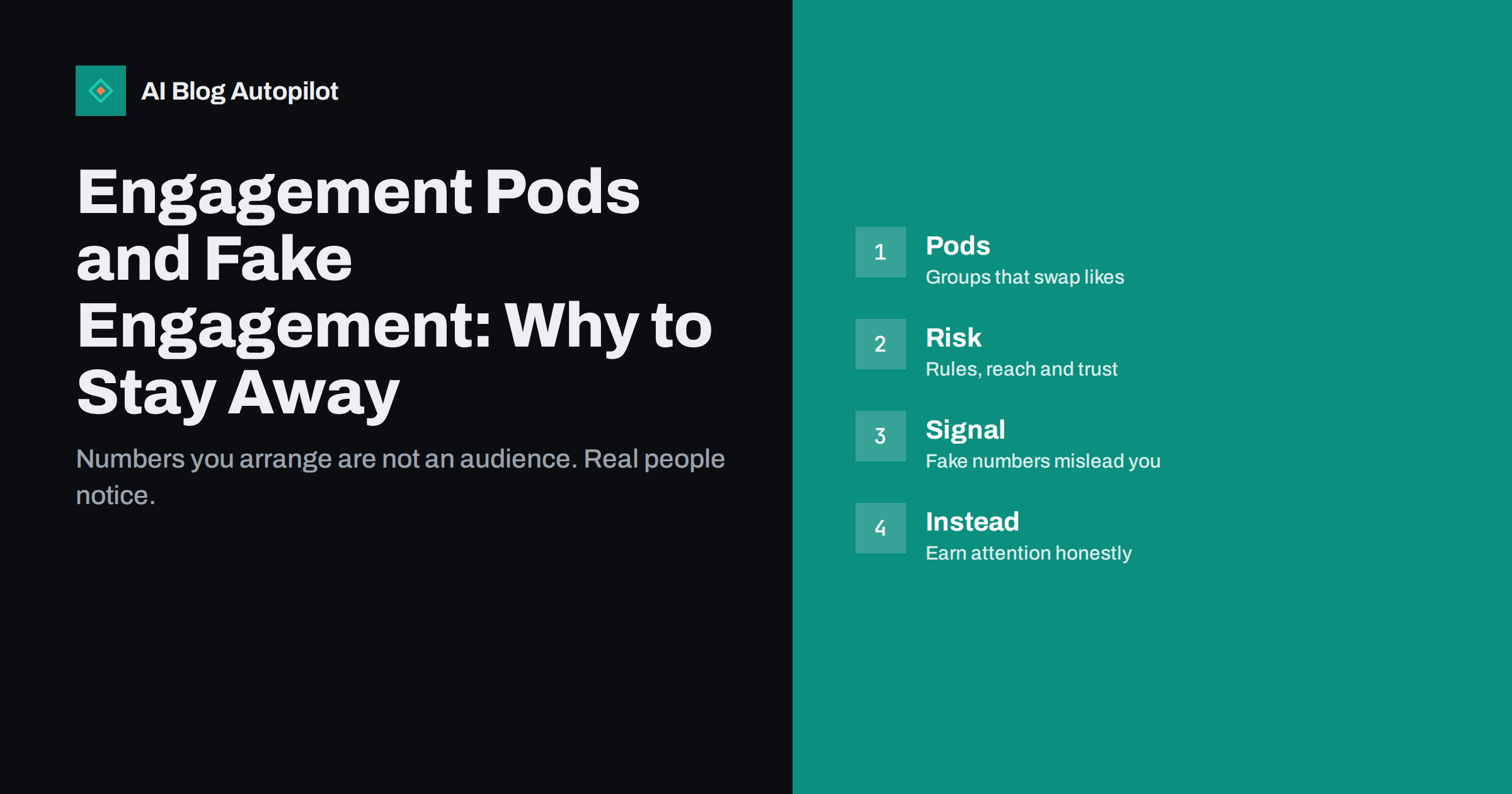
Short answer: an engagement pod is a group of accounts that agree to like, comment on or share one another’s posts to look popular. Bought likes and followers are a similar shortcut. They can break network rules, they give you misleading numbers and they do not create customers. A smaller audience of real people who care about your work is worth far more.
When a post gets few reactions, it is tempting to give it a push. Some people join a group where members support each other, and others pay for likes or comments. The idea is that early activity will persuade the network to show the post to more people. This article explains why the approach tends to backfire, how to spot the warning signs and what to do instead.
Some networks describe these practices in their own rules or help pages under names such as inauthentic behaviour or platform manipulation. Reading the relevant page for each network you use takes a few minutes and tells you exactly what is allowed.
What these tactics are
An engagement pod is usually a private chat or group in which members share links to their new posts and promise to react. Some pods are free exchanges between friends, and some are organised with rules and quotas. Members might be required to leave comments of a minimum length or to react within the first hour.
Fake engagement also includes services that sell likes, comments, views and followers, often from automated or hired accounts. Some offer “real” accounts that are paid to react. Others promise a gradual increase that looks natural. All of them share one feature: the reactions do not come from people who found the content valuable.
A softer version is the habit of asking every colleague to like every post. A little support from your team is normal, and our guide to getting your team to share blog posts shows a healthy way to do it. The line is crossed when the reactions are arranged or paid for to create a false impression.
Small accounts also hear advice from other creators that pods are normal and everyone does it. Even if some people do, that does not make the results real, and the network has no reason to reward a pattern that looks like manipulation. Your goal is an audience, not a score.
Why people are tempted
Social networks reward early activity, and a post that starts slowly can seem to disappear. Owners also feel pressure from visible numbers. A page with a few followers looks less trustworthy to some visitors, and a rival with thousands may seem more successful. Pods and purchases promise a fast way out of that feeling.
There is also a belief that the network will treat likes as proof of quality. Networks do look at engagement, but they also look at who is engaging, how they usually behave and whether they stay and take other actions. A rush of reactions from accounts that have no link to your topic is a poor signal and may be treated as one.
Understanding these motives helps you respond kindly to your own team if someone suggests it. The need behind the idea is real: you want your good content to be seen. The method is what causes the problem.
There is also a human cost to pods. Members feel obliged to react to posts they do not care about, and they spend time on exchanges that could go to real work. Many people leave such groups after a while, because the effort grows while the benefit stays small.
The risks
The first risk is breaking the rules. Many networks forbid buying engagement and using schemes to inflate numbers, and they can reduce reach, remove the reactions or restrict accounts when they find them. Because rules change and differ between networks, read the current terms of each platform you use instead of assuming.
The second risk is damage to reach. If a pod’s members have little interest in your topic, the network learns to show your posts to people like them, not to people who would buy from you. Your real audience gets a smaller share, and your results can get worse, not better.
The third risk is to your reputation. Followers and customers notice odd patterns: generic comments, the same names on every post or sudden jumps in numbers with no real conversation. If they decide that your popularity is staged, they trust the rest of what you say less. Trust is slow to build and quick to lose.
A useful habit is to track one number that is hard to fake, such as visits from social posts to your blog, replies from customers or enquiries that mention a post. These tell you whether your effort reaches the people who matter.
Fake numbers lead to bad decisions
A major hidden cost is that you can no longer learn from your data. If half of your reactions come from a pod, you cannot tell which topics, formats or times really work. You may repeat a poor post because it earned many arranged likes, and you may drop a good post that got fewer. Metrics only help when they reflect real behaviour.
This applies to follower counts as well. Bought followers do not read, click or buy. They also make your rates look worse, because a large audience with few reactions suggests weak content. Read social media metrics for bloggers for a sensible way to track what matters.
It is the same with traffic. Likes do not guarantee visits to your blog. Compare social activity with clicks and with the actions that matter to you, such as sign-ups or enquiries. Real interest shows up there.
If you notice suspicious reactions on your posts and you did not arrange them, do not worry. Networks see this often and mostly ignore accidental noise. Concentrate on the real people who engage and respond to them first.
Signs of fake engagement
You can spot unusual patterns on your own account or on others. Look for comments that could apply to any post, such as a general compliment with no detail. Look for accounts that comment on many unrelated posts within minutes, or that have no photo, few posts and many follows. Notice sudden spikes in followers from a country where you have no audience.
Check also the ratio between reactions and meaningful actions. A post with many likes but no saves, shares, replies or clicks is a warning. Real interest tends to create a mix of actions, with some people reading and acting without leaving a visible mark.
If you hire an agency or freelancer for social media, ask how they will build engagement and ask for the methods in plain words. A promise of a fixed number of likes or followers for a price is a red flag.
Set a realistic target for the first months. For a small account, ten real replies from people in your field, a few saved posts and some clicks to your blog are a better start than a thousand empty likes. Write the target down and review it each month.
What to do instead
Start with the content. Make posts that answer questions, show a process, share a lesson or give an honest opinion. Write a first line that earns attention, as discussed in social post first lines, and ask a question that your audience can answer from experience.
Take part in real conversations. Reply to comments on your posts, comment thoughtfully on posts from people in your field and join groups where your customers spend time. Our article on Facebook groups for bloggers and the one on LinkedIn for B2B blogs offer specific ideas for these places.
Use honest support from people who genuinely like your work. Ask customers, partners and colleagues to share posts that they find useful, without a quota and without a script. If you want to pay for reach, use the paid promotion tools that networks provide and label them properly, as covered in paid promotion for blog posts.
Check the security of your accounts. If you ever gave a login to a service that promised growth, change the password, turn on a second step for signing in and review which apps have access to your profile. Those services are a frequent source of account problems.
If you manage social media for a client, write the rules into your agreement: no purchased engagement, no pods and no sharing of logins with third-party growth services. A clear rule protects both sides and gives you an easy answer when someone proposes a shortcut.
If you already joined a pod
Do not panic. Leave the group, stop the exchanges and let the numbers settle. If you bought followers, you may want to remove obvious fake accounts where the network gives you tools to do so, but do not take risky steps such as using services that promise to clean your list by logging into your account.
Be honest with your team about what happened, and explain why you are stopping. If someone asks about the changes in your numbers, you do not owe a long explanation, but you should not claim a false level of popularity.
Then build a routine you can keep: a regular posting rhythm, a short daily slot for replies and a monthly look at what worked. Slow progress with real people adds up. Consistency matters more than any trick.
How AI Blog Autopilot helps
AI Blog Autopilot writes full SEO articles for your WordPress blog from the topics, keywords, audience and tone you set, with FAQ sections, tags and SEO meta included, and it shares each one to your social networks. It gives you a steady supply of useful posts to share, so you can focus your own time on replying to real people, and approval mode lets you read each article first. See the pricing page for plans.
Related reading
The bottom line
Pods and bought engagement give you numbers you cannot trust and risks you do not need. Invest in useful posts, real conversations and honest support from people who care.
SSS
What is an engagement pod?
A group of accounts that agree to like, comment on or share each other’s posts to make them look more popular.
Are engagement pods against the rules?
Many networks forbid arranged or bought engagement. Rules differ and change, so read the current terms of each platform.
Can asking friends to like my post be a problem?
A little natural support is normal. The problem starts with quotas, payments or schemes designed to inflate numbers.
How do I recover after buying followers?
Stop buying, avoid services that ask for your login, and focus on real content and conversations. Allow time for numbers to settle.
What gives real engagement?
Useful posts, clear first lines, replies to comments and taking part in conversations where your customers already are.