ENEnglish
 LTLietuviškai
 DEDeutsch
 FRFrançais
 RUРусский
 ESEspañol
 PLPolski
 ITItaliano
 UKУкраїнська
 CSČeština
 PTPortuguês
 JA日本語
JA日本語 LVLatviešu valoda
 ETEesti
 HUMagyar
 IDBahasa Indonesia
 TRTürkçe
 HIहिन्दी
 ELΕλληνικά
 ARالعربية
 THไทย
THไทย VITiếng Việt
 RORomână
 MSBahasa Melayu
 BNবাংলা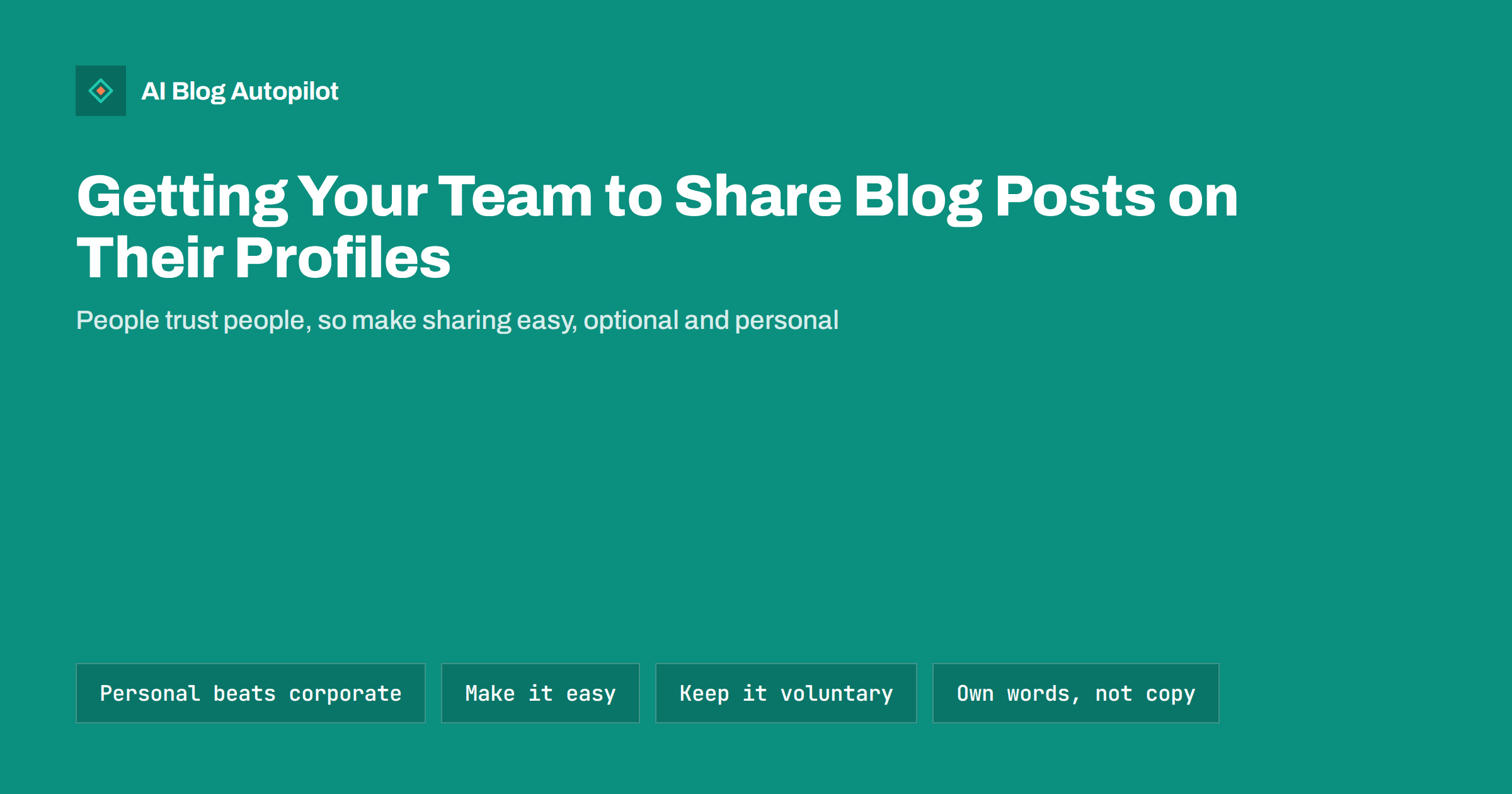
Short answer: colleagues sharing company blog posts on their own profiles can reach people the company account never will, and their posts are often trusted more because they come from a person. It works when sharing is easy, voluntary and personal: tell the team when a relevant article is published, explain who it is for, offer a suggested angle rather than a script, and let each person decide whether and how to share. Identical copied posts from a whole team look like spam and help nobody.
A company page on a professional network or social platform usually has a modest audience. The people who work at the company, taken together, often have far more connections, and those connections are exactly the customers, partners and peers the blog is written for.
This is sometimes called employee advocacy. The term sounds corporate, but the idea is simple: when someone you know shares an article they found useful, you are more likely to notice it and read it than when a brand does. This guide covers how to encourage that without making it awkward.
Why sharing by the team works
- Different audiences. Each person’s network is different. A salesperson knows buyers, an engineer knows other engineers, a founder knows investors and peers. Together they reach far more varied people than one company account.
- Personal credibility. A post from a named person with a real opinion reads as a recommendation. A post from a brand reads as marketing.
- Platform behaviour. Many networks give personal posts more visibility than company page posts in people’s feeds, although the details vary and change over time.
- Professional benefits for the sharer. Sharing useful, relevant articles helps people build their own professional reputation, which gives them a reason to do it beyond helping the company.
Start with articles worth sharing
No amount of encouragement will make people share articles they find dull or embarrassing. Before asking anyone to share, ask whether the blog publishes things your team would be proud to put their name next to.
- Useful to their contacts. Articles that solve a real problem for customers or peers are easy to share because the sharer looks helpful.
- Not overtly salesy. People are reluctant to push adverts into their personal feeds. Educational articles travel much better than product announcements.
- Relevant to the person’s role. A technical deep-dive suits engineers; a cost explainer suits sales; a hiring article suits managers. Not every post is for every colleague.
- Accurate. Nobody wants to share something a knowledgeable contact will correct in the comments.
Involving colleagues in the content itself, by asking for their questions, examples and expertise, also increases their willingness to share. People share articles they helped shape.
Make sharing easy
The biggest barrier is effort. If sharing requires finding the link, thinking of what to say and worrying about whether it is appropriate, most people will not bother. Remove as much friction as possible.
- Announce new articles in one place. A short message in a team channel or internal newsletter when a relevant post goes live, with the link.
- Say who it is for. “Useful for anyone talking to customers about migration” helps people decide in seconds whether it fits their network.
- Offer two or three angles. A key point from the article, a question it answers, or a surprising finding. These are starting points, not text to copy.
- Provide the right link. A clean URL, optionally with a tracking parameter so you can see results. Make sure the link preview shows a good image and title.
- Include a visual if you have one. A quote graphic or diagram from the article gives people an alternative to a plain link.
Keep it voluntary
This is the part that decides whether a programme builds goodwill or resentment.
- No quotas. Requiring a number of shares per week turns a personal choice into a task, and the resulting posts feel forced.
- No pressure from managers. Colleagues should feel free to share nothing, especially if their network is personal or they prefer to keep work off their profiles.
- Respect personal accounts. A person’s profile belongs to them. Never ask for login access or post on someone’s behalf.
- Thank, do not rank. Recognising people who share is fine; public leaderboards tend to reward volume over quality and make others uncomfortable.
Voluntary sharing produces fewer posts than a mandated programme, but the posts are better, and they come from the people whose networks genuinely care.
Own words beat copied text
When ten colleagues publish the identical sentence with the same link on the same morning, it looks automated. Their contacts notice, and some networks may treat repeated identical posts as low quality.
Encourage people to write one or two sentences of their own:
- Why they think the article is useful.
- A personal experience related to the topic.
- A question for their network.
- Which part they found most interesting.
A personal comment, even a short one, turns a link into a recommendation. It also starts conversations in the comments, which usually extend the post’s reach far more than the link itself.
Guidelines worth writing down
A short, friendly guideline document helps people share confidently. Keep it to a page.
- What is fine to share: published blog posts, public announcements and anything already on the website.
- What is not: confidential information, unannounced plans, customer details and internal discussions.
- Disclosure: make it clear that you work for the company when sharing its content. In many places, rules on endorsements and advertising expect employees to disclose their connection when promoting their employer. Having the employer named on the profile often does this, but a short “from our blog” removes any doubt.
- Tone: personal and professional; no attacks on competitors.
- Handling comments: answer what you can; forward complaints, support issues and press questions to the right person.
Timing and frequency
There is no need for everyone to share at once. Staggered sharing over a few days keeps the article visible longer and looks natural. A post from one colleague on the day of publication, another later in the week and a third the following week reaches more people than three posts in the same hour.
Frequency matters too. Colleagues who share every single company post quickly lose their audience’s attention. Encourage people to share only the articles they find genuinely relevant to their network, perhaps once or twice a month.
Measuring whether it helps
Measurement should be light enough that it does not turn sharing into a performance metric for individuals.
- Tracking parameters. A separate campaign tag for team shares, not per person, shows how much traffic comes from colleagues’ posts in total.
- Referral traffic from social networks. Compare periods with and without team sharing.
- Enquiries and conversations. Sales teams often notice when a prospect mentions an article they saw from someone at the company. Ask them to note it.
- Qualitative feedback. Ask sharers which articles got comments or messages. It tells you which topics resonate with your audience.
Matching articles to people
A simple way to raise both relevance and willingness is to stop sending every article to everyone. Instead, match articles to the people whose networks will care.
- Keep a light map of interests. Note which colleagues talk to which audiences: customers in a particular industry, developers, finance teams, job seekers, partners.
- Send targeted notes. “This one on data exports seems right for the people you work with” is more persuasive than a general announcement.
- Invite experts to add their view. If an article touches a colleague’s specialism, ask whether they would add a comment or a correction when they share it. Their expertise makes the share far more valuable than the link alone.
- Include new starters gently. People who have just joined often want to show their network what the company does, but may not know which articles are good examples. A short list of the best evergreen posts helps them.
Targeting means each colleague receives only a few suggestions a month, all relevant to them. That keeps the requests welcome rather than a stream of noise to ignore.
Common mistakes
- Asking everyone to share everything. Relevance is what makes personal sharing work.
- Providing a script. Identical posts undermine the personal credibility that makes team sharing valuable.
- Sharing only product news. Colleagues are rightly reluctant to advertise to friends and contacts.
- Forgetting the link preview. A missing image or a wrong title in the preview makes every share look worse. Check it before sending the announcement.
- Making it compulsory. Mandatory sharing generates volume, not trust.
How AI Blog Autopilot fits in
AI Blog Autopilot writes SEO articles, publishes them to your WordPress blog and shares each one to your company’s connected social networks automatically, with its own text and timing per network. That covers the company accounts. Personal sharing by colleagues stays personal: once an article is live and the company post is out, it is easy to send the link to the team with a note on who it suits, so people can share it in their own words. You can see how the automated sharing works on the AI Blog Autopilot home page.
Related reading
- Using LinkedIn to Distribute a Business Blog
- Turning an Article Into Social Posts That Get Read
- Using Blog Articles in Sales Conversations
- Quote Graphics From Blog Posts: Shareable Images That Work
The bottom line
Your team’s networks are often bigger and more relevant than the company account’s. Publish articles worth putting a name to, tell colleagues when a relevant one goes live and who it is for, offer angles rather than scripts, and keep sharing entirely voluntary. A few personal, well-chosen shares do more than a wall of identical posts.
SSS
How do I get employees to share company blog posts?
Publish articles that are genuinely useful to their contacts, tell them when a relevant one is live, explain who it is for and suggest a few angles. Keep it easy and voluntary, and encourage people to add a sentence in their own words.
Should employees post the same text when sharing?
No. Identical posts from several people look automated and reduce trust. A short personal comment about why the article is useful turns a link into a genuine recommendation.
Is it okay to require staff to share company content?
It is better not to. Personal profiles belong to the individual, and mandatory sharing tends to produce forced posts that their networks ignore. Voluntary sharing produces fewer but more effective posts.
Do employees need to disclose that they work for the company?
It is good practice, and advertising and endorsement rules in many places expect it when promoting an employer. Having the employer on the profile often makes the connection clear, and a short note such as “from our blog” removes any doubt.
How often should team members share blog posts?
Only when an article is relevant to their network, which for most people means occasionally rather than every post. Staggering shares across colleagues over several days also keeps an article visible for longer.