ENEnglish
 LTLietuviškai
 DEDeutsch
 FRFrançais
 RUРусский
 ESEspañol
 PLPolski
 ITItaliano
 UKУкраїнська
 CSČeština
 PTPortuguês
 JA日本語
JA日本語 LVLatviešu valoda
 ETEesti
 HUMagyar
 IDBahasa Indonesia
 TRTürkçe
 HIहिन्दी
 ELΕλληνικά
 ARالعربية
 THไทย
THไทย VITiếng Việt
 RORomână
 MSBahasa Melayu
 BNবাংলা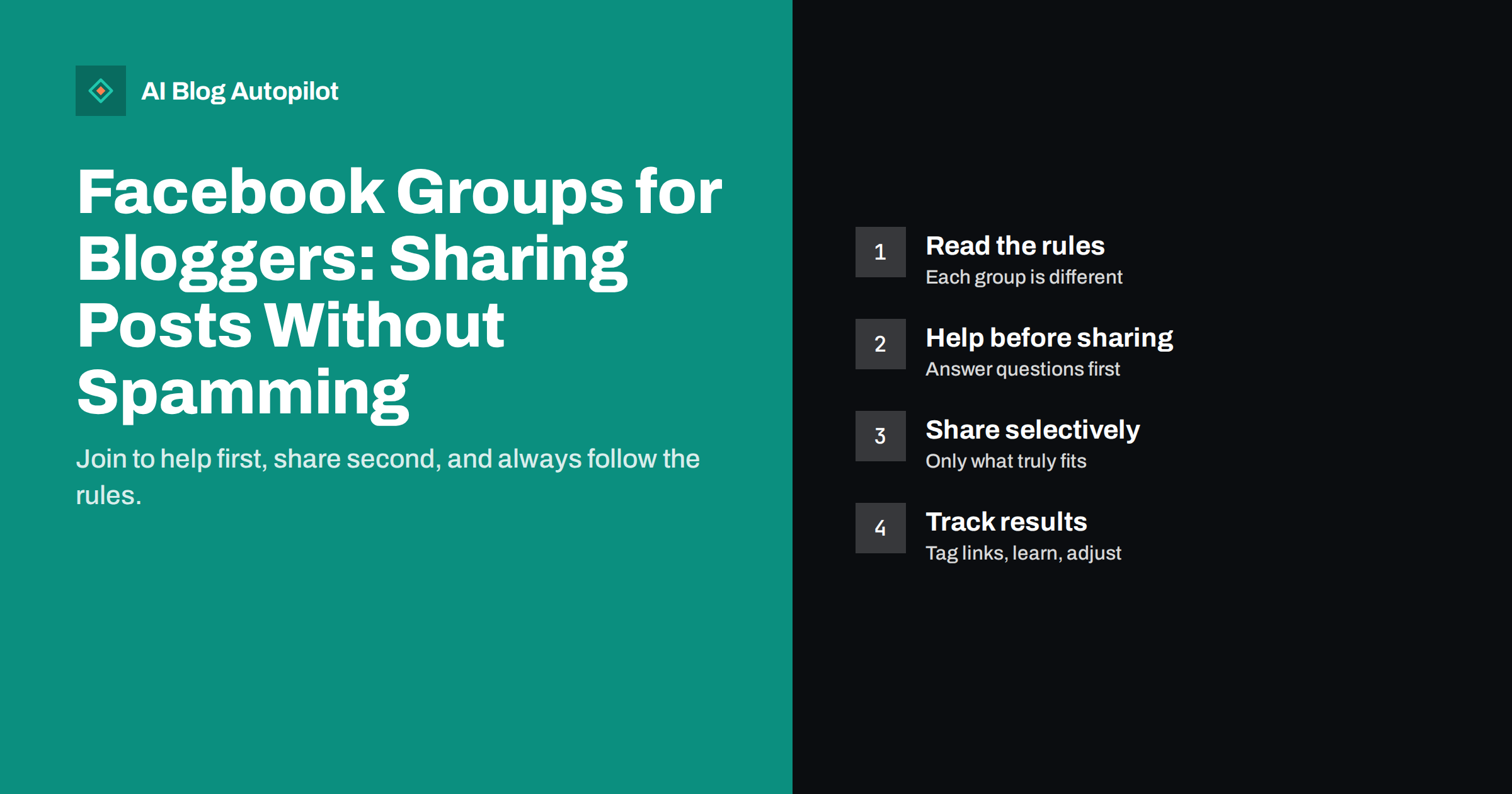
Short answer: Facebook groups can send useful readers to a blog, but only when you behave like a member of the community and not like an advertiser. Choose groups where your audience asks real questions, read and follow each group’s rules, answer questions helpfully before you share anything, post a link only when it genuinely answers a need, and tag your links so you can see what works. If a group bans links, respect that and contribute without them.
Groups are different from pages. A page is your own space, and people follow it to hear from you. A group is a shared space where people talk to each other, and the group belongs to its members and moderators. That changes the rules of behaviour. This article shows how to find the right groups, how to take part, how to share your articles in a way that people welcome, and how to measure whether the effort pays off.
Why groups can work for a blog
Groups gather people around a specific interest or problem, such as local gardening, freelance accounting, or running a small online shop. That focus is valuable because the audience is already interested in the topic of your articles.
- Relevance. A well-chosen group puts your article in front of people who asked for exactly that kind of help.
- Conversation. You can see what members struggle with, which is useful research for future topics.
- Trust. Members who see you help repeatedly start to recognise your name, and a link from a trusted member is clicked more willingly than one from a stranger.
The downside is that groups punish self-promotion quickly. Moderators remove links, members ignore drive-by posts, and repeated spam can lead to a ban. The effort only pays when you take part genuinely.
Finding groups that fit
Do not join fifty groups. Join a handful where you can actually be useful. Search the network for your topic, your industry and the kinds of problems your articles solve, and look at each candidate before joining.
- Check the activity. A group with many members but no recent discussion is not worth your time. Look for regular posts and comments from different people.
- Check the quality. Are questions answered thoughtfully, or is the feed full of adverts and unrelated links?
- Check the audience. Are the members the kind of people you want to reach, in the right country and language?
- Check the rules. Many groups state their policy on links and self-promotion in the description or pinned post.
- Consider group size. Smaller, focused groups often give better conversations than very large general ones.
Keep a simple list with the group name, the topic, the link policy and the days it is most active. This list becomes your working plan.
Read and respect the rules
Every group sets its own rules, and moderators enforce them. Common rules include a ban on links, a weekly promotion thread, a requirement to disclose affiliations, or a limit on posts from new members. Read them before you post anything, and read them again if they change.
- If links are banned, do not try to get around the ban. Answer in the comments with real advice, and let people find you through your profile.
- If there is a weekly self-promotion thread, use it, and only that.
- If you must disclose that you wrote the article or work for the company, do so plainly.
- If a moderator removes your post, ask politely what would be acceptable, and do not argue in public.
Moderators have a hard job, and the ones who see you follow the rules are more likely to welcome your contributions later.
Contribute first, share second
A simple habit works well: spend several weeks being useful before you post a link. Answer questions, share short practical tips in your own words and respond kindly to others. People notice who adds value. When you eventually share an article, you are known as someone who helps, and the link is received as another form of help.
- Answer in the comments first. If a member asks a question your article covers, write a real answer in two or three sentences. Add the link at the end only if the group allows it and the article gives more detail.
- Do not post and disappear. Stay for the discussion that follows and reply to comments.
- Do not paste the same text in many groups. Duplicate posts look like spam, and moderators talk to each other.
- Keep your profile honest. Show who you are and what you do, so members can see why you are in the group.
This approach is slower than dropping links, but it produces a positive reputation instead of a ban.
How to share an article without sounding like an advert
When a link is allowed and relevant, the way you present it matters. Write the post as a contribution to the conversation.
- Start with the problem or question the article addresses, in the words members use.
- Give a short summary of the main point, so the post has value even for people who do not click.
- Ask a question to invite discussion, such as how others handle the same issue.
- Use the link preview, and check that the image and title look right before you post.
- Avoid capital letters, repeated exclamation marks and promises of results.
An example: “Several of you asked how often to update older posts. I wrote up the checklist I use, including how to decide what to leave alone. Happy to answer questions here.” That reads like a person sharing a resource, which is exactly what it is.
Running your own group. You can also run a group for your readers or customers. This is a larger commitment than joining someone else’s. It needs rules, moderation and regular activity, and it can easily become an empty room. Consider it only if you have an audience that wants to talk to each other and the time to host the conversation. Do not turn it into a channel that only publishes your links; people will leave. If you start one, state the purpose and the rules clearly, welcome new members personally, and invite questions that are not about your products.
Measure what the groups bring
Effort should be tied to evidence. Add tracking parameters to the links you post, so your analytics shows which group or post sent each visitor. Then compare groups over a month or two.
- Which groups send visitors who stay and read more than one page?
- Which posts led to discussion, and what did people ask?
- How much time did each group take, compared with the value of the visits?
Drop groups that give nothing and put your time into the ones that do. Note the questions members ask, because they are a source of article ideas. If the same question appears several times, it deserves its own page.
A simple weekly routine
Group participation works best as a small, regular habit instead of a long session once a month. A routine of about thirty minutes a few times a week is enough for most bloggers.
- Scan the new posts in the two or three groups you follow, and note questions that relate to your subject.
- Answer two or three questions properly, using your own experience and a clear explanation, without a link unless it is needed and allowed.
- Save recurring questions in a list. Each one is a candidate for an article, and a finished article gives you a better answer next time.
- Share one article a week at most, and only where it fits the group’s rules and the current conversation.
- Review once a month: check the visits, the discussions and the time spent, and adjust your list of groups.
This rhythm keeps you visible without turning the groups into a job. It also protects you from the temptation to share every new article everywhere, which is how most people end up banned.
Finally, remember that a group is a community of people, not a traffic source. Treat members with the courtesy you would show in person, avoid private messages that no one asked for, and never collect names to add to a mailing list without consent. The reputation you build in a good group is worth more than any single click.
Common mistakes to avoid
Most problems in groups come from a handful of habits, and all of them are avoidable.
- Joining and posting on the same day. Moderators and members notice newcomers whose first act is to share a link.
- Only ever posting your own content. If every contribution points to your site, you are seen as an advertiser whatever your intentions.
- Ignoring the group’s language and culture. A tone that works on a professional page may feel cold in a friendly hobby group.
- Arguing with moderators or members. Disagreements in public damage your reputation more than they help your point.
- Sharing articles that do not answer the question. A loosely related link wastes the reader’s time and your credibility.
If you keep to the rule that every post must be useful to the people who read it, even if they never visit your blog, you will avoid nearly all of these problems.
How AI Blog Autopilot helps
AI Blog Autopilot writes articles for your blog and shares each one to your social networks, so your own channels stay active while you spend time on the conversations that need a person. Posting into groups, and replying in them, is best done by you, since it relies on judgement and on each group’s rules. See the pricing page for plans.
Related reading
- Sharing Blog Posts on Reddit Without Getting Banned
- Discord for Bloggers: Sharing Posts With a Community Server
- UTM Tags for Social Shares: See Which Posts Bring Readers
- How to Promote a Blog Post After You Publish It
The bottom line
Facebook groups reward people who help and punish people who advertise. Pick a few active, relevant groups, follow their rules, build a reputation through useful answers, and share an article only when it truly fits the conversation. Track your links, learn from the questions you see, and leave groups that do not repay your time. Slow, genuine participation is the version that works.
SSS
Is it allowed to share my blog links in any group?
No. Every group sets its own rules, and many restrict links or self-promotion. Read the rules first and follow them.
How long should I take part before sharing a link?
There is no fixed time, but a few weeks of helpful answers is a good habit. The aim is to be known for helping, not for promoting.
Can I post the same article in several groups?
Avoid copy-and-paste posts. If an article fits several groups, adapt the introduction to each audience and space the posts out.
What if my post is removed?
Check the rules, accept the decision and ask the moderators politely what is acceptable. Do not repost the same content.
Should I start my own group?
Only if you have readers who want to talk to each other and the time to moderate. A quiet group with only your links does more harm than good.