ENEnglish
 LTLietuviškai
 DEDeutsch
 FRFrançais
 RUРусский
 ESEspañol
 PLPolski
 ITItaliano
 UKУкраїнська
 CSČeština
 PTPortuguês
 JA日本語
JA日本語 LVLatviešu valoda
 ETEesti
 HUMagyar
 IDBahasa Indonesia
 TRTürkçe
 HIहिन्दी
 ELΕλληνικά
 ARالعربية
 THไทย
THไทย VITiếng Việt
 RORomână
 MSBahasa Melayu
 BNবাংলা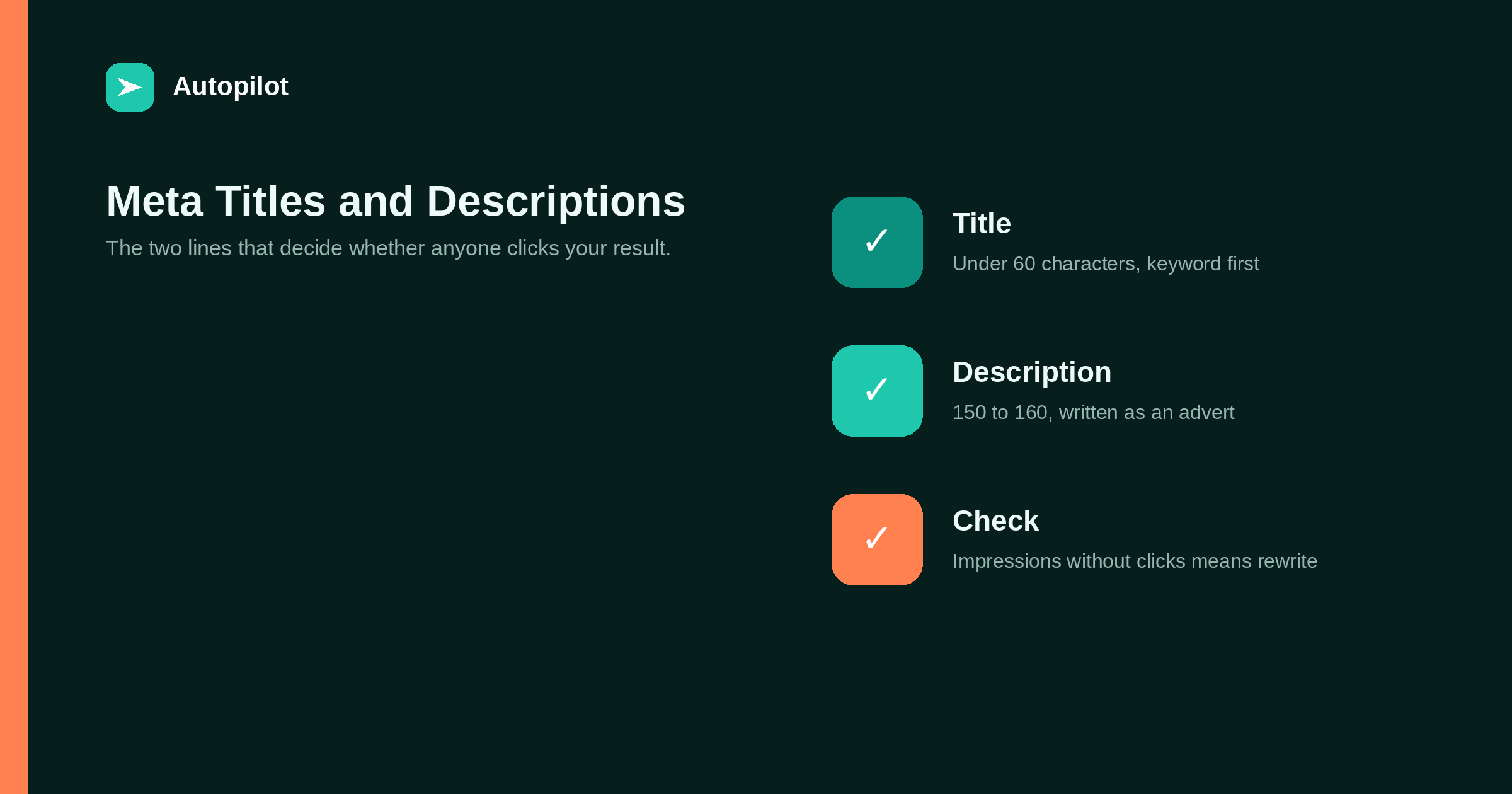
Short answer: write the title under about sixty characters with the main phrase near the front, and the description in 150 to 160 characters as an advertisement rather than a summary. The title influences ranking and clicks; the description influences only clicks, which is still most of the value. Search engines rewrite descriptions when they find something on the page that matches the query better, and that is usually a sign the description was vague rather than a malfunction.
A page can rank third and get more traffic than the page above it, purely because the title and description are better. That is the entire case for taking these two lines seriously.
They are also the most measurable thing in SEO: Search Console shows impressions and clicks per query, so a rewrite either works or it does not, within weeks.
The title
Length. Search engines truncate by pixel width rather than character count, but sixty characters is a reliable working limit. Anything important should be in the first forty.
The main phrase near the front. Not stuffed, just present early, because that is what a scanning eye catches.
One promise. A title trying to cover three angles covers none. Pick the angle that matches the query.
Distinct from your other pages. Two similar titles in your own site compete with each other, which is one of the visible symptoms of overlapping topics.
The article’s own headline and the search title do not have to match. The headline serves a reader who has already arrived; the search title serves someone choosing between ten options.
The description
The description does not affect ranking. It affects whether the ranking is worth anything, which is a distinction people use to justify ignoring it and should not.
150 to 160 characters. Longer gets cut; much shorter wastes the space.
Answer the query in the first half. Somebody deciding between results reads about eight words.
Say what they will get, not what the article is about. "This article discusses pricing models" is a table of contents. "What each pricing model costs at ten accounts, with the trade-offs" is a reason to click.
Be specific. Numbers, dates and concrete nouns outperform adjectives, provided they are true.
Why search engines rewrite your description
They often show something other than what you wrote, usually a passage from the page that matches the query more closely. This is normal and frequently an improvement.
It is worth investigating when it happens on your most important pages, because the common causes are fixable: the description was generic, it did not mention the query at all, or it was so long that the useful part was outside the visible area.
What does not help is trying to force it. Writing the description as a direct answer to the query is the only lever that reliably works, and it is the same lever that helps with being cited by answer engines.
Diagnosing a page with impressions and no clicks
Search Console makes this measurable. Sort by impressions, look at click-through rate, and investigate anything with a lot of the first and very little of the second.
| Symptom | Likely cause | Fix |
|---|---|---|
| High impressions, low clicks | Title does not match the query | Rewrite the title first |
| Title cut off in results | Too long | Move the important part earlier |
| Description replaced entirely | Too generic | Answer the query in the first line |
| Good CTR, quick exits | Title promised more than the page | Fix the page, not the title |
| Two of your pages on one query | Overlapping articles | Merge them |
The last two rows are worth noticing: a title that overpromises is worse than a dull one, because it spends attention and returns nothing.
What to automate and what to write by hand
For most articles, generated titles and descriptions are fine, and they are certainly better than the common alternative of leaving both empty and letting the CMS invent something.
Write by hand for the pages that matter: the ten that bring most of your traffic, anything commercial, and any page where the automated version reads like a summary. That is an afternoon’s work, not a policy.
Autopilot writes a meta description for every article it publishes, and where a site’s SEO plugin exposes the fields, it fills them; where it does not, the excerpt is used as the fallback, which is why writing a real excerpt is worth the extra minute. Plan details are on the pricing page, and automating a blog without losing quality covers where the rest of the review effort is best spent.
Titles for pages that are not articles
Blog posts are the easy case. The pages that earn money usually need more care and get less.
A pricing page competing on a commercial query is fighting comparison articles and competitors for the same click, and a title that reads as a label rather than an answer loses that fight. A category or tag archive, meanwhile, often ships with whatever the theme invented, which is frequently just the term name and the site title.
The fix is the same in both cases: write the title as the answer to what someone searching that query wants, and write the description as a reason to choose this result over the nine others. These pages are few enough to do by hand, and they are usually the ones where an improved click-through rate is worth the most.
Consistency across the blog
One habit worth adopting early: decide a title pattern and keep it. Whether you append the site name, whether you use a colon, whether years appear — these are small choices that look careless when they vary page to page in a results listing. Pick the pattern once, apply it everywhere, and revisit it only if the data gives you a reason.
The bottom line
The title and description are an advertisement for a page that already exists, and they are measurable within weeks. Keep the title under sixty characters with the phrase near the front, write the description as a direct answer in 150 to 160, and check Search Console for pages collecting impressions without clicks. Automate the long tail, write the top ten by hand, and revisit them when the data says to.
FAQ
Does the meta description affect rankings?
No, not directly. It affects click-through rate, which determines whether a ranking produces any traffic at all.
How long should a meta title be?
Around sixty characters, with the important words first. Truncation is by pixel width, so shorter is safer than exact counting.
Why does Google show a different description?
Because it found a passage on the page that matched the query better. On important pages, treat it as a hint that the description was too vague.
Should the title match the article headline?
Not necessarily. The search title competes for a click; the headline serves a reader who has already arrived. They can differ usefully.
What if I leave the description empty?
Something will be shown anyway, usually the first paragraph or an excerpt. It is rarely as good as a written description, and never as targeted.
How often should I revisit titles?
Once a quarter for the pages with the most impressions. Anything with many impressions and few clicks is a rewrite waiting to pay for itself.