ENEnglish
 LTLietuviškai
 DEDeutsch
 FRFrançais
 RUРусский
 ESEspañol
 PLPolski
 ITItaliano
 UKУкраїнська
 CSČeština
 PTPortuguês
 JA日本語
 LVLatviešu valoda
 ETEesti
 HUMagyar
 IDBahasa Indonesia
 TRTürkçe
 HIहिन्दी
 ELΕλληνικά
 ARالعربية
 THไทย
 VITiếng Việt
 RORomână
 MSBahasa Melayu
 BNবাংলা
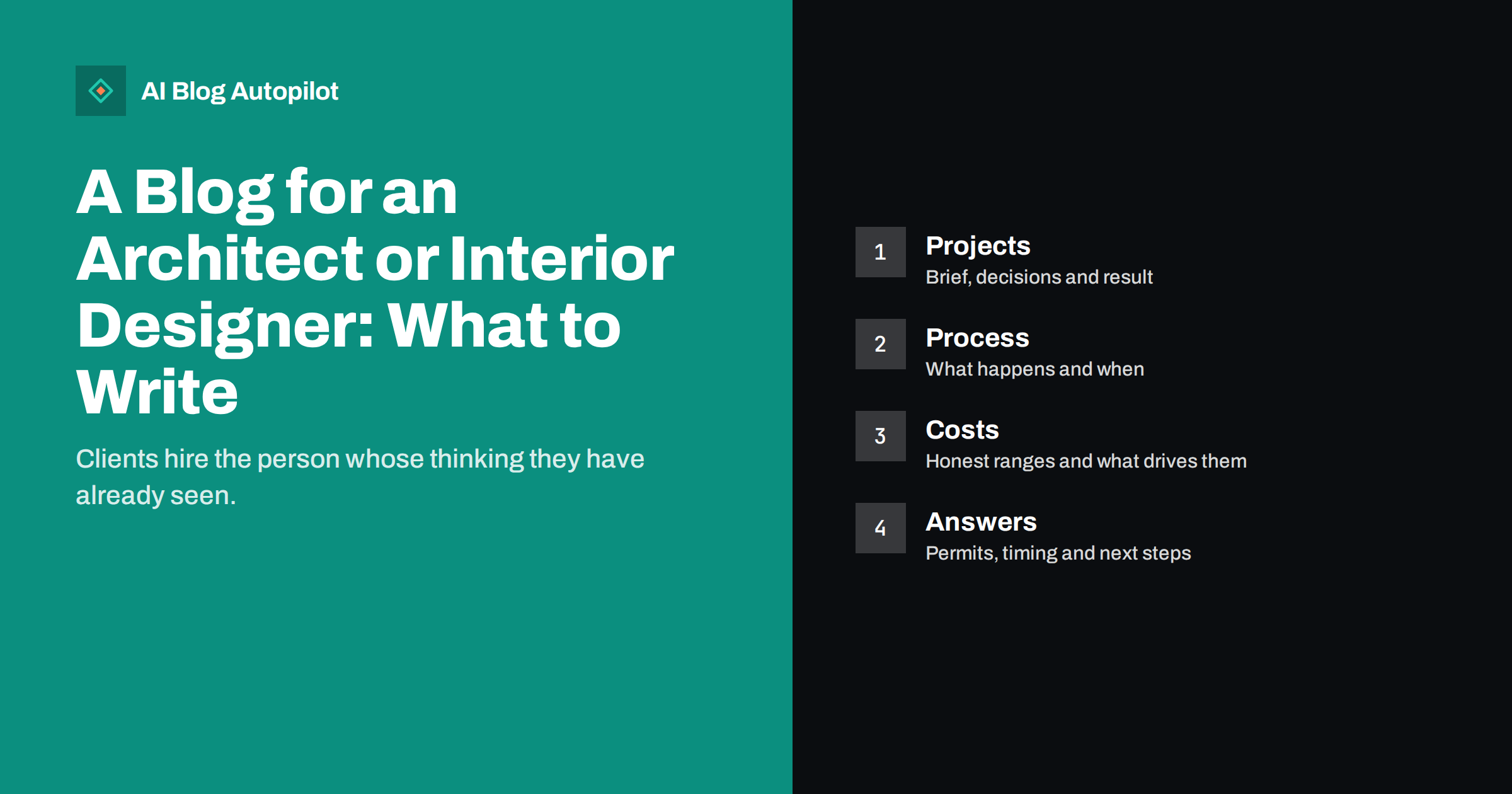
Short answer: a design practice blog works when it shows how you think: project stories that explain the brief, the decisions and the result, plain guides to the process, honest notes on what drives cost and time, and answers to the questions clients ask before they call. Use your own images, give credit to everyone involved and link each page to a clear way to get in touch.
Choosing an architect or interior designer is a high-trust decision. Clients are about to spend a large sum, live with the result for years and share intimate details of their home or business. Before they call, they read, compare and look for signs that a practice listens, explains and delivers. A blog is a place to show those qualities in advance, in a calm and specific way, to people who are not yet ready to speak to anyone.
Tell project stories, not just show pictures
A gallery of finished rooms looks good but says little about how you work. A project story gives the context: who the client was, what they needed, what the site or space made difficult, what options you considered and why you chose the one you did. Include a before picture where it helps, a plan or sketch where it explains, and a short note on the result and how the client uses the space.
Keep the structure the same each time, so that readers learn what to expect and you can write faster. Our guide to writing a case study that persuades without exaggerating explains how to stay factual. Ask the client for permission, agree what can be shown, and never reveal an address or details that could compromise their privacy or security.
Be honest about trade-offs. A page that says “the client wanted more light, the budget did not allow a bigger extension, so we moved the stairs” teaches a prospective client more than any claim of perfection. It also shows that you can work within limits, which is exactly what they will need from you.
Explain the process in plain words
Many people have no idea what an architect or designer does between the first call and the keys. A page that sets out the stages, such as the brief, concept design, planning or permits, detailed drawings, tendering, construction and handover, removes much of the anxiety. For each stage, say what you do, what the client does, how long it usually takes and what decisions are needed.
Avoid jargon or explain it when you use it. A short glossary of terms that clients meet, such as scope, snagging, variation or lead time, is easy to write and often searched for. Be careful with timelines: say that durations depend on the project, the local authority and the builder, and give typical ranges only if you can stand behind them.
Mention what happens if things change. Clients worry about delays, disputes and surprises on site, and a calm explanation of how you handle them is reassuring. Keep the tone professional and specific and avoid promises you cannot control, such as guaranteed approval or fixed completion dates.
It also helps to separate your fee from the cost of construction or furnishing, since clients often confuse the two. Explain that your fee pays for design, drawings and supervision, while the builder, suppliers and fittings are paid for separately, and that a contingency for surprises is wise, especially in older buildings. Readers who understand this early are less likely to feel misled later and more likely to give you a realistic budget.
Be open about cost
Cost is the question every client has and many practices avoid. You need not publish a price list, but you can explain what drives fees and building costs: size, complexity, materials, access, the standard of finish, the stage of work and the risks hidden in older buildings. Describe how you charge, whether by fixed fee, percentage or hourly rate, and what is and is not included.
If you give examples, label them as examples, give the date and say what they include and exclude. Prices change quickly, and a figure that is two years old can mislead and damage trust. Our article on writing honest articles about what things cost sets out how to do this well. Add a line inviting readers to describe their project for a realistic estimate.
Answer the questions clients really ask
Keep a list of the questions that come up in first meetings. Do I need planning permission? How long will it take? Can I live here during the work? How do I choose a builder? What happens if the budget grows? Each can become a short page with a clear answer, an honest note on what varies and a pointer to the rules in your area. Check the rules carefully, since permits and regulations differ by country and region and change over time.
Put the short answer first, as in this article, so that a reader who wants only the answer can leave satisfied. Include the date of the last review and say who wrote it. If a rule is complicated, say so and suggest that readers confirm with the local authority. Our guide to FAQ pages and FAQ sections will help you decide where to put such answers.
Consider plans, sections and sketches alongside the finished photographs. A simple drawing that shows how a room was reorganised often explains more than three paragraphs, and it shows a skill that a photograph alone cannot. Add a caption that tells the reader what to look at, and make sure that any text inside the drawing is readable on a phone, or repeat the main point in the caption.
Present images that help search and readers
Design is visual, and images are the strongest content you have. Use your own photographs, taken in good light and shown in a consistent style, and credit the photographer. Choose file names that describe the space, write alt text that says what the picture shows and add captions that name the materials, the room and the idea behind it. Our guides to image captions and image SEO for blog posts cover the details.
Watch the weight of the pages. High-resolution photographs can slow a page and frustrate people on a phone, so compress them and load them sensibly. A fast page that displays beautifully on a small screen makes a better first impression than a heavy one that stalls.
Include a short page on how you work with other professionals, such as structural engineers, surveyors, builders, joiners and lighting designers. Clients often fear that they must coordinate everyone, and a clear explanation of who does what, and who the client talks to, is a real selling point. Name the partners you regularly work with if they agree, and link to their sites.
Show your people and your values
Clients hire people, so introduce them. A short profile for each member of the team, with their role, background and a line on what they enjoy, makes the practice feel real. Add qualifications and professional memberships that you can verify, and avoid vague claims of being the best. If you work in a particular niche, such as heritage buildings, small kitchens or sustainable retrofits, say so and explain how you approach it.
Write about your values in practical terms. If you care about reusing materials, show a project where you did. If you prefer to keep the client involved at every step, describe how the meetings work. A concrete example is more convincing than a mission statement, and it helps the right clients to recognise you.
Reach local clients
Most design work is local, so make it easy for people nearby to find you. Name the towns and regions you serve, describe typical building types in the area, such as terraced houses, farmhouses or older shopfronts, and keep your address and contact details identical across the site and your business profiles. Our blog strategy for professional services firms and the guide to a local business blog give wider advice on this.
Collect testimonials with permission and with real names where clients agree. Link to published work, awards and press coverage you can prove. Local suppliers and craftspeople may link to your project pages if you credit them, which builds relationships and helps visibility in the community.
Share the writing among the team. A junior designer can write a first draft of a project story from their notes, and a senior partner can review it for accuracy and tone. This spreads the load, brings in different voices and gives each person a record of their work. Keep a short style note so that the pages sound like one practice, and agree who has the final say before anything is published.
Keep the blog manageable
Design practices are busy and deadlines are real, so choose a pace you can sustain. One project story and one guide every month or two is plenty. Write the story while the project is fresh, and ask the client for feedback at handover, when they are most enthusiastic. Keep a running file of photographs, notes and measurements so that you do not have to reconstruct them a year later.
Review the site twice a year. Update the process pages, check the cost notes, remove anything out of date and add new work. A modest blog that is accurate and current serves your reputation better than a large one that shows an older version of the practice.
How AI Blog Autopilot helps
AI Blog Autopilot writes full SEO articles for your WordPress blog from the topics, keywords, audience and tone you set, with FAQ sections, tags and SEO meta included, and it shares each one to your social networks. For a practice with no time to write, process guides and client questions keep appearing while you work on drawings. Approval mode lets you read each article first, which matters for regulations, costs and project details. See the pricing page for plans.
Related reading
- Blog Strategy for Professional Services Firms
- How to Write a Case Study That Persuades Without Exaggerating
- Writing Honest Articles About What Things Cost
- Image SEO for Blog Posts: File Names, Size and Formats
The bottom line
A design practice blog should show how you think and work. Tell project stories with context, explain the process, be open about cost, answer real questions, use your own images, introduce your people and keep local details accurate. Do it at a pace the practice can sustain.
FAQ
Should an architect publish prices?
You need not publish a price list, but explaining what drives fees and costs, with dated examples, builds trust and filters out poor-fit enquiries.
What makes a good project story?
A clear brief, the constraints, the options considered, the decision and the result, with the client’s permission and your own photographs.
Can I show client homes online?
Only with written permission, and without addresses or details that could compromise privacy or security.
How often should a design practice post?
One project story or guide every month or two is enough if it is accurate and well illustrated.
How do I handle rules and permits in articles?
Explain the general principle, say that rules differ by place and change, add the review date and tell readers to confirm with the local authority.