ENEnglish
 LTLietuviškai
 DEDeutsch
 FRFrançais
 RUРусский
 ESEspañol
 PLPolski
 ITItaliano
 UKУкраїнська
 CSČeština
 PTPortuguês
 JA日本語
 LVLatviešu valoda
 ETEesti
 HUMagyar
 IDBahasa Indonesia
 TRTürkçe
 HIहिन्दी
 ELΕλληνικά
 ARالعربية
 THไทย
 VITiếng Việt
 RORomână
 MSBahasa Melayu
 BNবাংলা
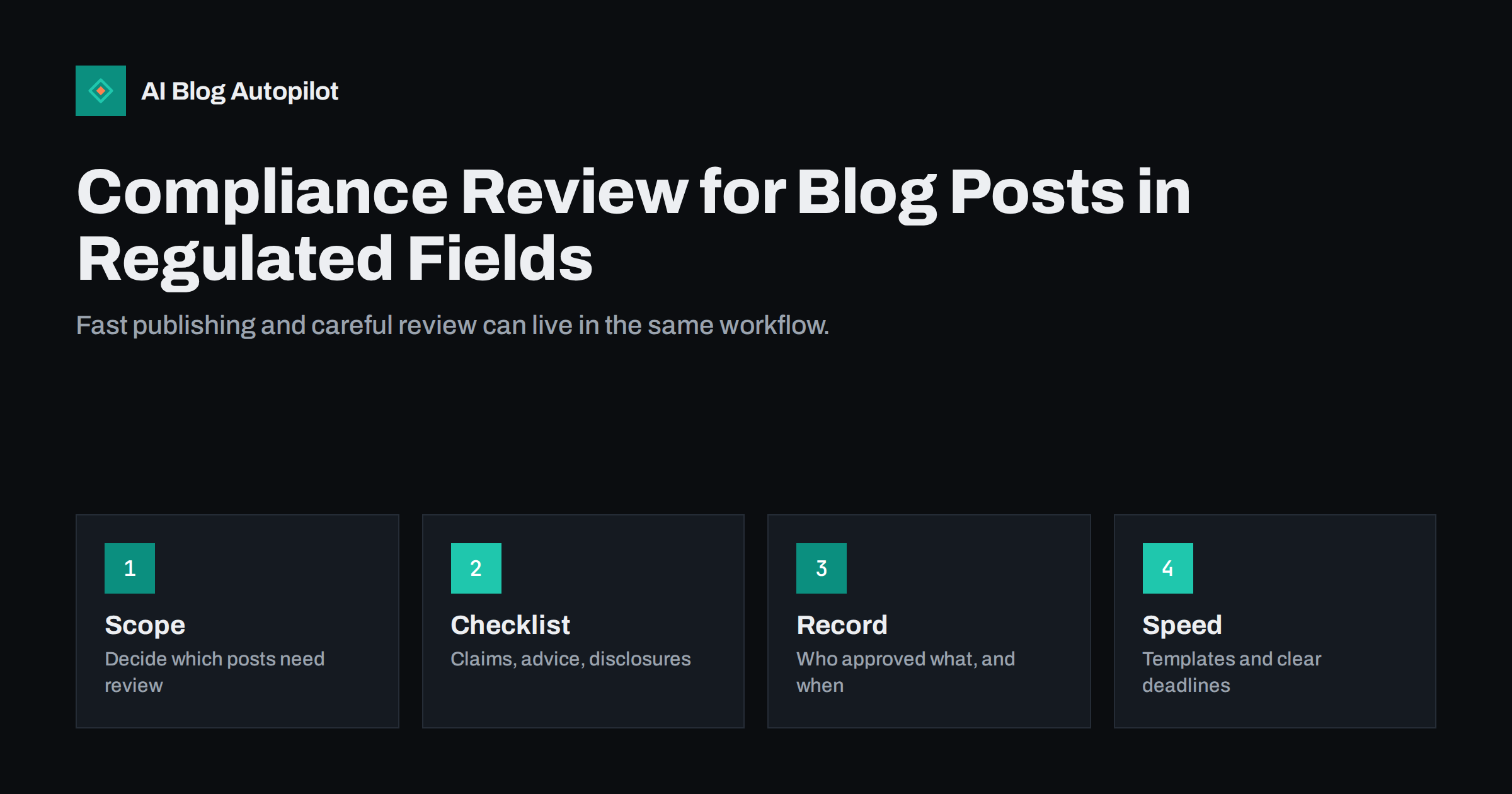
Short answer: a business in a regulated field, such as finance, health, law, insurance or education, should add a compliance review step before blog posts are published. Decide which posts need review, give the reviewer a short checklist covering claims, advice, required wording and sources, record each approval and keep the process quick with templates and clear deadlines. Ask a qualified professional for the rules that apply to your business.
Blogs in regulated industries carry more risk than most, because a careless sentence can be read as advice, a promise or a misleading claim. Yet these are also the businesses that most benefit from clear, helpful content. A light and well-defined review step lets you publish regularly without worrying about each post. This guide is general and is not legal advice: the rules differ by country and field, so check with the people responsible for compliance in your organisation.
Why a blog needs a review step
A blog post is public communication from the business, and regulators and customers may treat it like any other. A statement about returns, outcomes, safety or eligibility can create expectations. An explanation that is simplified too far can mislead. A post that appears to give personal advice to a general audience can be taken as more than information.
There is also a quality reason. Search engines pay particular attention to topics that can affect a person’s health, finances or safety, and they look for expertise, accuracy and trust. Our guide to YMYL topics on a blog explains why these subjects are held to a higher standard. A visible review process supports that standard and protects the readers.
A review is not a reason to publish less. It is a way to publish with confidence. The aim is to catch the few risky sentences before they appear and to leave the rest of the work alone.
Decide what needs review
Not every post carries the same risk. A post about the office move or a staff profile needs little review, while a post that explains eligibility, compares products, discusses results or mentions a regulated product needs much more. Write a short rule that separates the groups, for example: “any post that mentions a product, a rate, a result, a legal or medical matter or a comparison must be reviewed by compliance”.
Include older content. Posts written years ago may no longer match the rules or the product. A periodic check of the most visited and the most sensitive pages is part of the process, as described in how to audit a blog.
When in doubt, review. A rule that is too loose is a risk, and a rule that is slightly too strict costs a few minutes. Adjust the rule after a few months, using what the reviewer actually found.
Give the reviewer a short checklist
A reviewer works faster and more consistently with a list. A simple checklist might ask: are all factual claims supported by a source that can be named? Are figures current and dated? Are there promises, guarantees or comparisons that need qualification? Does the text give personal advice or only general information? Are the required disclaimers or statements present, in the right place? Is the author, and their qualification, correctly shown?
Add checks on language. Words such as “guaranteed”, “risk-free”, “best” or “cure” often need care. Testimonials and examples may require consent and context. Pictures should not imply something that is not true. Our guide to evidence for marketing claims describes how to support statements and when to soften them.
Check links too. Outbound links should lead to reliable sources, and internal links should point to the current version of a page. See external links in blog posts for how to choose them.
Put the right disclosures in the right place
Some fields require specific wording, such as a statement that the content is general information, a note about regulation or a risk statement. Where the wording is required, take it from your compliance team and do not paraphrase. Place it where readers will see it: near the top for a short notice, and in full at the end or in a clearly linked page for longer text.
Be careful with disclaimers that are used as a shield. A line at the bottom does not fix a misleading headline or a promise in the first paragraph. The message of the whole page must be fair. A notice can add context, but it cannot undo what the rest of the page says.
If posts are written with the help of tools, describe the process honestly in your policy, and make sure that a named person takes responsibility for the content. The advice in disclosure of AI use applies equally here, and an editorial policy page is a good place to state it.
Record the approval
Keep a simple record for each reviewed post: the title and address, the version that was checked, the date, the name of the reviewer and the decision, and any conditions. A shared spreadsheet or a field in your content tool is enough. If a question arises later, you can show what was published, when and with whose approval.
Keep a copy of the approved text, and of any later changes. If a post is edited after approval, it should return to review in proportion to the change: a corrected typo needs none, while a changed figure or claim does. Make the rule clear to the team.
Store the sources as well. A short list of the documents, data and pages that support the key statements saves time when the post is refreshed, and it helps a new reviewer to understand the earlier decision. Our guide to fact-checking AI content offers a routine that you can adapt.
Keep the workflow quick
Review should not become the reason that nothing is published. Set a deadline, for example two working days, and a deputy for when the reviewer is away. Send the reviewer a clear draft with the key claims marked, so that they can concentrate on the risky parts. Ask for comments in one batch, and agree who makes the final edit.
Use templates for recurring posts. If you publish a monthly market summary or a standard explanation, agree the approved wording once and reuse it, and review only what changes. Pre-approved phrases for common explanations, such as how a process works or what documents are needed, speed up writing and reduce the risk of inconsistent statements.
Plan ahead. If posts are scheduled a week or two in advance, the reviewer has time and the calendar does not depend on last-minute approvals. Our guide to editorial review: draft, approve or full auto compares the options for different levels of risk.
Train writers and keep rules in one place
Most problems come from habits, so a short guide for writers prevents many of them. List what you may say, what must be qualified and what you never say. Add a few examples of acceptable and unacceptable sentences for your field. Review the guide twice a year and when rules change.
Keep the rules in one place that everyone can find, and name an owner. Link the guide from your editorial style notes, as in editorial style guide basics. When a reviewer corrects the same issue three times, add it to the guide.
Encourage writers to ask early. A quick question before drafting saves a long rewrite after, and a team that feels that compliance is a help and not a barrier produces better content.
Imagine a small advisory firm that publishes a post on how a certain type of account works. The writer drafts the post and marks every figure and every statement about rules with the source. The editor checks tone, structure and links, and then sends it to the compliance reviewer with a deadline of two working days.
The reviewer uses the checklist, asks for one sentence to be softened and one disclosure to be moved to the top, and approves the version in the log. The editor makes the changes, schedules the post and notes the review date for a year later. Nothing in this flow is complicated, and each step has an owner, a record and a time limit.
The same flow works for a clinic, a school, a law practice or an insurance broker. Only the checklist and the reviewer change. Start with the smallest version that your organisation accepts, run it for a few months and then improve it using the problems that you actually found.
Handle mistakes and updates
Mistakes will happen. If a published post is found to contain an error, correct it promptly, note the correction and tell the compliance contact. Follow the approach in handling corrections, and avoid quietly deleting a post without a record, since the original may have been seen or shared.
Schedule reviews for sensitive posts. Rates, rules and products change, and a post that was accurate last spring may be wrong now. Put a review date on each sensitive post and check it. If it is no longer accurate, update it or remove it with a proper redirect, as in content pruning.
Finally, keep talking to your compliance team. They know the rules and the risks of your field, and a short regular meeting about upcoming topics often removes problems before any text is written.
How AI Blog Autopilot helps
AI Blog Autopilot writes full SEO articles for your WordPress blog from the topics, keywords, audience and tone you set, with FAQ sections, tags and SEO meta, and it offers an approval mode in which you read each article before it goes live. That fits a compliance step: a reviewer sees every draft first. AUTO is the default, and you can switch approval on at any time. See the pricing page for plans.
Related reading
- Editorial Review: Draft, Approve or Full Auto?
- YMYL Topics on a Blog: Extra Care for Health and Money
- Editorial Policy Page: What to Include
The bottom line
Decide which posts need review, give the reviewer a short checklist, put required wording in the right place, record each approval and keep the process quick with templates and deadlines. Take the rules for your field from your compliance experts.
FAQ
Does every blog post need compliance review?
Not always. Review posts that mention products, results, rates, comparisons or legal and medical matters, and use a written rule to decide.
Is a disclaimer enough to make a post safe?
No. A disclaimer cannot fix a misleading claim, and the whole page must be fair and accurate.
Who should review the posts?
A person who knows the rules of your field, such as a compliance officer or a qualified professional.
How do I keep review from slowing publishing?
Set deadlines, schedule posts in advance, use approved wording for repeat topics and give the reviewer the key claims marked.
Is this legal advice?
No. It is general guidance, and the rules that apply to your business must be confirmed by qualified advisers.