ENEnglish
 LTLietuviškai
 DEDeutsch
 FRFrançais
 RUРусский
 ESEspañol
 PLPolski
 ITItaliano
 UKУкраїнська
 CSČeština
 PTPortuguês
 JA日本語
JA日本語 LVLatviešu valoda
 ETEesti
 HUMagyar
 IDBahasa Indonesia
 TRTürkçe
 HIहिन्दी
 ELΕλληνικά
 ARالعربية
 THไทย
THไทย VITiếng Việt
 RORomână
 MSBahasa Melayu
 BNবাংলা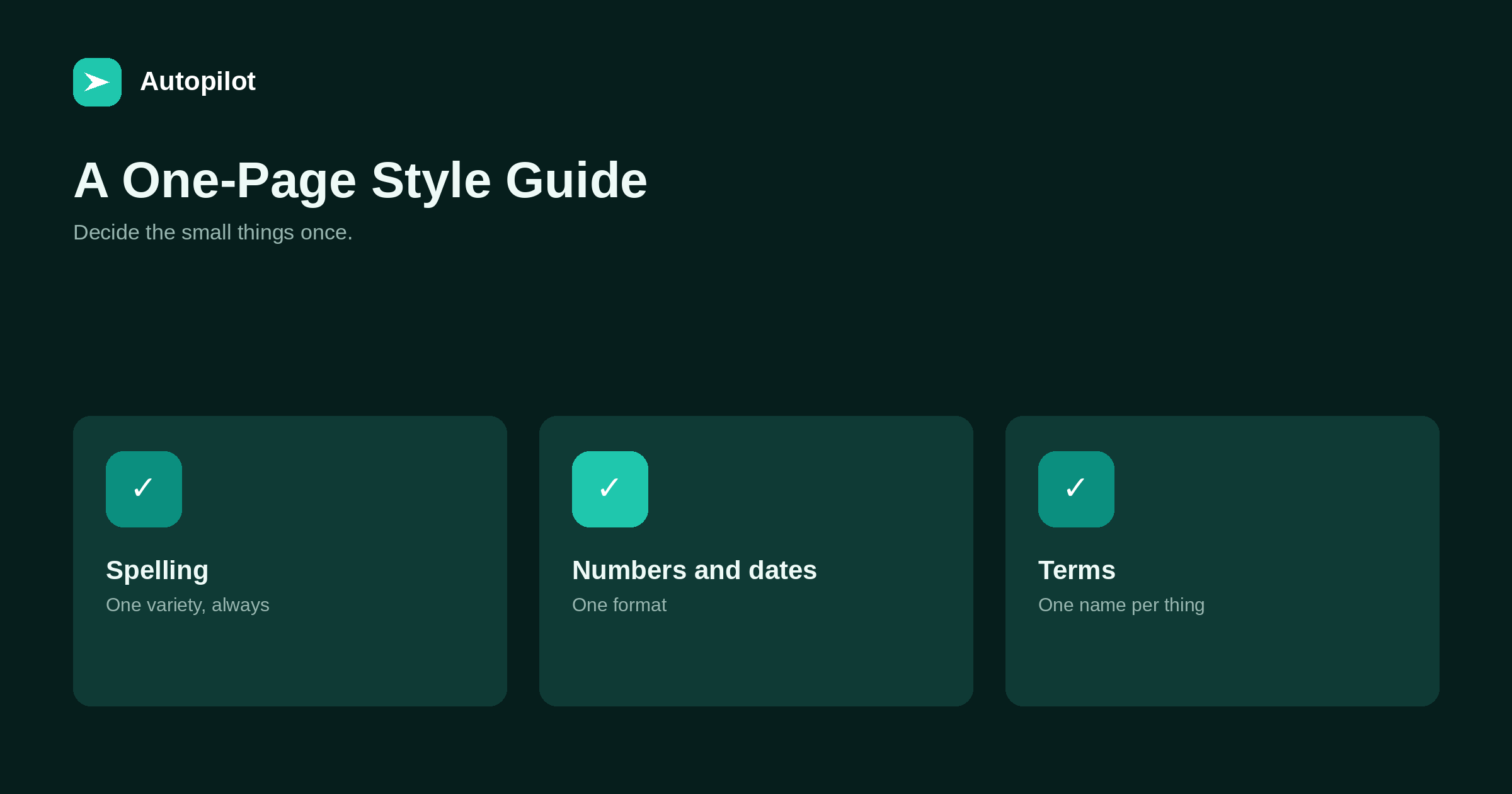
Short answer: a style guide records the small editorial decisions so they are made once rather than in every article: which spelling variety to use, how to write numbers, dates and times, how to capitalise headings, how to name your product and features, which abbreviations to spell out, and how to format links and lists. It differs from a voice guide, which covers tone. One page is enough for most blogs. Attach it to every brief so writers and tools follow it, and add to it whenever an editor makes the same correction twice.
Every article involves dozens of small choices: website or web site, 10 or ten, 5 March or March 5, Title Case or sentence case. Individually trivial, collectively they decide whether a blog looks careful or careless.
A style guide makes those choices once. It is different from a voice guide — tone is covered in writing down your brand voice — and it can be much shorter than people expect.
What belongs in it
A one-page style guide covers the decisions that come up most often.
| Area | Example decision |
|---|---|
| Spelling | British or American English, throughout |
| Numbers | Words for one to nine, figures from 10 |
| Dates | 5 March 2026, never 03/05/26 |
| Headings | Sentence case |
| Product names | Exact capitalisation, never abbreviated |
| Abbreviations | Spell out on first use |
| Lists | Parallel structure, consistent punctuation |
| Links | Descriptive anchor text, never click here |
Add a short list of words you have decided on: email or e-mail, ecommerce or e-commerce, sign up as a verb and sign-up as a noun.
Spelling and language variety
Choose one variety of English, or the equivalent for each language, and use it everywhere. Mixing colour and color on the same site looks careless to readers who notice.
The choice usually follows your main market. What matters is consistency, including in headings, image alt text, meta descriptions and FAQ answers, which are often written separately and drift.
Numbers, dates and money
These cause the most inconsistency. Decide how to write numbers in text, how to format dates without ambiguity, how to write percentages and currencies, and how to handle ranges.
Dates deserve care in international content: 03/05/2026 means different days in different countries. Writing the month as a word removes the ambiguity. For prices, the guide should also say where prices may appear at all — many businesses link to a live pricing page instead, for the reasons in fact-checking before you publish.
Product and feature names
Write product and feature names exactly as the business does, every time. A feature called Evergreen Reshares in one article and evergreen resharing in another looks like two things.
List each name with its exact form. For multilingual sites, note which names stay in English and which are translated — translating or writing natively covers terminology lists per language.
Headings and formatting
Choose sentence case or Title Case for headings and apply it everywhere. Decide how lists are punctuated and when bold is used.
Formatting rules should support readability rather than decoration. how to structure an article covers the structure; the style guide just makes sure it looks the same in every article.
Keep it to a page
A style guide that runs to thirty pages is consulted by nobody. One page covering the decisions that actually come up is followed.
For anything not covered, name a reference — a published style manual or dictionary — so there is a tie-breaker without writing every rule yourself.
Applying it
Attach the guide to every brief, so writers and tools have it from the start rather than being corrected afterwards. writing a brief an AI can use covers standing instructions.
Then enforce it in editing. The structural pass and the read-aloud pass in editing a draft catch most inconsistencies; a search for common variants catches the rest.
A sample page
To show how short it can be, a complete guide for a small business blog might read: British English. Numbers one to nine in words, 10 and above in figures. Dates as 5 March 2026. Headings in sentence case. Our product is always Autopilot, capitalised, never AP. Spell out abbreviations on first use. Lists: no full stops after short items. Link text describes the destination. Prices: link to the pricing page rather than stating amounts. Reference: a standard published style manual for everything else.
That is ten lines, and it removes most of the inconsistency editors correct in a typical month.
Style across several writers
The guide matters most when several people, or a mix of people and tools, write for the same blog. Without it, each brings their own conventions, and readers see a site that changes style from one article to the next.
Share it with every new writer on their first day, include it in agency briefs, and keep it somewhere everyone can find. A guide nobody has seen does not help.
When writers disagree about a rule, decide it, write it down, and move on. Consistency matters more than which option wins.
Where to keep it
Keep the guide in the same place as the voice guide and briefing instructions, so anyone producing an article finds all three together. Date each change, so writers know whether the version they remember is current.
Checking compliance quickly
A handful of searches catches most style slips before publication: the other spelling variety of common words, numeric dates, the product name in lower case, and the phrase click here. Five searches take a minute and catch what tired eyes miss.
Growing it sensibly
Add a rule whenever an editor makes the same correction twice. That keeps the guide grounded in real problems rather than hypothetical ones.
Remove rules nobody needs. A guide that stays at one page because it is pruned as well as extended stays useful. Consistency will not make an article rank; it makes the whole blog look like the work of people who pay attention.
Related reading
If this was useful, these cover the questions that usually come next.
- Writing down your brand voice — the tone side, which is different
- Writing a brief an AI can use — where the style guide is applied
- Editing a draft — the pass that enforces it
The bottom line
Record the small decisions once: spelling variety, numbers, dates, headings, product names, abbreviations, lists and links. Keep it to a page, name a reference for everything else, attach it to every brief, enforce it in editing, and add a rule whenever the same correction is made twice.
FAQ
What is an editorial style guide?
A short document recording decisions on spelling, numbers, dates, capitalisation, product names and formatting, so every article follows the same conventions.
How is a style guide different from a voice guide?
A voice guide covers tone and personality; a style guide covers mechanical conventions such as spelling, numbers and capitalisation.
How long should a style guide be?
One page is enough for most blogs, plus a named reference manual for anything not covered.
Should headings use Title Case or sentence case?
Either works; choose one and apply it everywhere.
How do I get writers and tools to follow it?
Attach it to every brief as standing instructions, and check against it during editing.
When should I add new rules?
When an editor makes the same correction twice. Remove rules nobody needs so it stays short.