ENEnglish
 LTLietuviškai
 DEDeutsch
 FRFrançais
 RUРусский
 ESEspañol
 PLPolski
 ITItaliano
 UKУкраїнська
 CSČeština
 PTPortuguês
 JA日本語
JA日本語 LVLatviešu valoda
 ETEesti
 HUMagyar
 IDBahasa Indonesia
 TRTürkçe
 HIहिन्दी
 ELΕλληνικά
 ARالعربية
 THไทย
THไทย VITiếng Việt
 RORomână
 MSBahasa Melayu
 BNবাংলা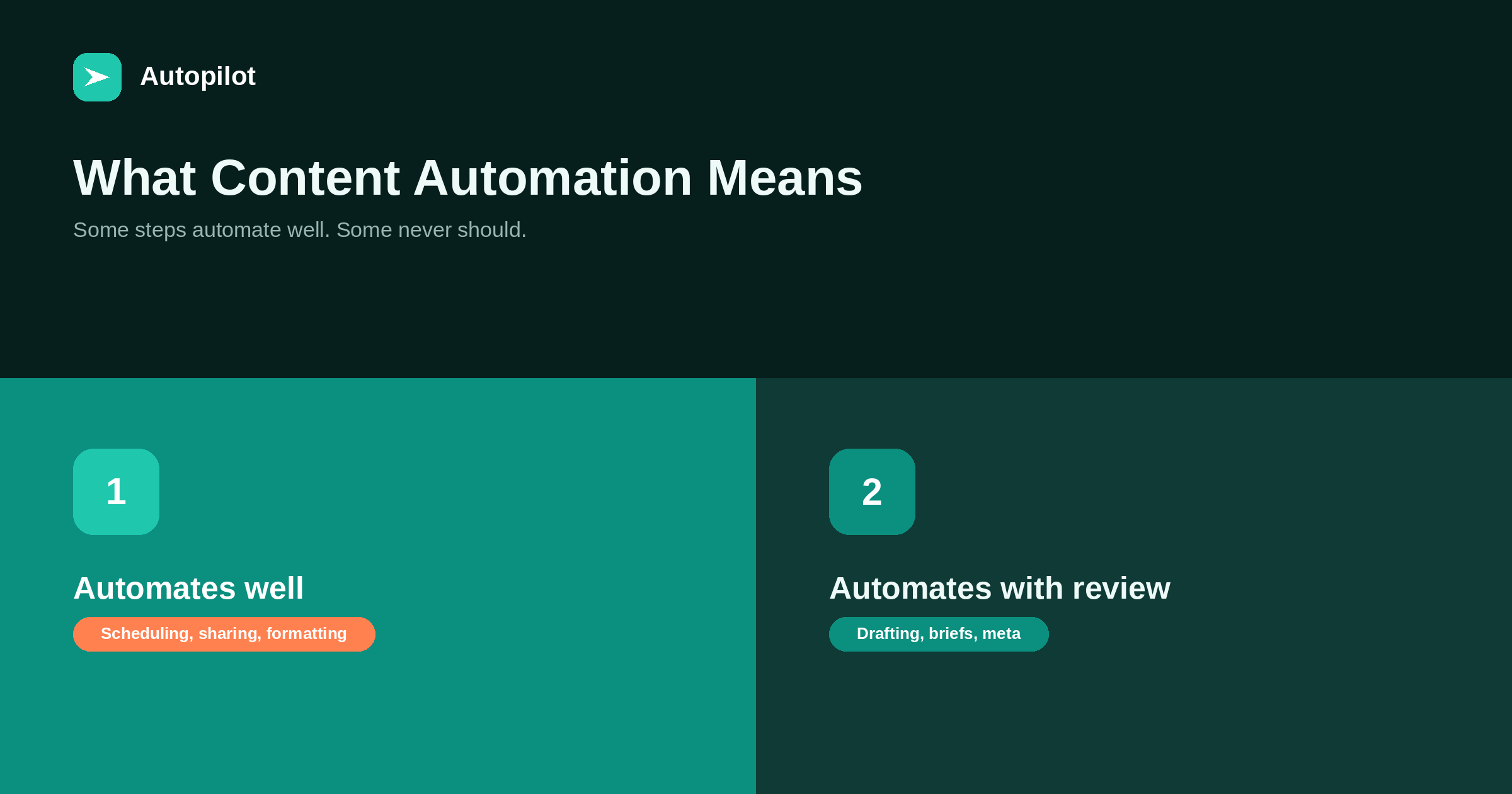
Short answer: content automation means using software to carry out steps in producing and distributing content that would otherwise be done by hand. Some steps automate very well: scheduling, publishing, formatting, resizing images, sharing to social networks, and notifying search engines. Some automate well with review: choosing topics, writing briefs, drafting articles, writing titles and descriptions. A few stay human: deciding what the business should say, adding first-hand experience, and taking responsibility for accuracy. Most of the value comes from automating the first two groups and protecting time for the third.
The phrase gets used for very different things. For one person it means a scheduling tool; for another it means software that writes and publishes articles with nobody involved. Both are content automation, and they have almost nothing in common.
A clearer way to think about it is step by step: list what producing an article involves, and ask of each step whether a machine can do it reliably.
The steps in producing an article
Every published article goes through roughly the same sequence, whether one person does it all or a team does.
| Step | Automates | Notes |
|---|---|---|
| Choosing a topic | With review | Suggestions from data; a person decides |
| Writing the brief | With review | Standing instructions do most of it |
| Drafting | With review | Fast and fluent; needs checking |
| Title and description | With review | Easy to generate, worth a glance |
| Featured image | Well | Templated images automate cleanly |
| Formatting and publishing | Very well | Pure mechanics |
| Sharing to social networks | Very well | Once set up, no reason to do by hand |
| Notifying search engines | Very well | Sitemaps and IndexNow |
| Adding experience | No | Only you have it |
| Taking responsibility | No | Someone must stand behind the page |
The table is the whole argument in miniature. The bottom rows are small in time and large in importance.
What automates very well
The mechanical steps — formatting, publishing, image sizing, social sharing, search engine notification — have no judgement in them. Doing them by hand is not more careful; it is just slower and more error-prone.
These are also where most small teams lose the most time. Sharing a new post to five networks by hand, with a different format for each, takes longer than people expect and is the first thing dropped when a week is busy — automatic sharing to social media covers doing it automatically.
If a team automates nothing else, automating these steps alone recovers hours a month without touching the writing at all.
What automates with review
The middle group involves language and judgement, and machines now do it fluently. Fluent is not the same as right, which is why review matters here.
Drafting is the obvious case. A draft can be structured, readable and relevant and still contain a wrong price or an outdated claim. The review that catches this takes twenty minutes rather than the hours the drafting would have taken — the process is in editing a draft.
Topic selection is the less obvious case. Tools can suggest topics from search data; only someone who knows the business can tell whether a topic matters to customers.
What stays human
Two things cannot be automated because they are not tasks; they are properties of the business.
Experience. The numbers from your own operations, the situations customers were in, the things you tried that failed. A draft cannot contain them unless someone adds them, and they are what separates a useful page from a competent summary — see adding something original.
Accountability. Somebody must stand behind what is published. That can be a named person or the organisation, but it cannot be nobody, and it is not something a tool can take on for you.
Levels of automation
In practice, businesses choose a level rather than an all-or-nothing position.
- Distribution only. Writing by hand, publishing and sharing automated.
- Drafts for review. Everything automated except the final approval.
- Selective autopilot. Low-risk categories publish directly; sensitive ones wait for approval.
- Full autopilot. Articles publish on a schedule without review, with periodic spot checks.
Most businesses end up at the second or third level. draft, approve or full auto covers choosing between them, and the choice usually depends more on the subject matter than on the tool.
What automation does not change
Automation changes the cost and speed of producing content. It does not change what makes content worth reading or what search engines reward.
Published guidance is explicit that automation is acceptable when the result is helpful and problematic when it is used mainly to manipulate rankings — what search engines actually say about AI content quotes it. The standard for the page is the same whoever or whatever produced it.
It also does not guarantee results. No tool can promise a ranking, traffic or leads, because those depend on the market, competitors and search changes as well as the content.
Where to start
If you are new to it, automate in the order that carries the least risk.
- Distribution: publishing, sharing, search engine notification.
- Formatting and images.
- Drafting, with every article reviewed for the first month.
- Selective autopilot for categories where review found little to change.
AI Blog Autopilot covers drafting, images, publishing and social sharing in one place, with plans listed on the pricing page and the first three articles free. Whatever tool you use, the order above keeps the risk small while you learn what your content actually needs.
Related reading
If this was useful, these cover the questions that usually come next.
- Whether a blog can really be automated — the honest answer to the obvious follow-up
- What an AI blog writer is — the drafting part in detail
- Draft, approve or full auto — choosing how much to hand over
The bottom line
Content automation is a set of steps, not a switch. Automate the mechanical ones completely, the language-based ones with review, and keep experience and accountability human. Start with distribution, add drafting with full review, and loosen review only where it has stopped finding problems. The standard for the page does not change.
BUJ
What is content automation?
Using software to carry out steps in producing and distributing content that would otherwise be done by hand, from scheduling and social sharing to topic suggestions and drafting.
Which content tasks are easiest to automate?
The mechanical ones: publishing, formatting, image resizing, sharing to social networks and notifying search engines. They involve no judgement and automating them saves time with little risk.
Can content automation replace writers?
It can take over drafting, but not experience or accountability. Someone still needs to add first-hand knowledge, check accuracy and stand behind what is published.
Is automated content allowed by search engines?
Published guidance judges content by whether it is helpful, not how it was produced. Automation used mainly to manipulate rankings is against the guidelines; automation used to produce useful pages is not.
Where should a business start with content automation?
With distribution, then formatting and images, then drafting with every article reviewed. Loosen review only for categories where it consistently finds little to change.
Does content automation guarantee more traffic?
No. It changes the cost and pace of publishing. Traffic and rankings depend on the quality of the pages, competition and search changes, which no tool controls.