ENEnglish
 LTLietuviškai
 DEDeutsch
 FRFrançais
 RUРусский
 ESEspañol
 PLPolski
 ITItaliano
 UKУкраїнська
 CSČeština
 PTPortuguês
 JA日本語
JA日本語 LVLatviešu valoda
 ETEesti
 HUMagyar
 IDBahasa Indonesia
 TRTürkçe
 HIहिन्दी
 ELΕλληνικά
 ARالعربية
 THไทย
THไทย VITiếng Việt
 RORomână
 MSBahasa Melayu
 BNবাংলা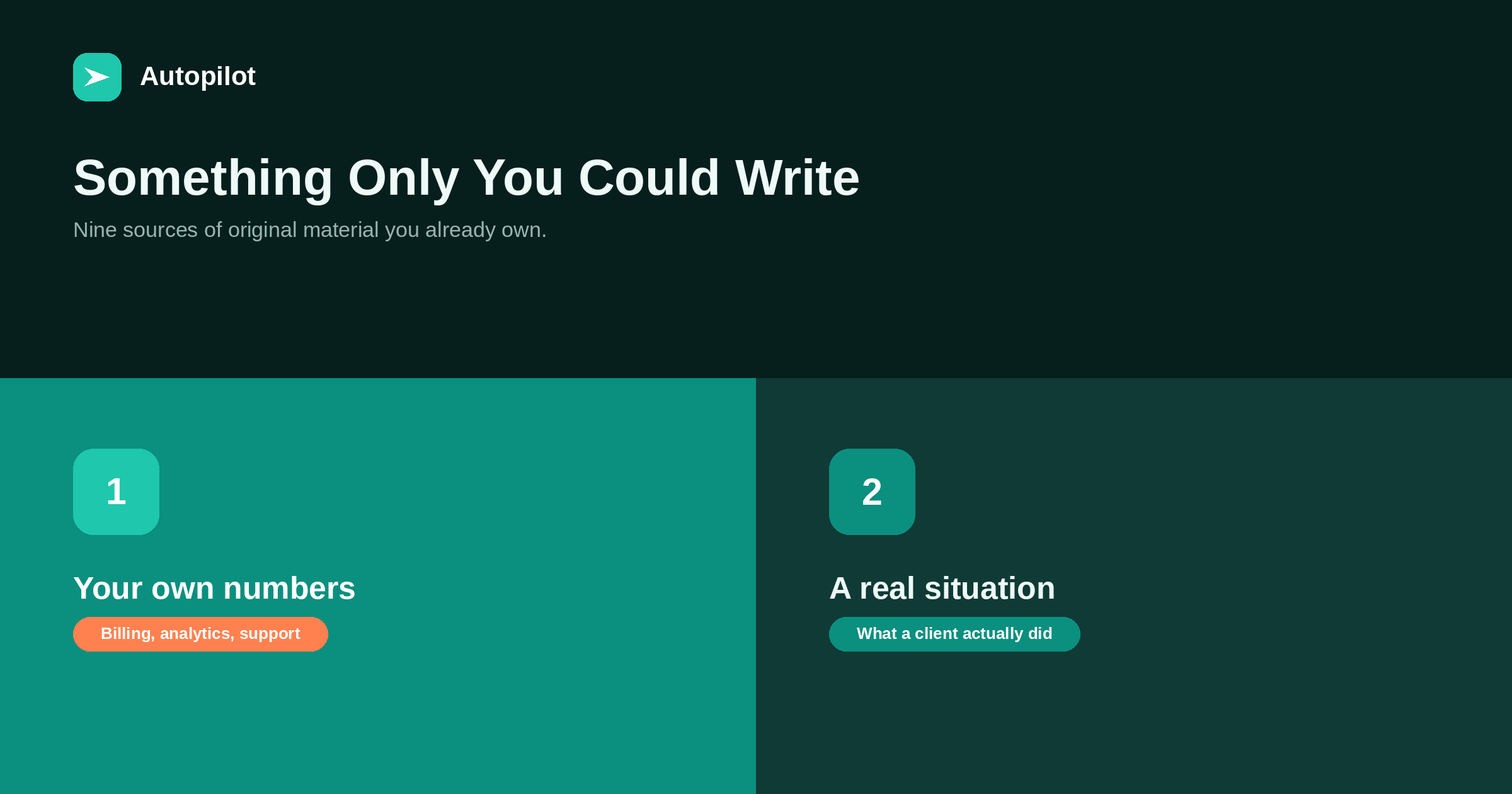
Short answer: take one or two things from a list you already own: a number from your own billing or analytics, a situation a customer was actually in, a process you changed and why, a mistake you made, a screenshot of your own screen, a place where you disagree with the common advice, what you charge, what you tried that failed, or a question you get asked constantly. Each takes two to five minutes to add and none of it can be researched. Two per article is enough to make a page that could not have been produced by anybody else.
The honest weakness of any drafted article, generated or not, is that research produces a summary of what is already published. It cannot contain what you have seen.
This is usually discussed as a philosophical problem. It is a practical one, and the solution is a list you consult rather than inspiration you wait for.
Nine things you already have
None of these require new research. They require remembering that you know them.
- A number from your own systems. How long something takes, how many requests you get a week, what proportion of customers choose a particular option.
- A real situation. A customer had this problem, we tried this, that happened.
- A process you changed. We used to do it this way; we stopped because.
- A mistake. The most under-used material anybody has.
- A screenshot of your own screen. Your dashboard, your settings, your output.
- A disagreement. The standard advice says X; here is when it is wrong.
- What you charge, or what things cost you. Specific, current, checkable.
- Something you tried that did not work. With the reason.
- A question you are asked constantly. Including the answer you actually give.
Read the draft, pick the two that fit, write them in. That is the whole method.
Where to put it
Placement matters more than volume. Original material buried in section six does less than one sentence early.
The three positions that work: inside the opening, where it signals immediately that this is not a summary; at the start of the section it supports, as the evidence for the point; and as the reason behind a recommendation, which is where readers are most sceptical.
What does not work is a box at the end labelled our experience. It reads as an afterthought because it is one, and readers who left in section two never saw it.
Your own numbers, handled honestly
A number from your own operations is the strongest thing you can add and the easiest to get wrong.
| Do | Do not |
|---|---|
| Say where it came from | Present an estimate as measured |
| Give the period it covers | Imply it is an industry figure |
| Say how small the sample is | Round 17 up to about 20 |
| Use your own data only | Guess at customer outcomes |
| Update it when it changes | Leave a 2024 figure undated |
Small and honest beats large and vague. In the last six months, eleven of our thirty clients asked for this is a real finding. Most businesses struggle with this is not.
And never publish results you cannot evidence, especially about what customers achieve. That is both a trust problem and, in many jurisdictions, an advertising one — see fact-checking before you publish.
Customer situations without breaking confidence
The most useful material involves other people, which raises an obvious question.
Three approaches cover nearly everything. Ask, which for a happy customer is usually a yes and sometimes a link. Anonymise properly: a manufacturer with about forty staff rather than the name, and change any detail that identifies them. Or generalise across several: clients in this situation usually hit the same problem, which is true and identifies nobody.
What not to do is invent a composite and present it as a specific case. That is fabrication with extra steps, and it is exactly the kind of thing that destroys the trust the addition was meant to build.
Disagreement is original by definition
If you have done this work for a few years you disagree with some of the received advice. Writing that down produces a page nobody else has.
It needs to be honest disagreement with a reason, not contrarianism. The shape that works: here is the common advice, here is why it is usually reasonable, here is the situation where it fails, here is what we do instead.
This is also the material most likely to get you cited, because a summary of consensus gives nobody a reason to link and a specific reasoned objection does. It is the main argument for publishing something substantial occasionally rather than only volume, as experience, expertise and trust sets out.
Making it part of the process
Relying on remembering to do this means it happens for four articles and then stops.
Two mechanisms work. Put the list of nine in your review checklist, so the question is asked every time. And keep a running file of material as it occurs — a client question this morning, a number from last month’s report, a thing that went wrong — so that the review step is a matter of picking rather than generating.
That file is worth more than any tool. Ten minutes a week keeping it means every article for the next quarter has something in it, and it is also where next quarter’s topics come from, which picking topics worth writing treats as a better source than a keyword export.
How much is enough
Two additions per article, consistently, changes the character of a blog within a quarter. It is not a large amount of work: five minutes in a twenty-minute review.
The test is whether a competitor could publish your article unchanged. If they could, it contains nothing of yours, and that is true whoever wrote the draft — it is the same test that separates a useful page from a competent one in editing a draft.
One caveat worth stating: this does not guarantee any ranking, and no technique does. What it guarantees is a page that is worth the click and an archive you would be willing to defend.
Related reading
If this was useful, these cover the questions that usually come next.
- Experience, expertise and trust — why this is the part nothing else supplies
- Editing a draft — the pass where this belongs
- Fact-checking before you publish — keeping your own numbers honest
The bottom line
Keep a list of nine kinds of material you already own and take two from it per article, placed early rather than in a box at the end. Be exact about where your numbers come from, anonymise customers rather than inventing them, and write down the places you disagree with the standard advice. Five minutes, and the article becomes one only you could have published.
BUJ
What counts as original material in a blog post?
Anything that could not be found by researching: your own numbers, a real customer situation, a process you changed, a mistake, a screenshot of your own tooling, a reasoned disagreement with common advice, or what you actually charge.
How much original material does an article need?
Two additions is enough to change the character of the page. The useful test is whether a competitor could publish your article unchanged; if they could, there is nothing of yours in it.
Where should original material go in the article?
Early. In the opening, at the start of the section it supports, or as the reason behind a recommendation. A box at the end labelled our experience reads as an afterthought and is missed by anyone who left earlier.
Can I write about a client without naming them?
Yes. Describe them by size and sector, change identifying details, or generalise across several clients. What you must not do is invent a composite case and present it as a specific one.
Is a small number worth publishing?
Yes, if you say how small it is. Eleven of our thirty clients is a real finding; most businesses is not. Honesty about the sample is what makes a small number credible.
How do I keep doing this at volume?
Keep a running file of material as it happens — a question from this morning, a figure from last month, something that went wrong — so the review step becomes picking rather than inventing. Ten minutes a week covers a quarter of articles.