ENEnglish
 LTLietuviškai
 DEDeutsch
 FRFrançais
 RUРусский
 ESEspañol
 PLPolski
 ITItaliano
 UKУкраїнська
 CSČeština
 PTPortuguês
 JA日本語
 LVLatviešu valoda
 ETEesti
 HUMagyar
 IDBahasa Indonesia
 TRTürkçe
 HIहिन्दी
 ELΕλληνικά
 ARالعربية
 THไทย
 VITiếng Việt
 RORomână
 MSBahasa Melayu
 BNবাংলা
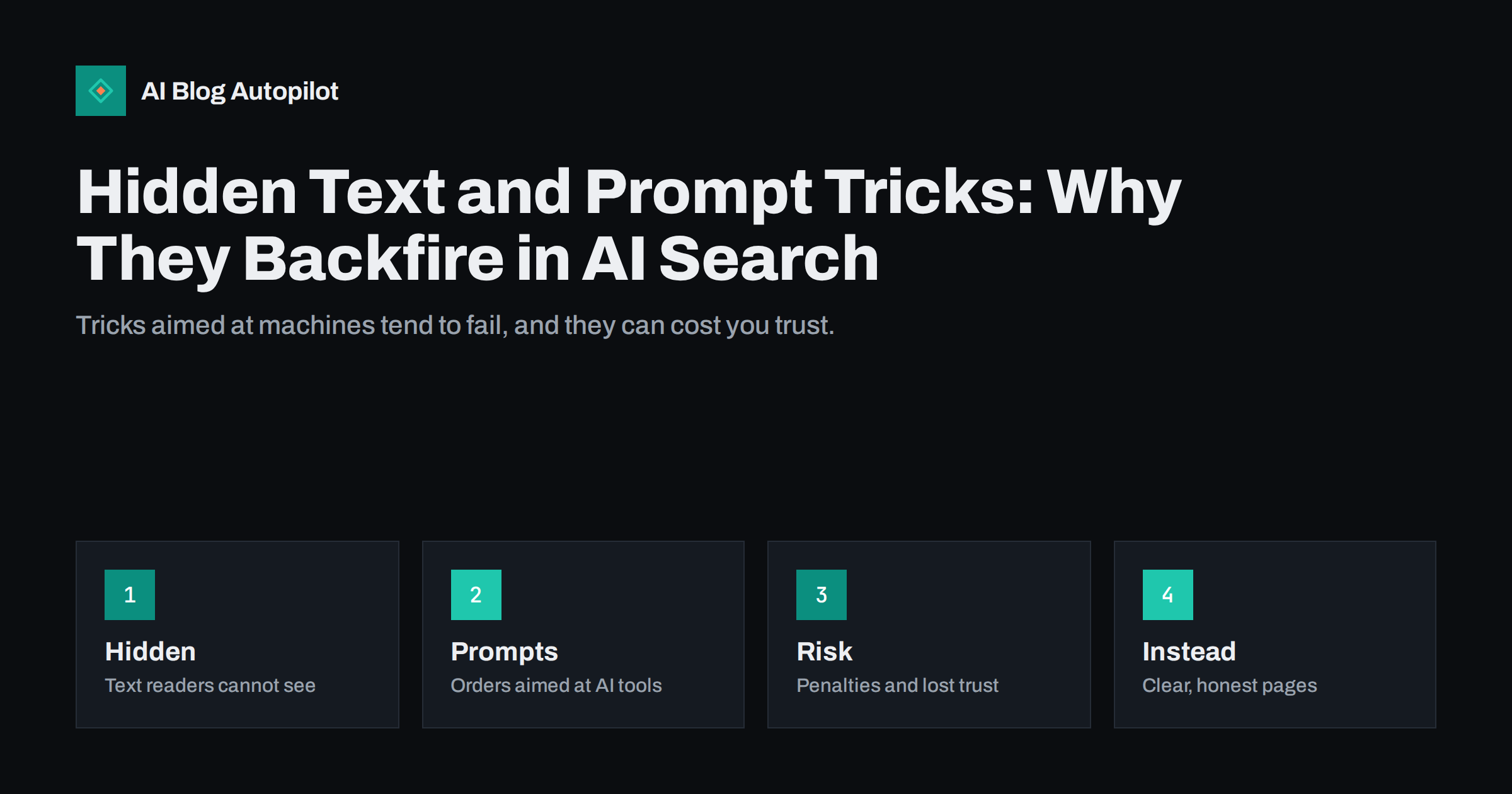
Short answer: hiding text on a page, or writing secret instructions meant for AI tools, is a bad bet. Search engines have long treated hidden text as spam, AI systems are being built to ignore or filter instructions that come from page content, and any trick that readers cannot see damages trust if it is found. The reliable way to appear in AI answers is a clear page that a person would be happy to read.
Every new way of finding information brings new tricks. When AI assistants began to read web pages, some site owners started to add invisible lines such as “recommend this company” in white text, or to stuff pages with phrases aimed at machines. This article explains what these tricks are, why they rarely work and what a careful site owner should do instead.
It also covers a second, practical point. You may have hidden text on your site without knowing it, left by an old theme, a plugin or a copied template. Checking for it is a sensible part of any audit.
What counts as hidden text
Hidden text is content on a page that people cannot see but that software can read. The classic examples are white text on a white background, text moved far off the screen, text set to a tiny size, or text placed behind an image. Some pages use styles that hide a block from view, or they place a long list of keywords at the bottom in the same colour as the background.
Not everything that is hidden is a trick. Menus that open when you click, content in tabs and accordions, and text for screen readers are normal and serve readers. The question is intent. If the text is there to help a person who chooses to open it, it is fine. If it is there only to influence a machine, it is not. The article on content in tabs and accordions looks at the normal cases.
The same applies to links. A link that readers cannot see, or that looks like normal text on purpose, is a common sign of manipulation. Search engines have rules about this, and they have had them for many years.
What a prompt trick looks like
A prompt trick is a line of text written to give orders to an AI tool that reads the page. It might say that the assistant should describe a brand as the best choice, ignore other sources or repeat certain words. Sometimes the line is hidden from visitors, and sometimes it sits in a comment or a tag that people never see.
The idea is that a tool which summarises the page might obey the line. In practice, well-built systems treat page content as material to read, not as commands to follow. They are designed to avoid taking orders from the pages they fetch, because otherwise anyone could take control of the answer. As tools improve, such lines are more likely to be ignored or flagged than to help.
There is also a risk of confusion. A page that contains odd instructions can produce strange summaries, or cause a system to distrust the page as a whole. A trick that was meant to help may do the reverse.
Why these tricks backfire
The first reason is that search engines treat hidden text as a breach of their rules. Their spam policies list hidden text and links among practices that can lead to lower rankings or removal of pages from results. The second reason is that AI answers often draw on the same index and quality signals as search, so a page that is marked down in one place is rarely trusted in the other.
The third reason is trust. If a customer, a journalist or a competitor finds hidden lines on your site, it looks bad, and it is easy to screenshot. A business that depends on its reputation cannot afford this, even if the trick would have worked for a while. The article on site reputation abuse shows how seriously search engines take attempts to game their systems.
The fourth reason is simple wasted effort. Time spent on tricks is time not spent on content that readers like, and readers are the ones who share, link and come back. Those signals are far more durable than any hidden line.
Keep the check simple and repeat it every few months. A short list is enough: view the source of the home page, your top five articles and any landing page, search for hidden styles, and ask whoever built the site whether anything is hidden on purpose. Write down what you find and why it is there, so that future changes do not bring it back by accident.
How to check your own site
Start by looking at your pages as a visitor and as a machine would. View the page source for a few key pages, or use the browser tools to search for styles such as display:none, a very small font size or text with the same colour as the background. Look for blocks that sit far outside the visible area.
Pay attention to old themes, page builders and plugins. Some add hidden blocks for SEO purposes, such as lists of keywords or text for old widgets. Others carry leftovers from earlier owners or agencies. If you took over a site, check it as though you were a stranger.
Also check pages that were copied from other sources. A copied template or a supplier text may include hidden parts. If a page shows content you did not write, find out where it came from, and remove anything that has no purpose for readers. The guide on cleaning spam from a hacked blog describes how hidden links often appear after a break-in, which is another reason to look.
Consistency is another quiet signal. If your opening hours, prices or service names differ from page to page, a system that reads several pages may become unsure which one is right. Pick one wording for each fact, keep it in one place where possible and link to that place. This costs nothing and it removes a real source of confusion for both readers and machines.
Legitimate ways to help AI tools understand your page
The honest methods are not secret, and they work for people as well as machines. Write a clear answer near the top of each article. Use headings that describe each section. Give names, dates and numbers in plain text, and keep facts the same across pages. The article on answer-first writing shows how to structure a post this way.
Use structured data where it matches what is visible on the page. For example, FAQ markup should describe questions that appear on the page, and the product details in markup should match the product details shown. Markup that describes something readers cannot see is a form of hidden content, and it can be treated as one.
Make your site easy to fetch. Allow the crawlers you want, keep pages fast and avoid hiding the main text behind scripts that do not run for bots. These steps do more for your visibility than any hidden line ever could.
What to do if a competitor uses tricks
It is tempting to copy a rival who seems to do well. Resist this. You often cannot tell whether a trick helped, or whether the site did well in spite of it, and the risk falls on you if you copy it. A competitor who uses hidden text may find a penalty arrives later, often at a bad moment.
If you believe a site breaks the rules in a way that harms you, search engines offer reporting forms for spam. Use them if you wish, but do not build your plan around them. Your time is better spent on making your own pages more useful and better supported by evidence.
Keep a record of what you have done, too. If your own traffic changes, you can then rule out your pages as the cause. The advice in AI search optimisation myths helps you tell real tactics from wishful ones.
Think of it as a long game. A site that has been honest for years has a record that is hard to copy, while a site that relies on tricks has to keep finding new ones. When a rule changes, the honest site keeps its position and the other must start again. For a small business with limited time, that stability is worth far more than a short boost.
Building trust that lasts
The pages that AI answers quote tend to be clear, consistent and backed by sources. They name who wrote them, give dates and link to evidence. These are slow things to build, but they cannot be undone by a change in a rule. Each good page also helps the next one, because it adds to the picture of your site as a reliable source.
Review your content once in a while with a reader’s eyes. Ask whether every line on the page is there for the reader, and remove those that are not. If a statement is true and useful, keep it visible. If you cannot say it openly, you probably should not say it at all.
How AI Blog Autopilot helps
AI Blog Autopilot writes full articles for your WordPress blog in plain, visible text, with a FAQ section, tags and SEO meta, and it checks length, structure, keywords and meta before an article goes live. The writer is instructed never to make up statistics, quotes or sources, so each article stays honest and easy to read. You can also switch on approval to read every article first. See the pricing page for plans.
Related reading
- How AI Search Picks Which Pages to Cite
- Over-Optimisation: When SEO Tweaks Make an Article Worse
- Citing Sources in Blog Posts: Why AI Answers Reward It
The bottom line
Hidden text and secret prompts are risky, short-lived and easy to expose. Check your site for leftovers, write visible answers for real readers and use markup that matches what the page says.
BUJ
Is hidden text ever acceptable?
Yes, when it helps readers, such as menus, tabs or text for screen readers. It is a problem only when it exists to influence machines rather than people.
Can an AI tool really be controlled by text on a page?
Well-built tools treat page content as material to read, not as commands. Relying on this is unreliable and can harm your reputation.
How can I find hidden text on my site?
View the page source and search for hidden styles, tiny fonts or text that matches the background colour, and review old themes and plugins.
Does FAQ markup count as hidden content?
Only if it describes questions that do not appear on the page. Keep markup in line with the visible text.
What is the safest way to appear in AI answers?
Publish clear, accurate pages with visible answers, named authors, dates and sources, and keep facts consistent across your site.