ENEnglish
 LTLietuviškai
 DEDeutsch
 FRFrançais
 RUРусский
 ESEspañol
 PLPolski
 ITItaliano
 UKУкраїнська
 CSČeština
 PTPortuguês
 JA日本語
JA日本語 LVLatviešu valoda
 ETEesti
 HUMagyar
 IDBahasa Indonesia
 TRTürkçe
 HIहिन्दी
 ELΕλληνικά
 ARالعربية
 THไทย
THไทย VITiếng Việt
 RORomână
 MSBahasa Melayu
 BNবাংলা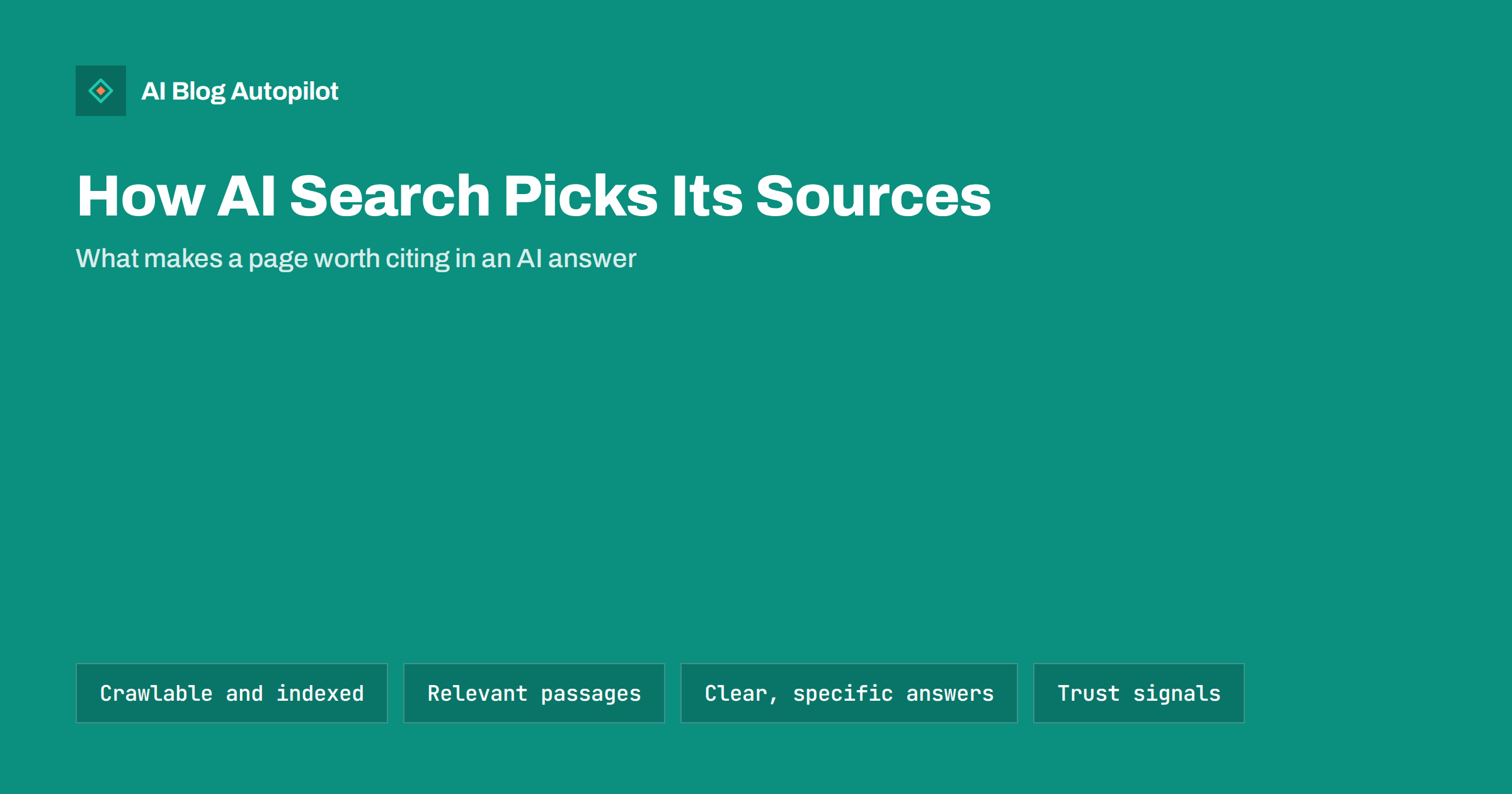
Short answer: AI search features generally work by retrieving pages from a search index, selecting passages that answer the question, and generating a summary that links to some of those pages. The exact selection rules are not published, but the requirements that are known are ordinary ones: the page must be crawlable and indexed, it must contain a passage that clearly answers the question, and it must come from a source the system has reason to trust. A blog improves its chances by writing specific, well-structured answers on topics where it has real expertise.
When an AI-generated answer appears above the search results or in an assistant, it usually links to a small number of sources. Site owners understandably want to know how those few pages are chosen out of thousands of candidates.
Nobody outside the companies that build these systems knows the full answer, and anyone claiming a secret formula is guessing. But a good deal is known from public documentation and from how retrieval systems work in general. This article separates what is known from what is speculation, and turns it into practical steps.
The basic pipeline: retrieve, select, generate
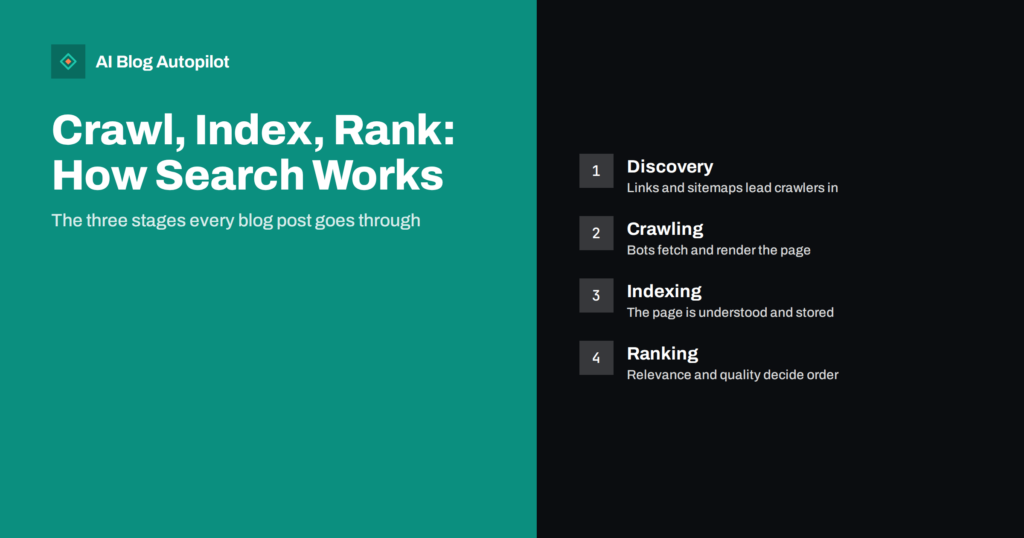
Most AI search features that cite sources follow a broadly similar pattern, often described as retrieval-augmented generation.
- Understanding the question. The system interprets what is being asked, and may expand it into several related searches to cover different aspects of the question.
- Retrieving candidates. It searches an index of web pages, much like a conventional search, and pulls back pages that seem relevant.
- Selecting passages. From those pages it picks the specific passages that best address the question or its parts.
- Generating an answer. A language model writes a summary grounded in the selected passages.
- Attributing sources. Links are shown to pages that supported the answer, typically a handful, sometimes more for complex questions.
The important consequence: a page that cannot be retrieved in step two cannot be cited in step five. Traditional search visibility is the entry ticket, not a separate game.
What the search engines say publicly
Google’s documentation on AI features and your website states that there are no additional requirements for appearing in AI Overviews or AI Mode beyond the normal requirements for appearing in search, and no special markup or files are needed. A page must be indexed and eligible to be shown with a snippet.
That is a useful anchor against a lot of noise. It means the fundamentals of technical SEO and helpful content apply directly: pages that are blocked, not indexed, or set to prevent snippets are out of consideration.
Other AI search products describe their own crawlers and controls in their documentation. The common thread is the same: the system needs to be able to access and read your page, and your robots.txt and meta directives are respected by the well-behaved crawlers. AI crawlers, robots.txt and llms.txt covers the access side in detail.
Signal one: the page is accessible and indexed
This sounds obvious and is the most common reason a page is never cited. Check:
- The page is not blocked in robots.txt and does not carry a noindex tag.
- It does not use nosnippet or a very small max-snippet setting, which limits what can be quoted.
- The main content is in the HTML, not loaded only after user interaction or hidden behind scripts that fail for crawlers.
- It appears in search when you search a distinctive sentence from it.
- Search Console shows it as indexed with the canonical you expect.
If a page fails any of these, no amount of content work will get it cited.
Signal two: a passage that answers the question
Retrieval systems increasingly work at the level of passages rather than whole pages. A page covering a broad topic may be retrieved because one paragraph answers a narrow question well.
That rewards writing where each section can stand on its own:
- Descriptive headings that say what the section answers, ideally phrased close to how people ask.
- An answer in the first sentence or two under each heading, followed by the explanation.
- Self-contained paragraphs that name their subject instead of relying on “it” and “this” from three paragraphs earlier.
- Concrete specifics: steps, criteria, ranges, conditions and exceptions, rather than general encouragement.
A passage that makes sense when lifted out of the page is much easier to use in a generated answer than one that depends on context. Blog post structure that works and writing for featured snippets show the same principles from the traditional search side.
Signal three: relevance to the whole question
AI answers often address several aspects of a question at once. Someone asking how to choose a tool for a task may get an answer covering criteria, trade-offs and common mistakes, each drawn from a different page.
This has two implications for a blog. First, pages that cover a topic thoroughly, including the follow-up questions a reader naturally has, give the system more to retrieve. Second, a narrowly focused page that answers one sub-question better than anyone else can still be cited for that part, even if it is not the most comprehensive page overall.
FAQ sections at the end of articles are a practical way to capture follow-up questions, because each question and answer pair is a compact, self-contained passage. Writing FAQ sections explains how to choose and phrase them.
Signal four: trust and reliability
AI systems that cite sources have an obvious incentive to prefer reliable ones, because a wrong answer with a citation damages trust in the product. How exactly reliability is judged is not public, but reasonable, well-documented indicators from traditional search quality work are likely to matter:
- The site has a clear topic and consistent expertise in it.
- Authors or the organisation behind the content are identifiable, with an about page and contact details.
- Claims are specific and consistent with established sources, and statistics come with their origin.
- Content is maintained: outdated information is corrected and dates are accurate.
- Other reputable sites reference or link to the content.
These are the same qualities described in E-E-A-T for automated blogs. There is no separate trust system for AI answers that you can optimise for in isolation.
What probably does not matter
A lot of advice circulating about AI search is unsupported. Treat these with caution:
- Special files or tags that guarantee citation. Google explicitly says none are required for its AI features. Some proposed files may be read by some tools, but none is a known ranking or citation switch.
- Stuffing pages with question phrases. Repeating questions without substantive answers adds nothing a retrieval system can use.
- Writing exclusively for machines. Pages written as disconnected fact lists are harder for people to use and there is no evidence they are cited more.
- Tricks aimed at the model, such as hidden instructions in page text. These are manipulation, can violate search spam policies, and risk the whole site.
Why good pages are sometimes not cited
Even a strong page will not be cited for every relevant question, and it helps to know why before changing anything.
- Only a few sources are shown. An answer might draw on many pages but display links to a handful. Being useful to the answer does not guarantee a visible link.
- Answers vary between searches. The same question asked twice, or phrased slightly differently, can produce a different answer with different sources. A single check proves little.
- Another page says it more directly. If a competitor answers the specific question in one clear sentence while yours takes three paragraphs to get there, theirs is easier to use.
- The question is broad. For general questions the system often leans on large, well-known references. Specific questions leave more room for specialist sites.
The practical response is to track a set of questions over weeks rather than reacting to single results, and to improve the clarity of the passages that matter most.
A practical checklist for your most important pages
Choose the ten articles that matter most to your business and run through this list:
- Is the page indexed and able to show snippets?
- Does it open with a direct two to four sentence answer to its main question?
- Does each section heading describe what it answers?
- Does each section start with its answer and read sensibly on its own?
- Does it cover the natural follow-up questions, in the body or an FAQ?
- Are facts specific, sourced where needed and current?
- Is it clear who wrote it or which business stands behind it?
- Do other pages on your site link to it with descriptive anchor text?
Pages that pass all eight are in good shape for both conventional results and AI answers. Getting your blog cited by AI search goes further into measurement and distribution.
How AI Blog Autopilot structures articles
AI Blog Autopilot writes long-form articles planned around real search queries and includes an FAQ, tags and SEO meta with each one. An automatic quality check reviews length, structure, keyword and meta before anything is published, and the writer is instructed never to invent statistics, quotes or sources. That gives each article the structural basics described above; the expertise and first-hand detail are still best supplied through the topics and guidance you set. See the AI Blog Autopilot home page for how it works.
Related reading
- How to Get Your Blog Cited by AI Search
- AI Answers in Search Results: What They Mean for Traffic
- Structured Data for a Blog: What Is Worth Adding
The bottom line
AI search features retrieve pages from an index, pick passages that answer the question and cite some of the pages they used. The detailed selection rules are private, but the known requirements are familiar: be crawlable, indexed and snippet-eligible, write clear self-contained answers, cover the follow-up questions and give readers reasons to trust you. Ignore promises of secret formulas and invest in the fundamentals, which serve conventional search at the same time.
BUJ
How do AI search engines choose which sources to cite?
They generally retrieve relevant pages from a search index, select passages that answer the question, generate a summary and link to supporting pages. The exact ranking and selection rules are not public, but indexing, relevance, clear answers and trustworthiness are the known foundations.
Do I need special markup to appear in AI Overviews?
No. Google’s documentation says there are no extra technical requirements beyond being indexed and eligible to show a snippet in search. Structured data can still help search engines understand a page, but it is not a requirement for AI features.
Can a small blog be cited in AI answers?
Yes. Because passages are selected for how well they answer a specific question, a focused page from a smaller site can be cited if it answers a sub-question clearly and the site is credible on that topic. Broad, highly competitive questions remain harder.
Does blocking AI crawlers stop my site from appearing in AI answers?
It depends on which crawler is blocked and which product you mean, because different systems use different crawlers and controls. Blocking the crawler a product relies on will usually prevent your content from being used by it. Check each product’s documentation before changing robots.txt.
Is writing for AI search different from writing for normal search?
Mostly not. Clear structure, direct answers, specific facts and trustworthy sources help in both. The main shift is paying more attention to passages that make sense on their own, because AI answers often draw on individual sections rather than whole pages.