ENEnglish
 LTLietuviškai
 DEDeutsch
 FRFrançais
 RUРусский
 ESEspañol
 PLPolski
 ITItaliano
 UKУкраїнська
 CSČeština
 PTPortuguês
 JA日本語
JA日本語 LVLatviešu valoda
 ETEesti
 HUMagyar
 IDBahasa Indonesia
 TRTürkçe
 HIहिन्दी
 ELΕλληνικά
 ARالعربية
 THไทย
THไทย VITiếng Việt
 RORomână
 MSBahasa Melayu
 BNবাংলা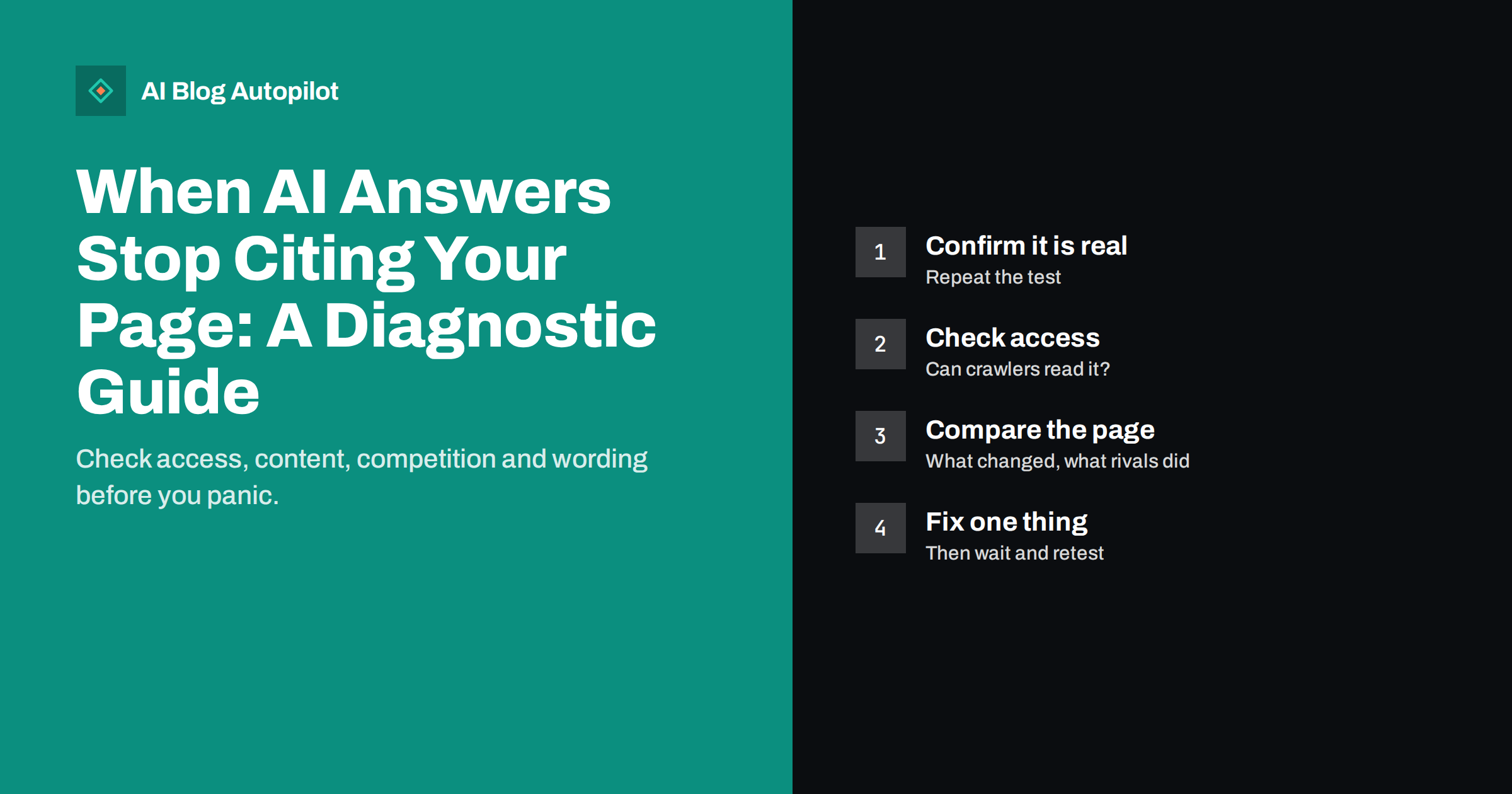
Short answer: when an AI answer stops citing your page, first confirm the change is real by repeating the question on different days, because answers vary. Then check that the page is still reachable and readable, whether you changed it, whether the question or the competing pages changed, and whether another page of yours now competes with it. Fix the clearest cause, change one thing at a time and retest after a few weeks. Sometimes the cause is plain variation, and no action is needed.
It is frustrating to see that a page cited last month has disappeared from the sources in an AI answer. The instinct is to rewrite everything. A calmer approach works better, because several different causes produce the same symptom, and the right fix depends on which one applies. This guide gives a sequence of checks, from the cheapest to the most work, with a note on what each result means. It does not rely on any single product’s internal rules, which are not public and which change, so treat it as a method for investigating rather than a set of guaranteed fixes.
Step one: confirm the change is real
AI answers are not fixed. The same question asked twice can give different wording and different sources, and results can differ by location, language, account settings and time of day. Before you act, collect evidence.
- Repeat the question on at least three different days and, if you can, on more than one assistant or search feature.
- Use variations of the question. People phrase things differently, and your page may be cited for some wordings but not for others.
- Record what you see, including the date, the exact question, the answer and the cited pages.
- Check your earlier evidence. If you only saw the citation once, you may be comparing a normal fluctuation with a peak.
If the page is cited on some days and not on others, you are probably looking at variation. If it has been missing consistently for several weeks, move on to the next steps.
Step two: check access and indexing
A page that cannot be fetched or understood cannot be cited. Check the basics before anything else.
- Open the page as a visitor in a private window. Does it load fully and quickly, and is the main text visible?
- Test the status code. It should return a normal success, not an error, a soft error or an unexpected redirect.
- Look at robots rules and meta tags. Check that nothing blocks crawlers or tells search engines not to index or show the page. A setting made for a staging copy, or changed during a theme update, is a common culprit.
- Inspect the page in Search Console. Confirm that it is indexed and that the version the search engine sees contains your text.
- Check for new barriers. A cookie wall, a login prompt, a bot-protection challenge or a script that hides content can stop systems from reading the page.
- Review your server and security settings. Rules that block unfamiliar visitors can also block legitimate crawlers.
If the page is not indexed, fix that first. Many AI features draw on pages that the search engine has already processed.
Step three: look at what changed on your side
If access is fine, ask whether something changed on the page or on the site.
- Content edits. Did someone shorten the answer, remove a definition, rename a heading or move the key passage lower down? Compare the current version with an earlier one, using your backups or revision history.
- Title and headings. Changes that make the page less clearly about the question can reduce its fit.
- Structure. A redesign may have turned a clear list into an image, a tab or a script-driven widget that is harder to read.
- Dates and facts. If the page now contains information that contradicts other sources, or an old date that makes it look stale, it may be seen as less reliable.
- Internal links. A page that lost links from the rest of the site may now look less important.
- Site-wide changes, such as a speed regression, a new pop-up or a migration to a new address without proper redirects.
Keeping a simple change log for important pages makes this step much quicker.
Step four: check the question and the competition
Sometimes your page did not change at all. The world around it did.
- Search for the question yourself and read the pages that rank and the ones the answer cites. Is there a newer, clearer or more complete page than yours?
- Compare the passage. Does the competing page answer the question in the first lines under a direct heading? Does yours bury the answer?
- Check freshness. For topics that change, a recently updated competitor may be preferred over a page that looks old.
- Look at intent. The kind of result expected for the question may have shifted, for example from a guide to a product comparison or a video.
- Consider the source mix. If answers now lean on forums, official documents or news, a blog post may be less likely to appear, whatever its quality.
This step often shows that the right response is to improve the page, not to repair something.
Step five: look for competition from your own pages
If you have published several articles on similar topics, they may compete with each other. A new post may have taken over the role of an older one, or two similar pages may split the signals.
- Search your site for the main phrase and see which of your pages appear.
- If two pages answer the same question, merge them into one stronger page with a redirect, or sharpen each page so that they serve different questions.
- Link from the weaker page to the stronger page with clear anchor text.
Step six: improve the page and wait
Once you have a likely cause, change one thing and give the change time. Making five changes at once makes it impossible to learn what worked.
- Put a clear answer near the top, under a heading that matches the question.
- Update facts and dates that are old, and show an honest updated date.
- Add specifics: numbers with sources, examples, steps and a short list of limits.
- Fix technical problems found in step two, and request a fresh crawl of the page.
- Strengthen internal links from related pages with descriptive anchors.
Then retest after two to four weeks using the same questions, and record the results next to your earlier log. If nothing changes, try the next most likely cause.
Keep the log in a shared sheet, with one row per test: date, question, assistant, whether your page was cited, which pages were, and any change you made since the last test. After a few months the sheet becomes a record that shows seasonal patterns, the effect of your edits and the difference between a real decline and ordinary noise. It also helps new team members understand why a page looks the way it does, and it stops the same unsuccessful fix from being tried twice.
A worked example
Suppose a small software company has a guide explaining how to export data from its tool, and an AI answer used to cite it. Over a month the citation vanishes. The team repeats the question on five days and finds the page missing every time, so the change is real. Access checks pass, and the page is indexed. A look at the revision history shows that a redesign three weeks ago moved the numbered steps into an accordion that only opens on click, and the first paragraph now begins with a long marketing introduction.
They make one change: they restore the steps as plain text, place a two-sentence answer under the heading, and keep the marketing text lower on the page. They request a fresh crawl, record the date and wait. Three weeks later the page appears again in some answers, though not all. The team leaves it alone, and keeps a note in the change log. They did not need to rewrite anything else.
The example is simple, but it shows the pattern. The cause was a change on their own side, the fix was small and the test was repeatable. Most real cases are less tidy, yet the same sequence of confirm, check, compare, change one thing and retest will usually get you to an answer faster than guessing.
When to do nothing
Not every drop calls for action. If the page still brings readers, ranks in ordinary search, and answers vary from day to day, it may simply be the nature of the system. Over-editing a good page can do more harm than good. Set a threshold, for example “missing for four weeks across several tests”, and act only when it is crossed. Keep in mind too that no one can guarantee a citation, so measure the page by the readers it serves and the enquiries it brings, not by a single appearance in a generated answer.
How AI Blog Autopilot helps
AI Blog Autopilot publishes articles with a direct opening answer, a FAQ, tags and SEO meta, and the content map lists what has been published, so you can see which pages exist for a topic and avoid overlaps. It is instructed never to make up statistics, quotes or sources. It cannot read the answers of other assistants for you, so run the tests yourself. See the pricing page for plans.
Related reading
- Checking Whether AI Assistants Mention Your Blog
- How AI Search Picks Which Pages to Cite
- Crawled but Not Indexed: Why Some Blog Posts Stay Out
- Updating Old Posts So AI Answers Can Use Them
The bottom line
A missing citation has many possible causes, from normal variation to a blocked page, an edit, a stronger competitor or your own overlapping content. Confirm the change over several days, check access and indexing, review what changed, study the competing pages and then fix one thing at a time. Retest with the same questions and keep a log. Where the page still serves readers, patience is often the right answer.
BUJ
Why does my page get cited some days and not others?
AI answers vary with wording, time, location and settings. A single missing citation is usually normal variation, so repeat the test over several days before acting.
Can I find out exactly why a page was dropped?
No. The rules inside these systems are not public. You can only check access, content changes and competing pages, and treat the findings as likely causes.
Should I rewrite the page straight away?
Not before you have confirmed that the change is lasting and checked for technical causes. Rewriting a good page without a diagnosis can make things worse.
How long should I wait after making a change?
Allow at least two to four weeks, since pages must be recrawled and answers vary. Retest with the same questions each time.
Does a page need to rank first in search to be cited?
Not always, but pages that are indexed and relevant are more likely to be used. Fix indexing and clarity before worrying about position.