ENEnglish
 LTLietuviškai
 DEDeutsch
 FRFrançais
 RUРусский
 ESEspañol
 PLPolski
 ITItaliano
 UKУкраїнська
 CSČeština
 PTPortuguês
 JA日本語
JA日本語 LVLatviešu valoda
 ETEesti
 HUMagyar
 IDBahasa Indonesia
 TRTürkçe
 HIहिन्दी
 ELΕλληνικά
 ARالعربية
 THไทย
THไทย VITiếng Việt
 RORomână
 MSBahasa Melayu
 BNবাংলা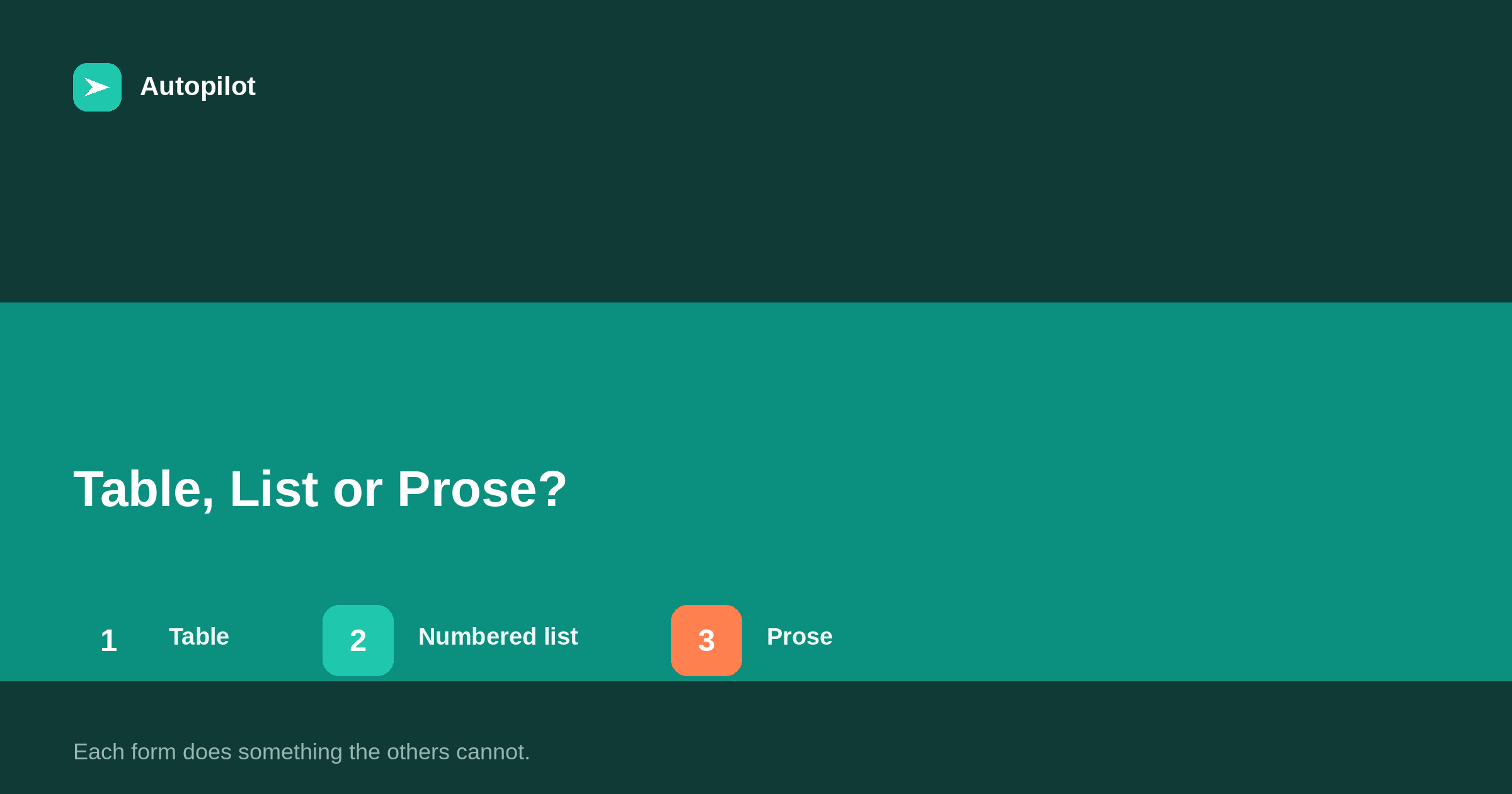
Short answer: use a table when you are comparing several things across the same attributes, a numbered list only when the order genuinely matters, bullets for parallel items with no order, and prose for anything involving nuance, causation or judgement. The commonest mistake is turning an argument into bullet points, which strips out the reasoning that made it an argument and leaves a set of assertions. A table with two columns and two rows should be a sentence; a list with one item should be a sentence too.
Formatting is treated as decoration, so it gets chosen by habit: some writers bullet everything, others never break a paragraph. Both lose information.
Each form carries a different kind of meaning. A table says these things are comparable on these axes. A numbered list says do this, then this. Prose says this caused that, except when. Picking the wrong one does not just look wrong; it deletes part of what you were saying.
Use a table when you are comparing
A table is the right form when several items share the same attributes and the reader wants to compare across them.
That is the test: same attributes, multiple items. Three plans with prices and limits. Four approaches with cost, time and risk. Six claim types with where to check each. If you find yourself writing a paragraph per item with the same structure each time, you have written a table longhand.
Keep it narrow. Two to four columns survive a phone screen; six do not, and a table that scrolls sideways is worse than the paragraphs it replaced. If you need six columns, you probably need two tables.
When a table is the wrong choice
Tables fail in three recognisable ways.
- Two rows and two columns. That is a sentence with extra formatting.
- Cells containing sentences. If each cell is a paragraph, the comparison is not really structured, and a reader cannot scan it. Either shorten the cells or use prose.
- A table used as a summary. Restating in a grid what you just explained adds length, not clarity.
Tables also need real headers rather than bold first rows, so that screen readers can associate each cell with its column. That is a genuine accessibility requirement and the reason a properly marked-up table is worth slightly more effort than a visual imitation of one.
Numbered lists mean order
A numbered list is a promise that sequence matters: step three cannot happen before step two.
Use it for processes, setups and anything with prerequisites. Do not use it for three reasons, because there is no reason one, or for five tips in no particular order — readers infer a ranking that you did not intend and then argue with it.
Keep steps to one action each. A step that contains three actions is three steps, and the reason that matters is that people follow numbered lists literally, losing their place if a step is compound.
Bullets for parallel items, and nothing else
Bullets work when items are genuinely parallel, unordered and short.
They fail as soon as the items are not parallel. A list mixing one-word items with full sentences reads as broken. A list where the first three are examples and the fourth is a warning reads as careless.
The deeper failure is the one worth naming: bulleting an argument. An argument has structure — this is true, therefore that, unless this other thing. Split into bullets, the connectives disappear and you are left with a set of assertions in a column, which is why so many articles look organised and say nothing. If your bullets each need a because, write prose.
Prose is the default
Prose is the only form that can carry causation, qualification and judgement, which is most of what is worth writing.
| Job | Form |
|---|---|
| Comparing items on shared attributes | Table |
| A process with a required order | Numbered list |
| Parallel short items, no order | Bullets |
| Explaining why something happens | Prose |
| A trade-off or a recommendation | Prose |
| A definition plus its edge cases | Prose |
A useful ratio for an instructional article is roughly two-thirds prose. Below half, the page usually reads as a slide deck: lots of structure, very little said.
Formatting and how pages get quoted
Structured formats are quoted more readily than paragraphs, which is a real consideration and a frequently overstated one.
What genuinely helps is a clear, self-contained answer near the top and sections that can be read alone — the substance of being cited by AI search and of how to structure an article. A table can be the clearest form for a comparison and therefore the most quotable. But formatting a paragraph into bullets does not make a weak passage citable; it makes it a weak passage in a column.
So choose the form for the reader. The quoting follows from clarity, and nobody can promise a citation in any case.
Making it survive automation
If articles are produced to a standing instruction, formatting is one of the things worth specifying, because otherwise every article comes out the same shape.
Three rules are enough. Say when a table is required — any comparison of three or more items on shared attributes. Say that numbered lists are for ordered processes only. And set a rough prose proportion so articles do not become lists end to end. That belongs in the brief, as writing a brief an AI can use describes.
Then check it on published pages. Reading four recent articles and noting the form of each section takes ten minutes and tells you whether the instruction is being followed or quietly ignored.
Related reading
If this was useful, these cover the questions that usually come next.
- How to structure an article — matching form to section, throughout
- Writing FAQ sections — another form with its own rules
- Alt text, properly — the accessibility side of tables and images
The bottom line
Table for comparisons across shared attributes, numbered list only for real sequences, bullets for short parallel items, prose for everything with a because in it. Keep tables under four columns with proper headers. And if your bullet points each need a reason attached, you have bulleted an argument and lost it.
DUK
When should I use a table instead of paragraphs?
When several items share the same attributes and the reader wants to compare across them. If you are writing one similarly structured paragraph per item, that is a table written longhand.
How many columns can a table have?
Two to four survive a phone screen. More than that scrolls sideways and becomes harder to read than the prose it replaced, so split it into two tables instead.
When is a numbered list wrong?
Whenever order does not matter. Numbering three reasons or five unranked tips makes readers infer a priority you did not intend, and then argue with it.
What is the most common formatting mistake?
Turning an argument into bullet points. The connectives that made it an argument disappear and you are left with assertions in a column, which looks organised and says much less.
Do tables and lists help a page get quoted in AI answers?
Clear, self-contained passages help, and a table is often the clearest form for a comparison. Reformatting a weak paragraph into bullets does not make it quotable, and no format guarantees a citation.
How much of an article should be prose?
Roughly two-thirds for an instructional piece. Below half, pages tend to read like a slide deck — heavily structured, with the reasoning removed.