ENEnglish
 LTLietuviškai
 DEDeutsch
 FRFrançais
 RUРусский
 ESEspañol
 PLPolski
 ITItaliano
 UKУкраїнська
 CSČeština
 PTPortuguês
 JA日本語
JA日本語 LVLatviešu valoda
 ETEesti
 HUMagyar
 IDBahasa Indonesia
 TRTürkçe
 HIहिन्दी
 ELΕλληνικά
 ARالعربية
 THไทย
THไทย VITiếng Việt
 RORomână
 MSBahasa Melayu
 BNবাংলা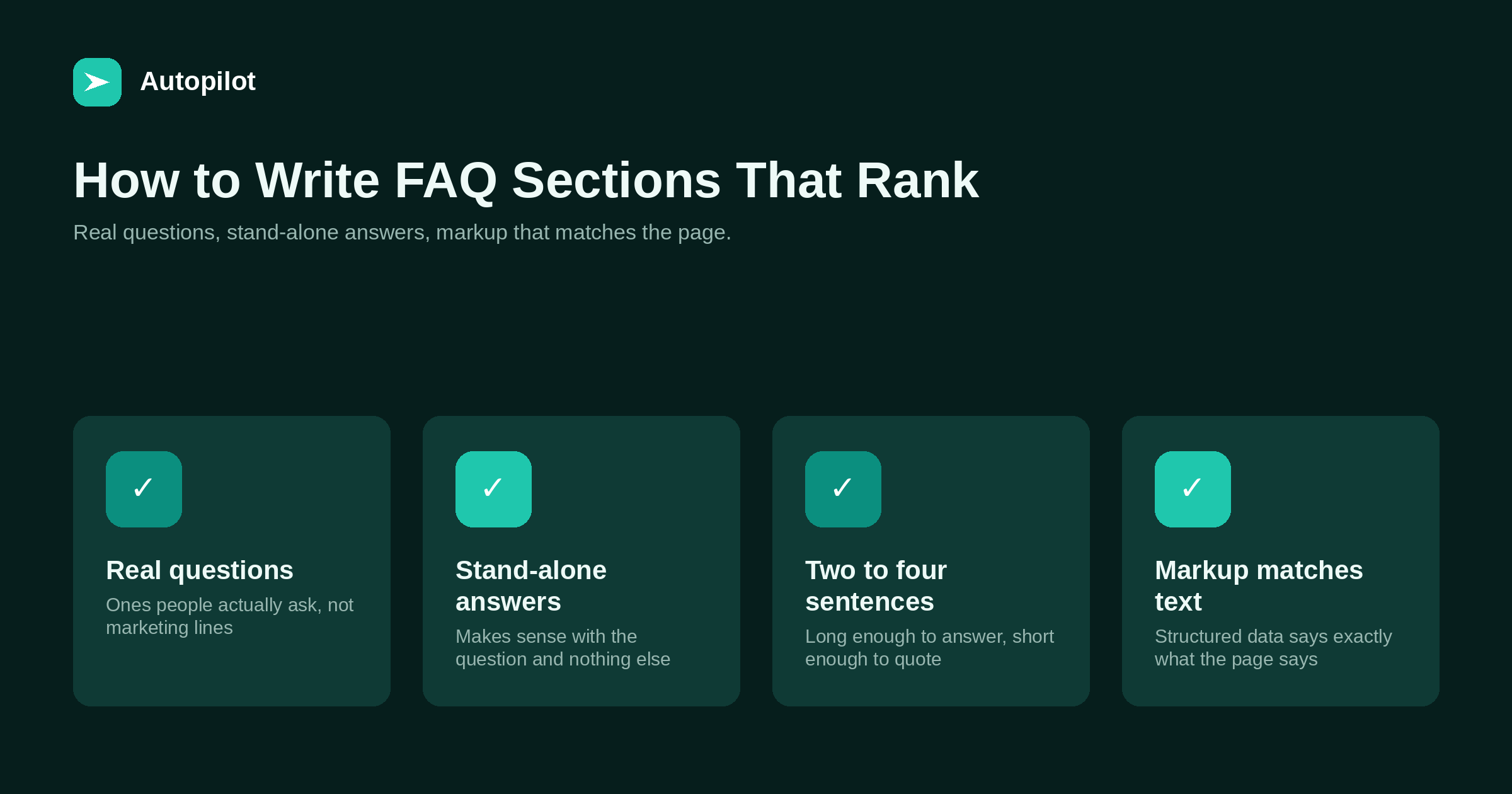
Short answer: collect the questions people actually ask, answer each one in two to four sentences that make sense on their own, and make sure any FAQPage markup repeats the visible text word for word. An FAQ is not a place for marketing lines phrased as questions, and it is not a dumping ground for keywords; it is the most extractable format on a page, which is why answer engines quote it. Google narrowed FAQ rich results in 2023, so write the section for readers and retrieval, not for a star rating in the search listing.
The FAQ section went through a full hype cycle. It was a rich-result trick, then Google narrowed those results to a small set of authoritative sites, and a lot of blogs quietly dropped the section.
That was the wrong lesson. The rich result was always the least interesting reason to have an FAQ. A question-and-answer pair is the most self-contained unit of text on a page, which makes it the easiest thing for a reader to scan and for an answer engine to quote.
Which questions belong in an FAQ
The test is simple: a question belongs in the FAQ if it deserves an answer but not a section.
Questions that deserve a section get one — they are the structure of the article. Questions that deserve nothing get nothing. The FAQ is for the residue: the specific, practical, slightly awkward things people ask that would break the flow of the main text.
Good sources for that residue:
- Support tickets and sales calls, which is where the real phrasing lives.
- The "people also ask" box for your main query.
- Objections. "Is this a bad idea?" answered honestly builds more trust than avoiding it.
- Anything a reader might still be unsure of at the end of the article.
What does not belong: marketing copy shaped like a question. "Why is our platform the best choice?" is not a question anyone typed.
How to write an answer that stands alone
Assume the answer will be read with no article around it, because increasingly that is what happens.
Name the subject. "It usually takes a week" is useless in isolation. "Indexing a new page usually takes a few days to a week" survives extraction.
Answer in the first sentence. Then qualify. Not the other way round.
Two to four sentences. Long enough to be a real answer, short enough to be quoted whole. A six-sentence answer was a section that lost its way.
Say no when the answer is no. "Can I automate this? No, the platform does not allow it" is more useful, and more credible, than a paragraph that avoids the word.
Structured data, honestly
FAQPage markup is a machine-readable copy of the section you already wrote. Two rules matter more than the rest.
The markup must match the visible text. Not paraphrase it — match it. Marking up questions that are not on the page is a guidelines violation, and it is also the easiest way to end up with structured data that quietly contradicts your article after an edit.
Rich results are not the point any more. Google restricted FAQ rich results in 2023 to a narrow set of authoritative sites, so for most blogs the markup will not produce a visible change in the search listing. It still gives machines an unambiguous copy of your questions and answers, which is worth the few lines it costs.
Practical consequence: every time you edit an FAQ answer, edit the markup in the same breath. A tool that generates both from one source removes the problem entirely.
What good and bad FAQs look like
| Weak FAQ | Useful FAQ | |
|---|---|---|
| Question | Why choose our solution? | Can I cancel after one month? |
| Answer opening | We are proud to offer… | Yes. Plans are monthly… |
| Length | One line or eight | Two to four sentences |
| Stands alone | No, needs the page | Yes |
| Source | Invented by marketing | Asked by customers |
| Markup | Added later, drifts | Generated from the same text |
The right-hand column is harder to write because it requires knowing what people actually ask. That is the real work of an FAQ, and no format trick substitutes for it.
Keeping FAQs current
FAQ answers go stale faster than article bodies, because they tend to contain the specifics: limits, availability, what is supported. A policy change turns a helpful answer into a wrong one.
Two habits keep it manageable. Review the FAQ whenever the product or policy it describes changes, rather than on a calendar. And avoid putting anything in an FAQ that changes monthly — link to the page that holds the current version instead, which is why pricing questions here point at the pricing page rather than quoting figures that would age.
Autopilot writes an FAQ section into every article and generates the matching markup from the same text, so the two cannot drift apart. The structure is the part worth copying whether or not you use it, and how long a blog post should be covers how the rest of the article around it should be sized.
The bottom line
Write the FAQ from real questions, answer each in a few sentences that survive being read alone, keep the markup identical to the visible text, and revisit it when the facts change rather than when the calendar says so. Done that way the section earns its place twice: once for the reader who scrolled to the bottom still wondering, and once for every machine that quotes a page a paragraph at a time.
DUK
Do FAQ sections still help SEO?
They help readers and they help retrieval, which are the durable benefits. The rich-result advantage largely went away in 2023 for most sites, so treat any ranking effect as indirect.
How many questions should an FAQ have?
Five or six is usually right for an article. Fewer suggests the article left nothing unanswered; many more suggests some of them deserved sections.
Can I reuse the same FAQ on several pages?
Better not to. Duplicated blocks across pages add nothing and make it harder for a search engine to decide which page answers the question.
Does the markup have to match the visible text exactly?
Yes. Structured data describing content that is not on the page is against the guidelines, and mismatches usually appear after someone edits one and not the other.
Should the FAQ go at the top or the bottom?
Bottom, in nearly all cases. The main article should answer the main question; the FAQ handles what is left. An FAQ at the top usually means the article has no structure.
Can I answer a question with a link?
Answer it first, then link for detail. A link on its own is not an answer, and it is worthless to anything that quotes the passage without following it.