ENEnglish
 LTLietuviškai
 DEDeutsch
 FRFrançais
 RUРусский
 ESEspañol
 PLPolski
 ITItaliano
 UKУкраїнська
 CSČeština
 PTPortuguês
 JA日本語
JA日本語 LVLatviešu valoda
 ETEesti
 HUMagyar
 IDBahasa Indonesia
 TRTürkçe
 HIहिन्दी
 ELΕλληνικά
 ARالعربية
 THไทย
THไทย VITiếng Việt
 RORomână
 MSBahasa Melayu
 BNবাংলা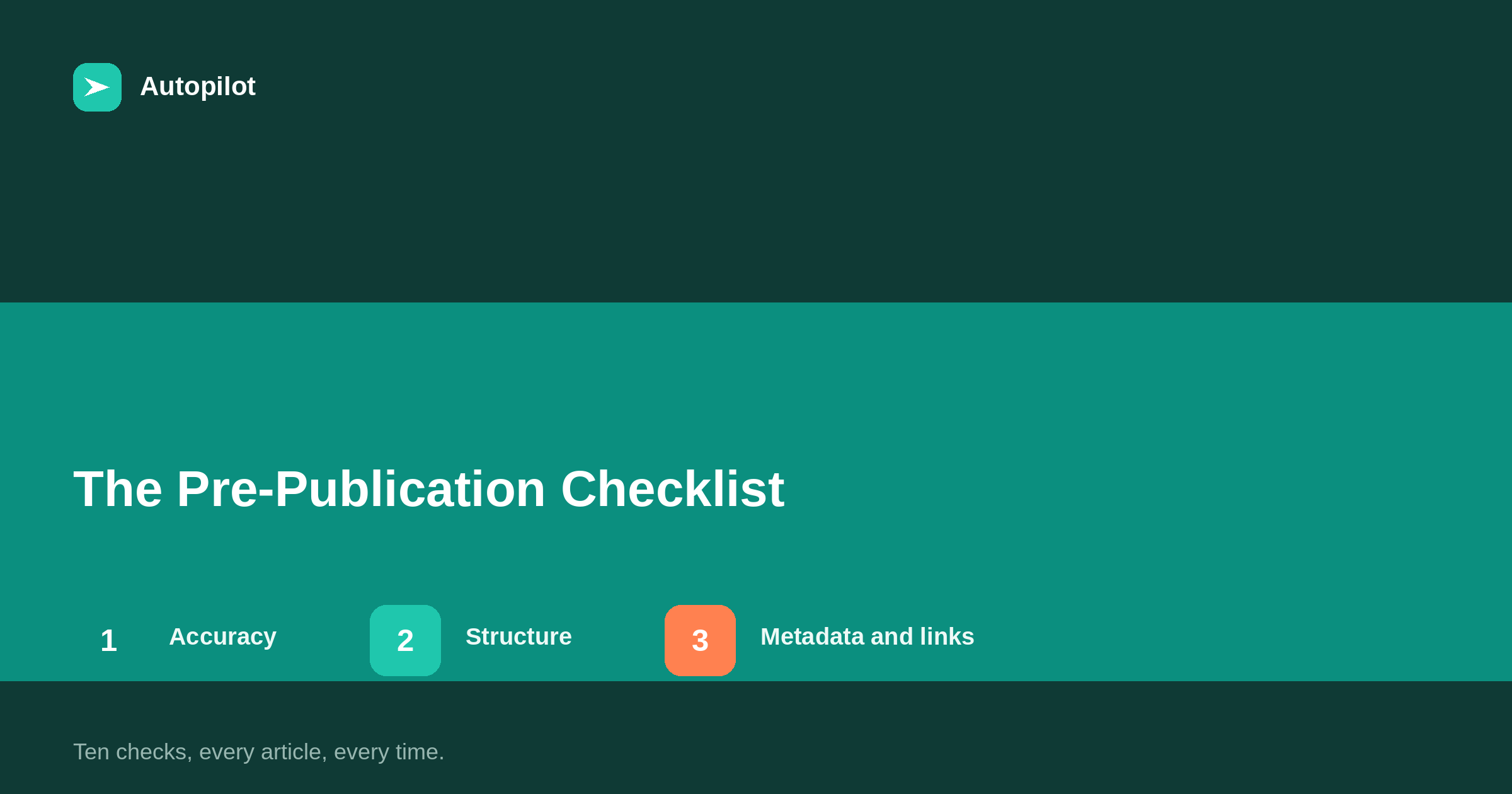
Short answer: before any article goes live, check ten things: every verifiable claim is correct or removed; the question is answered in the first hundred words; headings describe their sections; there is at least one addition only your business could make; the title and description are written for the click; internal links point to live pages; the featured image and alt text are present; categories and tags are right; the FAQ and its structured data match; and the page reads well on a phone. Ten to twenty minutes per article.
Most problems in published articles are not failures of writing. They are small things nobody checked: a wrong price, a missing image, a link to a page that does not exist, a heading that says nothing.
A single checklist, run the same way on every article, catches almost all of them.
The ten checks
In the order that finds problems fastest.
| Check | Looking for |
|---|---|
| 1. Claims | Prices, dates, numbers, features: correct or removed |
| 2. Answer | The question answered in the first hundred words |
| 3. Headings | Each describes its section |
| 4. Originality | At least one addition only you could make |
| 5. Title and description | Specific, within length, written for the click |
| 6. Links | Internal links to live pages, descriptive anchors |
| 7. Image | Featured image present, alt text written |
| 8. Organisation | Right category, two to four tags |
| 9. FAQ and markup | Visible FAQ and structured data match |
| 10. Phone | Reads well, tables fit, images load |
Each check takes a minute or two. Together, ten to twenty minutes per article.
Claims first
Accuracy comes first because it matters most and because fixing it may change other parts. Check every statement a reader could verify — fact-checking before you publish. Link to live pages for prices and features rather than stating them.
Answer and headings
Read the title, then the first hundred words: is the promise kept? Then read only the headings: do they summarise the article? introductions that do not waste time and how to structure an article cover both.
Originality
Is there at least one thing in the article that could only come from your business: a number, an example, a view? If not, add one — adding something original.
Metadata, links and images
Check the title and description as they would appear in results — titles and descriptions. Click every internal link. Confirm the featured image appears and has alt text — writing alt text.
FAQ and structured data
If the article has an FAQ, its questions should be genuine and its answers self-contained. Any FAQPage markup must match the visible text exactly, which is easiest when both are generated from the same source — writing FAQ sections.
The phone test
Open the article on a phone: text size, tables, images, how far the reader scrolls before the first paragraph. Most readers will see it this way — reading on a phone.
Before or after publishing
For sensitive subjects, run the checklist before publishing. For low-risk categories with a good track record, some teams publish first and check within a day — draft, approve or full auto. Either way, every article gets checked.
A checklist for automated articles
Automated articles need the same checks, with extra attention to three of them. Claims, because drafts can state wrong facts confidently. Originality, because drafts contain no first-hand experience unless someone adds it. Links, because drafts may reference articles that do not exist yet or use vague anchors.
Instructions can prevent many problems before the checklist sees them: forbidden claims, approved facts, a list of existing articles to link to. The checklist then confirms the instructions worked — writing a brief an AI can use.
Sharing the checklist
Keep the checklist where reviewers work, not in a document nobody opens: a template in the publishing tool, a pinned note, or a short printed card. Everyone who reviews articles should use the same version, so checks are consistent across reviewers.
Share it with agencies and freelancers too, so the work arrives already checked against the same standard.
After publishing
A few checks are worth repeating after publication: that the article appears on the live site as expected, that social sharing went out with the right image, and, a few days later, that the page is indexed. These take a minute and catch problems that only appear once the article is live.
When the checklist finds too much
If the checklist regularly finds many problems in each article, the issue is upstream: vague instructions, the wrong reader, missing facts. Fix the instructions rather than relying on review to correct the same things every time — quality control at volume covers the feedback loop.
A printable version
For reviewers who prefer something to hand, the ten checks fit on a single card: claims correct; answer in the first hundred words; headings descriptive; one original addition; title and description ready; links live; featured image and alt text present; category and tags right; FAQ and markup matching; checked on a phone. Tick each, every time.
The checklist and this blog
Every article on this blog follows the same shape the checklist expects: a short answer at the top, descriptive headings, links to related articles, an FAQ whose structured data is generated from the same text readers see, and a featured image with alt text. Consistency makes the checklist quick to run, because reviewers know exactly where to look.
Consistency across reviewers
When several people review articles, compare notes occasionally on the same article. Differences in what each person catches show which checks need clearer wording, so every reviewer applies the same standard.
Improving the checklist
When a problem reaches publication, ask which check should have caught it, and adjust the checklist or the instructions. Over time the checklist finds less, because the drafts arrive with fewer problems.
No checklist guarantees results. It guarantees that nothing avoidable goes out wrong.
Related reading
If this was useful, these cover the questions that usually come next.
- Editing a draft — the passes behind the checklist
- Quality control at volume — the checklist at scale
- Fact-checking before you publish — the most important check
The bottom line
Run the same ten checks on every article: claims, answer, headings, originality, title and description, links, image and alt text, category and tags, FAQ and markup, and the phone test. Check claims first, run it before publishing for sensitive subjects, and improve the checklist whenever something slips through. Consistency across articles makes all ten checks quicker.
DUK
What should I check before publishing a blog post?
Claims, the answer near the top, headings, originality, title and description, links, image and alt text, category and tags, FAQ and markup, and how it looks on a phone.
How long should the checklist take?
Ten to twenty minutes per article.
What is the most important check?
Claims. Wrong prices, dates or features cause real harm and repeat if not caught.
Should articles be checked before or after publishing?
Before for sensitive subjects; low-risk categories with a good record can be checked shortly after.
Does the checklist apply to automated articles?
Yes, and it is especially important for them, since errors can repeat across many articles.
How do I improve the checklist?
When a problem slips through, identify which check should have caught it and adjust.