ENEnglish
 LTLietuviškai
 DEDeutsch
 FRFrançais
 RUРусский
 ESEspañol
 PLPolski
 ITItaliano
 UKУкраїнська
 CSČeština
 PTPortuguês
 JA日本語
JA日本語 LVLatviešu valoda
 ETEesti
 HUMagyar
 IDBahasa Indonesia
 TRTürkçe
 HIहिन्दी
 ELΕλληνικά
 ARالعربية
 THไทย
THไทย VITiếng Việt
 RORomână
 MSBahasa Melayu
 BNবাংলা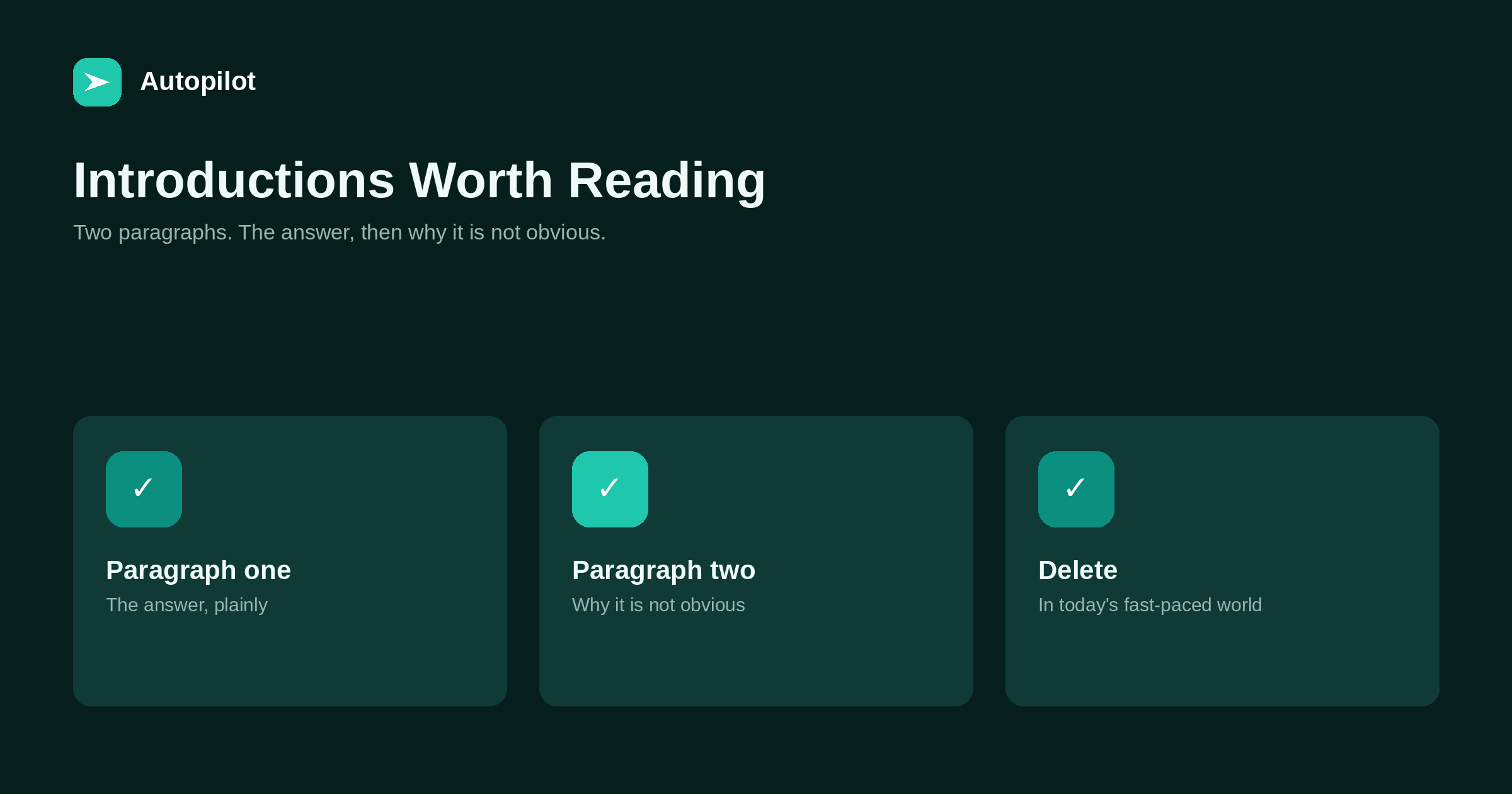
Short answer: two short paragraphs, no more. The first states the answer or the point; the second says why it is not obvious, or what most people get wrong. Nothing else belongs there: not a definition of a term everyone reading already knows, not a paragraph about how important the subject has become, and not a summary of what the article will cover. A reader arrived from a headline that made a promise, and the introduction either keeps it or loses them. If you find you cannot write the opening, write it last.
The opening is where most articles lose the reader, and the cause is nearly always the same: the writer warming up in public.
A reader who clicked a headline has already decided the subject is relevant. They do not need convincing that it matters, and they will not wait three paragraphs while you establish it.
What an introduction is for
One job: confirm they are in the right place and give them the answer.
Confirmation happens by saying the thing the headline promised, in the words they would use. If the title was how to connect WordPress safely, the first sentence is about connecting WordPress safely.
The answer is the part people resist, because it feels like giving away the article. It is not: an article is the reasoning, the caveats, the process and the cases the short answer does not cover. Leading with the answer buys the attention you need for all of it, and it gives passage-based systems something quotable, which is most of being cited by AI search.
Delete these on sight
A short list covers the majority of bad openings.
- In today’s fast-paced digital landscape. Also in an increasingly competitive market, and every variant.
- The importance paragraph. Content marketing has become essential for businesses of all sizes. The reader knows; that is why they are here.
- The definition nobody needed. Explaining what a blog is to somebody searching for how to structure one.
- The table of contents in prose. In this article we will explore five factors.
- The rhetorical question. Ever wondered why your traffic is flat? They did not wonder; they searched.
- The invented statistic. Studies show that 70% of marketers, uncited. See fact-checking before you publish.
Cut all six from a typical draft and you usually remove 120 words and improve the page.
A template that works
Two paragraphs, two jobs.
Paragraph one: the answer or the point. Two or three sentences. State it plainly, with the specifics. If the answer is genuinely it depends, say what it depends on rather than saying it depends.
Paragraph two: why this is not obvious. The common mistake, the reason the standard advice fails, the trade-off nobody mentions, or the thing that changed. This is what earns the rest of the article — it tells the reader you know more than the first result they clicked.
If you want a third paragraph, it should say who the article is for and who it is not. That is genuinely useful and it is short.
The short answer block
A distinct, labelled answer above the introduction is worth adding on any article answering a specific question.
The format is a single bolded label — Short answer — followed by two to five sentences that resolve the question completely, with no dependence on anything below. A reader who stops there should have been helped.
| Do | Do not |
|---|---|
| Answer completely in a few sentences | Tease what follows |
| Include the important caveat | List every exception |
| Make it readable in isolation | Refer to as described below |
| Keep it under about 90 words | Write a second introduction |
It also makes the page easier to quote, which matters for how answers are assembled now.
Write it last if it fights you
A blank opening is usually a sign that the article does not yet know its own point.
The fix is to write the sections first. Once they exist, the answer is visible and the introduction takes four minutes. Writers who insist on composing in order lose more time to the first paragraph than to any other part of the piece.
For generated drafts the equivalent move is to fix the brief rather than the opening: if the brief does not state the question and the answer, the draft will open by warming up. writing a brief an AI can use covers what to specify so this stops happening.
Length, and how it varies
Eighty to 150 words for most articles. Long enough for two real paragraphs, short enough that the first heading is visible without much scrolling on a phone.
Two cases justify more. A subject where the reader needs context to understand the question at all — a regulation, an unfamiliar concept — can take a third paragraph. And a long reference article can afford a slightly fuller opening because the reader has committed to something substantial.
Neither case justifies 400 words. If your opening runs that long, it contains a section that deserves a heading.
Checking it works
Three tests, none of which takes more than a minute.
- Read the headline, then the first hundred words. Is the promise kept? If not, one of them is wrong.
- Delete the first paragraph. Does the article still work? Very often it works better, which tells you the paragraph was a warm-up.
- Read it on a phone. Is the first heading reachable in one short scroll?
Applied to existing articles this is one of the cheapest improvements available: a page with impressions but poor engagement often has a good body and an opening that spends the reader’s patience before reaching it. refreshing old posts treats the opening and the title as the first two things to change.
Related reading
If this was useful, these cover the questions that usually come next.
- How to structure an article — where the introduction sits in the whole
- Writing a headline people click — the promise the introduction has to keep
- Editing a draft — the pass that catches a warm-up opening
The bottom line
Two paragraphs: the answer, then why it is not obvious. Cut the importance paragraph, the unneeded definition and the prose table of contents. Add a labelled short answer on anything that resolves a specific question. If the opening will not come, write it after the sections, and test it by deleting the first paragraph to see whether anything is lost.
DUK
How long should a blog introduction be?
Eighty to 150 words for most articles — two real paragraphs. The first heading should be reachable in one short scroll on a phone.
Should I give away the answer in the introduction?
Yes. The article is the reasoning, the caveats and the process; the answer is what the reader came for. Withholding it loses people who would otherwise have read on.
What should never appear in an introduction?
The paragraph explaining that the subject is important, a definition the reader clearly already knows, a prose summary of the sections, and any statistic you cannot source.
Is a separate short answer block worth adding?
On any article answering a specific question, yes. Two to five sentences that resolve the question with no dependence on the rest of the page, under about 90 words, and readable entirely on its own.
What if I cannot write the opening?
Write the sections first and come back. A blank opening usually means the article has not yet decided what it argues, and once the body exists the introduction takes a few minutes.
How do I know my introduction is working?
Delete the first paragraph and reread. If nothing is lost, it was a warm-up. Then check that the headline’s promise is kept within the first hundred words.