ENEnglish
 LTLietuviškai
 DEDeutsch
 FRFrançais
 RUРусский
 ESEspañol
 PLPolski
 ITItaliano
 UKУкраїнська
 CSČeština
 PTPortuguês
 JA日本語
JA日本語 LVLatviešu valoda
 ETEesti
 HUMagyar
 IDBahasa Indonesia
 TRTürkçe
 HIहिन्दी
 ELΕλληνικά
 ARالعربية
 THไทย
THไทย VITiếng Việt
 RORomână
 MSBahasa Melayu
 BNবাংলা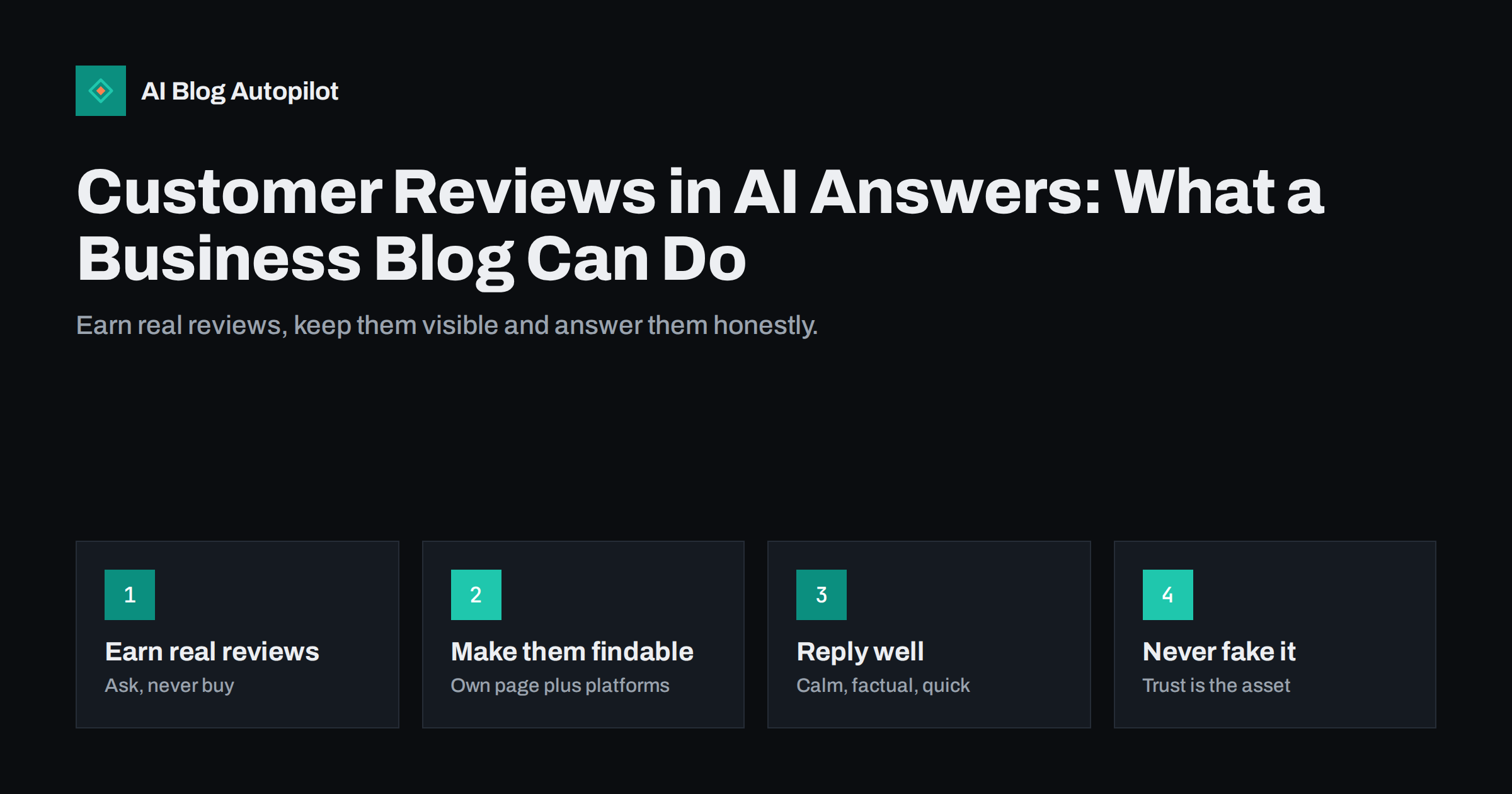
Short answer: AI answers about a business often draw on what other people say about it, including reviews and testimonials on third-party sites, so what customers write can shape how you are described. A blog cannot control that, but it can help by earning honest reviews, showing real testimonials on your own pages with context, replying to criticism calmly and keeping your key facts clear. Never write, buy or invent reviews: it breaks the rules of most platforms, and it destroys the trust you are trying to build.
When someone asks an AI assistant whether a company is any good, the answer is built from whatever the system can find and judge reliable: the company’s own pages, news, directories and review sites. Opinions from customers are a large part of that material. A business with plenty of recent, specific and balanced reviews tends to be described with more confidence than one with a handful of vague ones or none at all. This guide explains how reviews feed into AI answers, what you can do on your blog and elsewhere to support honest feedback and what to avoid. It makes no promises about any particular assistant, because their behaviour differs and changes.
How reviews can appear in AI answers
AI assistants and answer engines use different methods. Some search the web at the time of the question and summarise what they find. Some rely on material they learned earlier. Many mix both. In practice, reviews can reach an answer in several ways:
- Review platforms and directories. Pages that collect ratings and comments about businesses are often visible to search and may be cited or summarised.
- Maps and business profiles. For local businesses, ratings and review snippets from profile listings can inform what is said about reputation.
- Forums and social posts. Discussions where customers describe their experience are a common source for views on quality and service.
- Your own pages. Testimonials and case studies on your site count as your own claims, but they can still be read and quoted, especially when they are specific.
- News and articles. Independent coverage and comparison posts can carry opinions about your business.
The key point is that most of this material is outside your direct control. Your task is to make sure that what is out there is accurate, honest and up to date as far as you can influence it.
What makes reviews useful, to people and to systems
Not all reviews carry the same weight. Those that are most helpful to a human reader are usually also the easiest for a system to use.
- Specific. “The installer arrived on time, explained each step and cleaned up” says far more than “Great service!”.
- Recent. A steady flow of new reviews suggests the business is active and that the description is current.
- Balanced. A mix that includes some critical comments looks credible. A uniform wall of perfect scores looks suspicious to readers and to platforms.
- Verifiable. Reviews tied to a real purchase or an identifiable person are more trusted.
- Consistent with your own pages. If reviewers praise a service you do not mention anywhere, or complain about something your page promises, the mismatch may surface in answers.
This is also the lesson for your blog: specific, honest descriptions beat general praise.
Earn reviews honestly
The best way to improve how reviews look is to deserve good ones and to make it easy for satisfied customers to say so. Several simple steps help.
- Ask at the right time. Send a short request soon after delivery or completion, when the experience is fresh.
- Ask everyone, not only those you expect to be happy. Selecting who may review is against the rules of many platforms and gives a distorted picture.
- Make it easy. Provide a direct link to the place where you want the review and keep the instructions short.
- Suggest what to mention, such as what they bought and what they liked, without writing the review for them or offering payment or gifts in return for a positive one. Check each platform’s policy on incentives; many prohibit them.
- Do not buy, trade or fake reviews. This includes asking staff or friends to post, using services that sell reviews and writing your own. It breaks platform rules and, in many places, consumer protection law. Platforms and regulators act against it, and customers can often tell.
If you want to use feedback on your own site, ask for permission to publish it and to name the person or company.
Use testimonials on your own pages
Testimonials on your site are your own selection, so readers and systems treat them differently from independent reviews. They still help, if they are done well.
- Use real names, roles and, where permitted, the company, and ask for permission.
- Prefer specific stories over slogans: what the problem was, what you did and what changed.
- Place them next to the claim they support, such as beside a service description, not only on a separate page.
- Keep the wording as given. Light trimming for length is fine, but do not change the meaning.
- Link to the original review where the customer wrote it publicly, so that visitors can check.
- Update them. A testimonial from many years ago may no longer describe the business.
If you add review markup in the page’s code, follow the search engines’ guidelines on what qualifies and do not mark up reviews that you have written about yourself. Wrongly applied markup can lead to the loss of enhanced results, and it adds nothing for readers.
Reply to reviews well
Replies are visible to everyone who reads the reviews, and they show how you treat customers. A good reply policy matters at least as much as the reviews themselves.
- Reply to both praise and criticism, not only to the good ones.
- Be quick and calm. Thank the writer, address the point, state what you will do or have done and offer a way to talk offline.
- Stay factual. Do not argue, accuse or reveal private details. If a review seems to be about a different business, say so politely.
- Do not copy and paste the same reply under every review. It looks automatic.
- Report reviews that break the rules, such as abuse, spam or reviews by people who were never customers, through the platform’s own process.
- Learn from patterns. If several customers raise the same problem, fix it and perhaps say so on your site.
A thoughtful reply to a critical review can persuade more future customers than a dozen glowing ones.
What a business blog can add
A blog cannot replace independent reviews, but it can support them in ways that make a business easier to describe accurately.
- Case studies. Detailed accounts of real work, with the customer’s agreement, give concrete evidence that systems and readers can quote.
- Clear facts. Services, prices where you can state them, areas served, opening hours and policies, set out plainly on stable pages, reduce the chance that an answer fills the gaps with guesses.
- Honest limits. Say who the service is for and who it is not for. Reviews are happier when expectations are accurate.
- Answers to common complaints. If customers often ask about delays, cancellations or returns, publish a clear explanation. A reader checking a negative review can then see your side.
- Consistent naming. Use the same business name, address and description everywhere, so that reviews on other sites are matched to the right entity.
Keep these pages current and linked from your main navigation, so they are easy to find.
Mistakes that damage trust
- Review gating, where you ask only happy customers to post and send unhappy ones to a private form. Many platforms prohibit it, and the picture it gives is false.
- Deleting or hiding criticism on your own pages while showing only praise. Visitors can usually find the independent reviews anyway.
- Arguing in public. A defensive reply is read by every future customer.
- Quoting a rating you cannot back up, such as “rated best in the city”, without a source.
- Letting facts drift. If prices, hours or services change and your pages do not, reviews and answers will contradict each other.
Monitor what is said about you
Once or twice a month, spend a short time looking at how your business appears. Search for your name on a couple of review sites and on maps, read recent reviews and replies and ask an AI assistant a few questions a customer might ask, such as whether the business is reliable or what customers say about it. Compare the answers with your pages.
- If an answer is wrong, find the likely source. A wrong address on a directory, an outdated page or a misread review can all cause errors.
- Correct what you control, and request corrections from site owners for what you do not.
- Note recurring themes in feedback, both positive and negative, and reflect them honestly in your pages.
- Keep a record of what you changed and when, so that you can see whether answers improve.
Do not expect quick changes. Systems refresh at their own pace, and some answers will keep a stale view for a while.
How AI Blog Autopilot helps
AI Blog Autopilot writes articles that include a FAQ, tags and SEO meta, and it is instructed never to make up statistics, quotes or sources, which matters when a post discusses what customers say. If you want a testimonial or case study in an article, add the real one with the customer’s permission. An automatic quality check looks at length, structure, keyword and meta before anything goes live. See the pricing page for plans.
Related reading
- Brand Mentions: Why AI Answers Recommend Some Businesses
- When AI Answers Get Your Business Wrong: What to Do
- Product and Pricing Facts: Making Them Easy for AI Answers
- How a Local Business Gets Mentioned in AI Answers
The bottom line
Reviews are among the sources that shape how AI assistants describe a business, and most of them live outside your site. You cannot control them, but you can deserve good ones, ask every customer for honest feedback, reply calmly and keep your own pages clear and consistent. Use real testimonials with permission, publish case studies and straight answers to common complaints, and check how your business appears every month. Never fake or buy reviews: honest feedback is slow to earn and quick to lose.
GYIK
Do AI assistants use customer reviews?
Often they draw on reviews that appear on review sites, maps, forums and articles, but methods differ between assistants and change over time, so no outcome is guaranteed.
Can I ask customers for reviews?
Yes, ask everyone, make it easy and do not offer payment or gifts for positive reviews. Check each platform’s policy on incentives, since many prohibit them.
Are testimonials on my own website enough?
They help, especially when specific and permitted, but they are your own selection. Independent reviews on other sites carry more weight with readers and systems.
Should I reply to negative reviews?
Yes. A calm, factual reply shows how you treat customers and can persuade future buyers more than praise does.
Is it a problem to write reviews for my own business?
Yes. It breaks platform rules and in many places consumer protection law, and it can cost you both visibility and trust.