ENEnglish
 LTLietuviškai
 DEDeutsch
 FRFrançais
 RUРусский
 ESEspañol
 PLPolski
 ITItaliano
 UKУкраїнська
 CSČeština
 PTPortuguês
 JA日本語
JA日本語 LVLatviešu valoda
 ETEesti
 HUMagyar
 IDBahasa Indonesia
 TRTürkçe
 HIहिन्दी
 ELΕλληνικά
 ARالعربية
 THไทย
THไทย VITiếng Việt
 RORomână
 MSBahasa Melayu
 BNবাংলা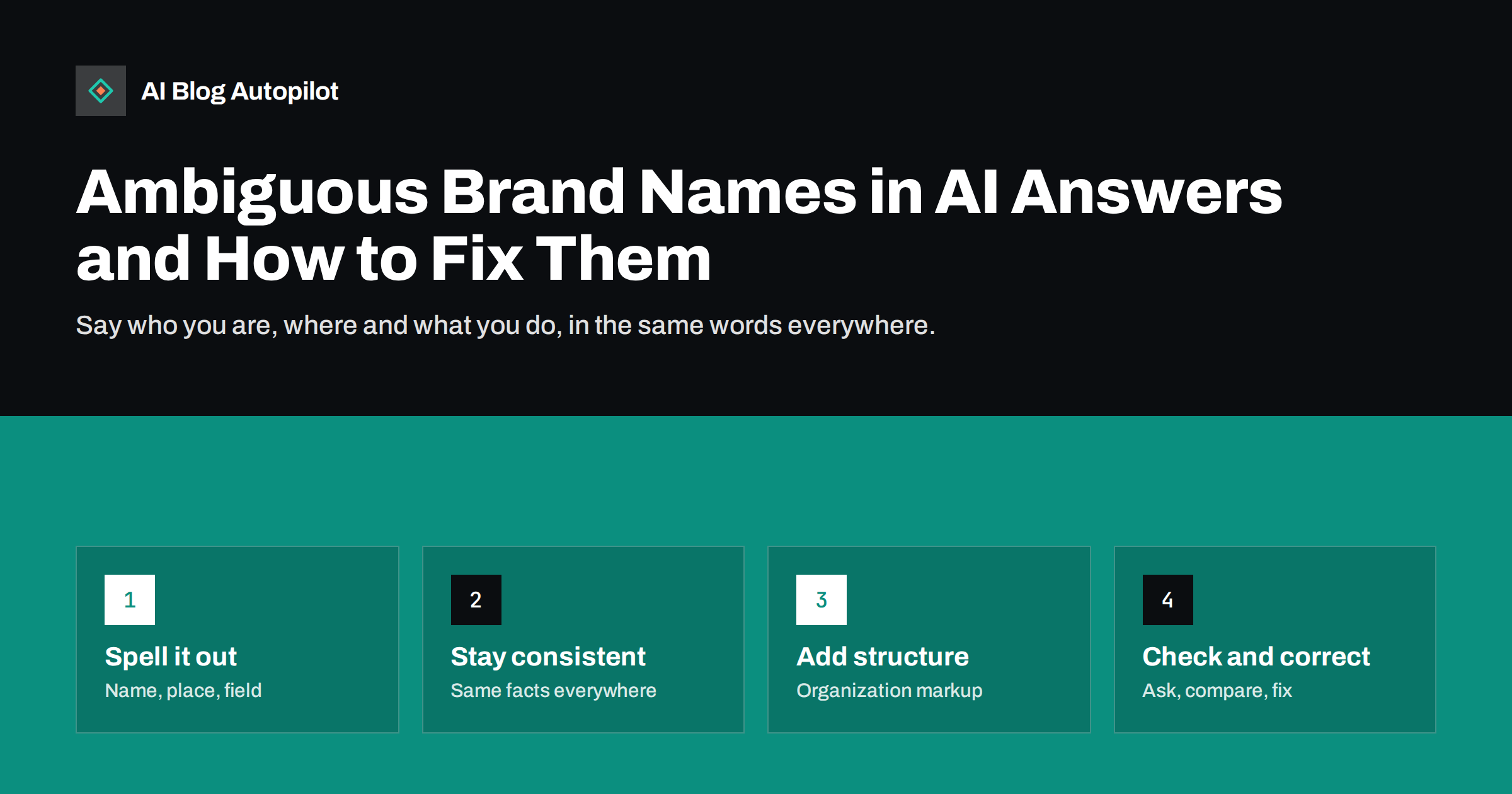
Short answer: if your business shares its name with other companies, people or a common word, AI answers may mix you up with them or leave you out. The fix is to make it unmistakable who you are: state your full name, what you do, where you are based and who you serve in plain text on stable pages, repeat the same facts on your profiles and listings, add organisation markup that matches the visible text and check regularly how assistants describe you. You cannot force a correction, but you can remove the reasons for confusion.
Name collisions are common. A word like “Apex”, “Nova” or a surname can belong to dozens of businesses in different countries and fields. A person asking an assistant about “Nova Studio” may get information about a different company with a similar name, or a blend of two. For a small business, that can mean wrong opening hours, the wrong services or no mention at all. This guide explains why the confusion happens, how to give assistants and search engines what they need to tell you apart and how to check and correct the result. No method guarantees a particular answer, and systems differ, but clarity helps all of them.
Why names get mixed up
AI systems build their picture of a business from many pieces of text, and they match those pieces by name, context and links. Confusion arises when the matching has too little to go on.
- Identical or similar names. Several organisations use the same name, sometimes in the same country or even the same town.
- Common words. If the name is also an ordinary word, mentions of the word are easily taken as mentions of the business, or the reverse.
- Thin context. A page that says “Welcome to Nova” without saying what Nova does or where it is gives nothing to separate it from others.
- Inconsistent facts. If your address, description or spelling differ between your site, directories and profiles, the system may treat them as different entities, or merge them with a neighbour’s.
- Old information. A previous owner, an earlier business at the same address or a former name can leave stale mentions.
- Few independent mentions. The more other sources describe you, the easier it is to identify you. A business mentioned nowhere else is easy to confuse with whatever else shares its name.
The shared remedy is to supply clearer, more consistent evidence about who you are.
Find out how bad the problem is
Start with a short test, using a few different assistants and a normal search engine. Ask the questions a customer might ask, using your business name only, then with your town or field added.
- “Who is [name]?” and “What does [name] do?”
- “[Name] in [your town]” and “[name] [your field]”.
- “Opening hours of [name]” or “Contact details for [name]”, if relevant.
- “Is [name] reliable?” or “What do customers say about [name]?”
Note what appears: whether you are mentioned at all, whether the facts are right and whether information from another organisation has crept in. Record the date, the assistant and the exact wording, since answers vary and you will want to compare later. Also search for your name on a search engine and look at the first page, since that is part of what assistants see.
State who you are in plain words
The most effective step is also the simplest: say clearly, on your own site, who you are. Put a short, precise description on your home page and “about” page, and repeat the key facts wherever it is natural.
- Full legal or trading name, written the same way each time.
- What you do, in one plain sentence, with the field named: “a bakery in Kaunas”, not “a passion for quality”.
- Where you are, including town and country, and the area you serve.
- Who you serve, such as households, small firms or schools.
- Since when, if you have a history that you can state accurately.
- Contact details that match your listings.
Use the descriptive words in headings and the first lines of key pages, so that the name never appears without context. A sentence such as “Nova Studio is a photography studio in Vilnius for families and small businesses” helps a reader and a system equally.
Keep facts consistent everywhere
Consistency across your own site and external profiles lets a system link them together as one entity.
- Make a master fact sheet with your exact name, address, phone number, website, description and key dates.
- Update the main profiles: business listings, maps profile, social accounts, industry directories and your registration or chamber of commerce entry, if public.
- Link between them. Your website should link to your official profiles, and the profiles should link back to the website.
- Deal with old data. Ask directories to correct or remove outdated entries, such as an old address or a former name.
- Use one domain. Pick the preferred version of your address and redirect the others, so signals are not split.
If you changed your name or merged with another business, publish a clear note explaining the change, and keep the old name visible for a time (“formerly known as…”) so that both sets of mentions can be linked.
Add structured data that matches the page
Structured data is code that states facts about a page in a standard form. For a business, the relevant type is an organisation or, for a physical premises, a local business. It can include your name, alternative names, website, logo, description, address, contact point and links to your official profiles.
- Only mark up what is visible on the page. The markup should confirm the text, not add claims.
- Include links to your real profiles on other sites, so the connection is explicit.
- Add the logo and the exact name as you want it shown.
- Test the markup with a validator and fix errors. Keep it on a stable page such as the home page or the about page, not repeated in different forms on every page.
Markup is a helpful signal but not a switch. It does not guarantee how a search engine or assistant will describe you, and it works best when the visible text and external profiles say the same thing.
Build independent mentions
External sources are the strongest evidence that a name refers to a particular business. You cannot buy trust, but you can earn mentions that are accurate and descriptive.
- Get listed in genuine local and industry directories, with the full, correct description.
- Offer useful information to local media, trade publications and partners, and ask that your name be written in full with your field and town.
- Take part in your community and field in ways that produce real mentions, such as events, associations and case studies with permission.
- Encourage customers to leave honest reviews that mention what you did and where.
- Write original content on your blog that shows your expertise in the subject, so that your name is associated with a topic, not just with a word.
Avoid shortcuts such as bought links, mass directory submissions and fake profiles. They can make the confusion worse and may harm your reputation.
A short worked example
Imagine a small accounting firm called “Pine Ledger” in a regional town. A search shows a software company and a restaurant with similar names. The firm’s home page says only “Pine Ledger: numbers made simple”. To fix this, the owner rewrites the first paragraph to read “Pine Ledger is an accounting firm in Klaipeda for small businesses and freelancers”. The same sentence goes into the maps profile, the business directory and the social bios. The owner adds organisation markup with the address and the profile links, asks the local chamber to correct an old entry and publishes two case studies, with permission. A month later, the same test questions bring up the right firm more often. No single step did it; the combination did.
Correct mistakes when you find them
When an answer is wrong, work from cause to symptom. Find where the wrong information might come from: a directory listing, an old page, a similarly named business or a misreading of your own text.
- Fix your own pages first. If any page is ambiguous or out of date, clarify it.
- Correct external sources. Ask the owners of directories and articles to update the facts, and use official forms.
- Use feedback tools where an assistant or search product offers them, giving a short, factual note and a link to the correct page.
- Be patient. Changes can take weeks or longer to show up, and some answers will continue to vary.
- Re-test with the same questions after a month and record the difference.
If another business has the same name and you believe it is infringing your rights, take advice on trademark and name law in your country, which is outside the scope of an SEO article.
How AI Blog Autopilot helps
AI Blog Autopilot writes articles that include a FAQ, tags and SEO meta, and its writer is instructed never to make up statistics, quotes or sources. You give it the topics, audience and tone, so your business name and field can appear with their context in your content. An automatic quality check looks at length, structure, keyword and meta before anything goes live. See the pricing page for plans.
Related reading
- Entities and AI Search: Making a Business Understandable
- Brand Search Results: What People See When They Look You Up
- Site Name and Favicon in Google Results: Getting Them Right
- When AI Answers Get Your Business Wrong: What to Do
The bottom line
When a business name is shared or ordinary, AI answers can mix you up with others. Reduce the risk by describing yourself plainly with your full name, field, place and audience, and repeat the same facts across your site and profiles. Add organisation markup that matches the visible text, earn accurate independent mentions and correct old or wrong entries. Test with a fixed set of questions, record the answers and re-test after a month. Clear, consistent evidence is the best protection you have.
GYIK
Why does an AI assistant confuse my business with another one?
Usually because the names are similar and the available text gives too little context or conflicting facts. Clear, consistent descriptions help the system tell you apart.
Does organisation markup fix the problem?
It helps as a signal, but it is not a switch. It works best when it matches visible text and when your profiles and listings say the same thing.
How can I check what assistants say about my business?
Ask a few assistants the questions a customer would ask, with and without your town and field, and record the date and answers so you can compare later.
Should I change my business name?
Rarely. First improve clarity and consistency. A rename is a major decision that affects customers, legal registrations and existing mentions.
How long does a correction take?
Weeks or longer, depending on the system and the source of the error. Fix your own pages and external listings first and re-test after a month.