ENEnglish
 LTLietuviškai
 DEDeutsch
 FRFrançais
 RUРусский
 ESEspañol
 PLPolski
 ITItaliano
 UKУкраїнська
 CSČeština
 PTPortuguês
 JA日本語
JA日本語 LVLatviešu valoda
 ETEesti
 HUMagyar
 IDBahasa Indonesia
 TRTürkçe
 HIहिन्दी
 ELΕλληνικά
 ARالعربية
 THไทย
THไทย VITiếng Việt
 RORomână
 MSBahasa Melayu
 BNবাংলা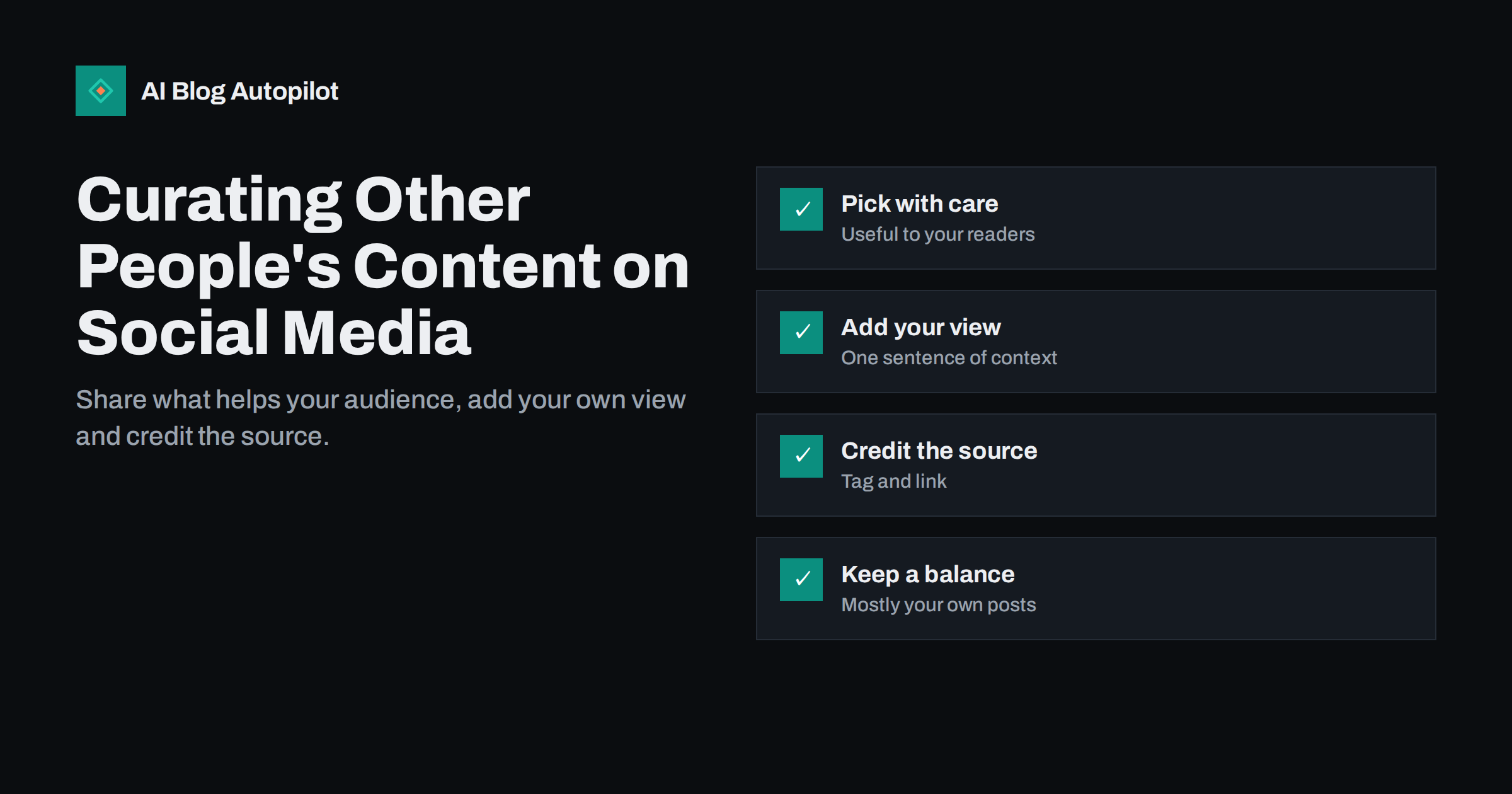
Short answer: content curation means sharing useful articles, studies or posts from other people on your social accounts, with a line of your own that explains why they matter. It works when you choose items your audience would value, read them first, add a short comment, credit and link the original and keep a sensible balance with your own posts. It fails when it becomes a stream of links with no view, or when you share without reading, credit or permission.
Few businesses have enough original material to fill every account every single day, and an account that only promotes itself is dull to follow. Sharing good work from others can fill the gaps, show that you know your field and build relationships with the people you cite. But curation is not copying. It takes judgement, honesty and a few simple rules. This guide covers what to share, how to introduce it, how to credit sources, how to avoid common problems and how to fit curated posts into a plan that still centres on your own blog.
What curation is, and is not
Curation is selecting and sharing content made by others because it helps your audience, together with your own context. The value you add is the selection and the commentary. It is different from several things that look similar:
- Reposting your own content, which is distribution, not curation.
- Copying text or images without permission, which is not curation at all and can cause legal and reputational problems.
- Aggregation, where an automated feed collects everything on a topic with no judgement. It can be useful as a source of ideas, but it is not a substitute for choosing.
- Endorsement of everything an author has said. Sharing an article does not mean you agree with all of it, but your audience may assume you do, so choose carefully.
Good curation gives your followers a reason to trust your account: they know that whatever you share has been read and picked for them.
Why curate at all
- Variety. A mix of your articles and other useful items keeps a feed from feeling like an advertisement.
- Authority. Knowing what is worth reading in your field shows expertise and builds credibility.
- Relationships. People like being credited. A thoughtful share can begin a conversation with an author, a customer or a partner.
- Efficiency. On days when you have no new article, a well-chosen share keeps the account active without forcing you to write something thin.
- Listening. Reading widely to curate makes you aware of what your audience reads and what questions are in the air, which feeds your own topics.
There are limits. Curated posts rarely bring as much traffic to your site as your own articles, and they should not replace them. Think of them as the supporting cast, not the main act.
How to choose what to share
Set a few standards before you start, so that choices are fast and consistent.
- Relevance. Does it help the people who follow you, in the area you are known for?
- Quality. Is it accurate, clearly written and based on something real? Check the date and the source.
- Freshness. Prefer recent items for fast-moving topics. Evergreen pieces can be shared again later.
- Balance. Do not share only the famous names. Smaller specialists often write the most useful material.
- Fit with your values. Avoid sources that mislead, scrape or rely on hype, even if they are popular.
- Not a competitor’s sales page. Sharing the work of a competitor is a business decision. It can be fine if the piece is useful, but do it knowingly.
Read the whole piece before you share it. The headline may promise one thing and the text say another, and sharing an article you have not read is how businesses end up endorsing something embarrassing.
Add your own line
The comment is what makes the share yours. It does not need to be long. One sentence is often enough, and it should tell the reader what to look for or why it matters.
- Point to the useful part: “The section on checking redirects is worth the read.”
- Connect it to your readers: “If you run a small shop, the table on page speed is the part to look at.”
- Offer a view: “We would add one caveat: this works best on pages that already rank.”
- Link it to your own work: “This pairs well with our guide to internal links,” if the connection is genuine.
Avoid empty phrases such as “Great read!” or “Interesting”. They add nothing and make the feed look automatic. If you have nothing to say about an item, consider whether it is worth sharing.
Credit, link and ask when needed
Treating the original creator fairly is both courteous and sensible.
- Link to the original page, not to a copy or a summary on another site. Where the network allows it, use the share function so that the original preview appears.
- Name the author or the publication in the post, and tag the account where it makes sense and the author would likely welcome it.
- Do not copy more than a short quotation. A large extract can replace the visit to the source, which is unfair to the author. See the guidance on quotations before you quote.
- Use images with care. The preview image the network generates is usually fine. Do not download someone’s picture and post it as your own graphic without permission or a licence.
- Ask first for anything unusual, such as sharing a customer’s post, using someone’s chart or reposting private material.
- Disclose relationships. If you have a commercial or personal link with the author, or you were paid or given something, say so.
The rules differ between countries and networks, and they change, so use the platform’s own tools where they exist and ask for permission if you are unsure.
Fit it into your plan
A balanced plan keeps your own content at the centre. There is no fixed ratio that suits everyone, but a few ideas may help.
- Make your own articles and original posts the majority, and use curated items to fill gaps and add variety.
- Plan curation in batches, for example by collecting a handful of good items each week and scheduling a few of them, instead of reacting to every interesting link.
- Keep a simple log of what you shared and when, so you do not repeat yourself or lean too heavily on one source.
- Match the format to the network. A professional network may suit a short comment on an industry report. A visual network may need an image of your own that refers to the idea, not the other person’s graphic.
- Review results. Look at which curated posts earned replies, saves or clicks, and which went unnoticed.
Be careful with automation. Scheduling saves time, but automatically sharing everything from a list of sources removes the judgement that makes curation valuable.
Curation and your own blog
Curated posts should send readers to good places, but your goal is still to bring people to your own site. Use curation to support that aim, not to replace it. A thoughtful comment that links your view to one of your articles, where the link is genuinely relevant, can serve both the reader and the blog. Avoid forcing a link to your own work into every share, which looks self-serving.
Curation can also help your blog directly. Citing and mentioning other writers makes them aware of you, and some will read your work, share it or link to it in return. That should be a pleasant side effect, never the reason for sharing, and you should not expect or demand anything back.
Common mistakes
- Sharing without reading, then being caught out by a poor article.
- Posting links with no comment, so the feed looks like a list of bookmarks.
- Failing to credit, or crediting the aggregator instead of the author.
- Sharing too much from one source, which looks like an advertisement for them.
- Letting curated posts outnumber your own, so the account has no voice.
- Ignoring comments on shared posts. If readers respond, reply, and tell the author about the discussion where appropriate.
- Sharing outdated items. An article that was sound five years ago may now be wrong.
A simple weekly routine
Curation works best when it is a small habit, not a daily scramble. A routine that takes about thirty minutes a week is enough for most small accounts.
- Collect. During the week, save interesting items in one place, such as a bookmarks folder or a shared note, with the link and a line about why you saved it.
- Select. Once a week, review the list and keep the three to five items that best serve your audience. Discard the rest without guilt.
- Write. Draft the one-sentence comment for each item and decide which network suits it.
- Schedule. Spread the posts between your own articles so that the feed alternates, instead of posting several curated items in a row.
- Review. At the end of the month, note which items drew replies or clicks and adjust your sources.
The routine also shows you where the gaps are. If you keep saving items on a topic you have not covered, that is a strong signal for a new article on your own blog, written from your own experience.
How AI Blog Autopilot helps
AI Blog Autopilot writes your own articles and shares each one to the social networks you connect, with a text written for each network, with its own length and timing. That gives your accounts a steady base of original posts, so curated items can be an occasional extra instead of the main content. Its content map shows every post per network. Choosing what else to share, and reading it first, stays with you. See the pricing page for plans.
Related reading
- Social Media Content Mix: What to Post Between Articles
- Originality and Plagiarism on a Business Blog
- Image Rights for Blog Posts: Stock, Screenshots and Generated Images
- Digital PR for Small Blogs
The bottom line
Curation is a good way to add variety, show expertise and build relationships, as long as you do it with judgement. Choose items your audience would value, read them before you share, add a line of your own, credit and link the original and ask when in doubt. Keep your own articles at the centre of the plan, review what works and do not automate away the selection. A curated feed that is honest and selective earns trust, while a stream of unread links loses it.
GYIK
Is it allowed to share other people’s articles on my business account?
Sharing a link with the network’s share function and a short comment is normal practice. Do not copy large extracts or images without permission, and follow the rules of each network.
How much of my feed should be curated content?
There is no fixed ratio, but your own articles and original posts should be the majority. Use curated items to add variety and fill gaps.
Do I need to tag the author?
It is courteous to name the author or publication, and tagging works well when the author would welcome it. Always link to the original.
Should I read an article before sharing it?
Yes. Headlines can mislead, and sharing something you have not read may suggest you endorse claims you have not checked.
Can I automate curation?
You can schedule items you have chosen, but automatically sharing everything from a source list removes the judgement that makes curation worthwhile.