ENEnglish
 LTLietuviškai
 DEDeutsch
 FRFrançais
 RUРусский
 ESEspañol
 PLPolski
 ITItaliano
 UKУкраїнська
 CSČeština
 PTPortuguês
 JA日本語
 LVLatviešu valoda
 ETEesti
 HUMagyar
 IDBahasa Indonesia
 TRTürkçe
 HIहिन्दी
 ELΕλληνικά
 ARالعربية
 THไทย
 VITiếng Việt
 RORomână
 MSBahasa Melayu
 BNবাংলা
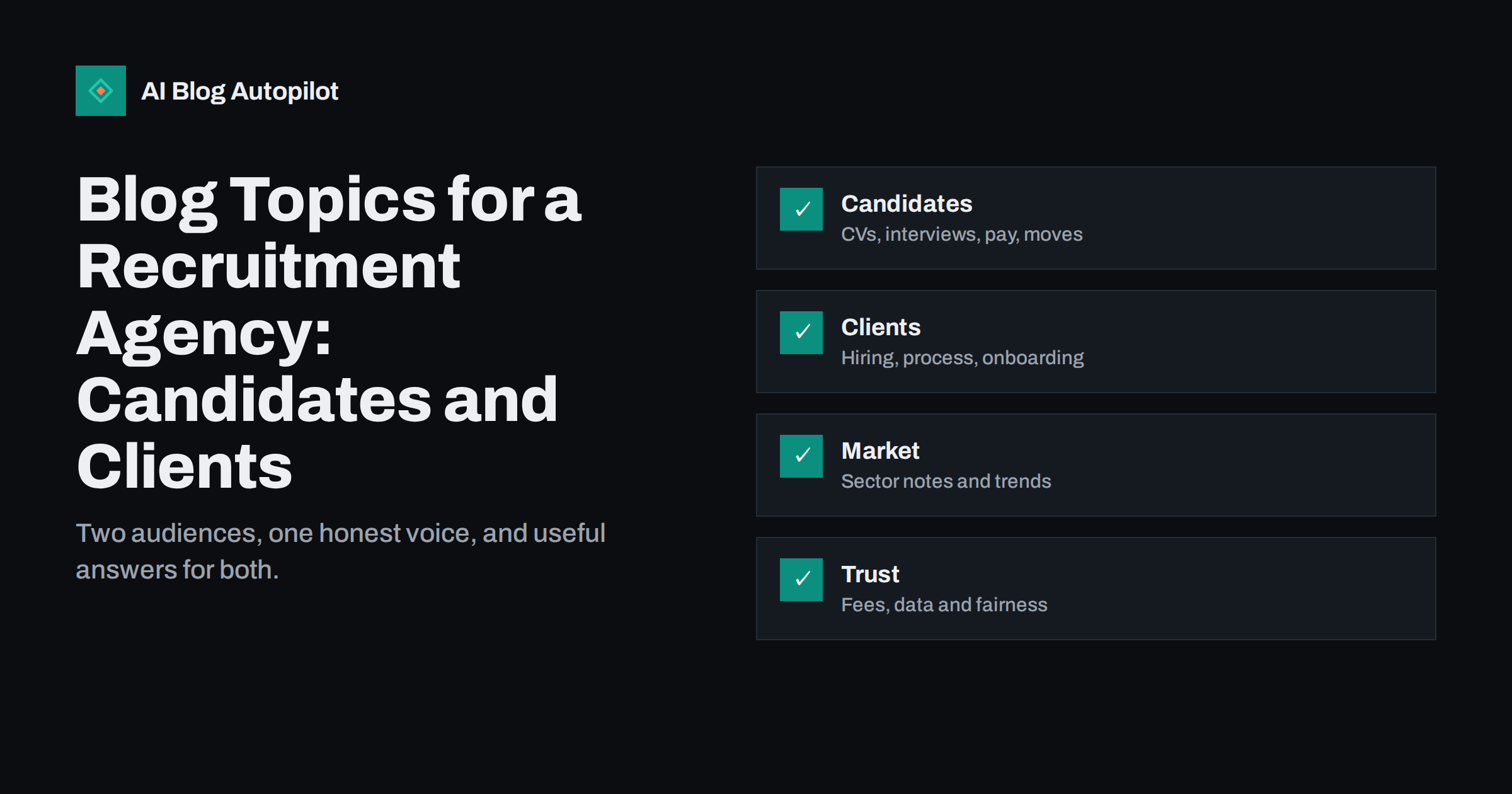
Short answer: a recruitment agency needs two sets of articles: practical help for candidates, such as CV, interview and career-change guides, and practical help for hiring companies, such as how to write a job advert, how a search works and what fees to expect. Add sector and location pages where you have real expertise, explain your process openly and keep every fact, salary range and legal statement accurate and dated. Link each article to the matching enquiry route.
Recruitment is a trust business with two sides. Candidates share personal data and hopes, and companies share budgets and plans. Both want to know who they are dealing with, how the process works and what it will cost them in time and money. A blog is a good way to answer these questions before the first conversation.
This guide gives topic ideas for each audience, shows how to build sector and local pages, and explains how to deal with the sensitive points that matter in this field: accuracy, fairness, privacy and honesty about results. It suits a small or mid-sized agency, a niche search firm or a freelance recruiter.
Know who each article is for
Decide before you write whether an article speaks to candidates or to clients, and make that clear in the title and the first paragraph. A page that tries to address both ends up helping neither. You can link between the two sides where it makes sense, but keep the main voice focused.
Candidate articles bring traffic, which can be large, but traffic that is not always valuable. Client articles bring fewer visitors who are closer to a decision. Both have a role. Candidate content builds your database and your reputation, while client content leads to paid work. Plan a balance, and track which brings enquiries, not only visits.
Check your search results for your sector and region. Look at who ranks for questions such as “how to hire a …” or “jobs in … in my area” and find the gaps that a specialist can fill. The article on blog strategy for a software business shows how a business-to-business blog can be planned around a buyer’s questions, and the same method applies here.
Topics for candidates
Candidates search for practical help, and they search often. Good topics include how to write a CV for a certain role, how long a CV should be in your country, how to explain a gap, how to prepare for typical interview questions, how to negotiate an offer, how to resign politely and what to expect in the first month of a new job.
Add guides that match your sectors. A nurse, an engineer, a driver and a software developer face different issues. If you place people in a field, you know the questions they ask, the certificates that matter and the common pitfalls. Articles that reflect this knowledge show that you understand their world.
Career-change and return-to-work articles also do well. People who change sector, come back after a break or move to a new country need guidance and reassurance. Be honest about what is realistic. If a move needs retraining, say so, and point to proper sources. The article on YMYL topics on a business blog explains why careful, accurate wording matters when advice affects a person’s income and future.
Topics for hiring companies
Companies look for help in different stages: deciding to hire, writing the role, finding people, choosing between candidates and bringing the person on board. Write one article for each step, with checklists that a busy manager can use. How to write a job advert that attracts the right people, how to build an interview scorecard, how to make an offer that is accepted and how to reduce early leavers are all useful topics.
Explain your own service in plain terms. What is the difference between a retained search and a contingency search? What is a typical process and timeline? What do you need from the client at the start? What happens if the person leaves after a few weeks? A clear page on each type of service helps clients choose and reduces the number of calls that begin with confusion.
Be open about fees. You may not publish exact percentages, but you can explain how fees are structured, what is included and what affects the cost. Clients value openness, and it filters out buyers who were never going to agree. The guide on writing honest articles about what things cost gives a pattern to follow.
Sector and location pages
Most agencies work in specific sectors and regions. A page for each main sector, such as healthcare, engineering, finance, logistics or technology, gives you a place to show deep knowledge: typical roles, skills in demand, certificates, salary factors and hiring patterns. Update these pages regularly, since a market changes quickly.
Local pages work in the same way. Describe the local job market, the main employers, the commuting patterns and the special features of your region. Do not copy the same text for every town. Pages that differ only by the place name give little value and may look like thin content.
Use real examples when you can, without breaking confidentiality. A short note on the types of roles you filled in a certain sector over the past year gives a flavour of your activity. Do not name clients or candidates without written permission, and do not publish details that could identify them. The article on blog strategy for a local business adds ideas for building local relevance.
Salary guides and market reports
Salary information attracts many readers, and it can bring good links. It also carries risks. Figures that are out of date, based on a few cases or taken from other sites without checking can mislead candidates and clients. If you publish salary data, say where it comes from, how many cases it covers, which period it describes and which region it applies to.
Prefer ranges and explain what moves a salary up or down: experience, certificates, size of company, location, sector and working pattern. Avoid single numbers that look precise but are not. Update each guide at least once a year and show the date at the top.
Original data is a strong asset. If you collect your own information from placements, candidate surveys or client feedback, you can publish a short report with real findings. Keep the method simple and honest, and remove any detail that would identify a person or a company. The guide to statistics round-up posts shows how to present numbers without overstating them.
Think about how you describe the people you place. Success stories help, but they must be true and approved. A short note on how a candidate moved from one sector to another, written with their agreement and without identifying details unless they ask for them, shows what you can do and gives other candidates hope. Never exaggerate a result, and never imply that a placement was guaranteed.
Be careful with job adverts published as blog posts. A role that is no longer open should be marked as closed or removed, and the same goes for adverts that you wrote for a client who has since filled the position. Out-of-date vacancies frustrate candidates, waste your reputation and can create legal problems if the advert still contains inaccurate terms.
Fairness, privacy and honesty
Recruitment is regulated in many countries, and rules about discrimination, advertising and personal data apply to your content as well as to your work. Do not write job-related articles that suggest a preference based on age, sex, nationality or other protected traits. Check the rules in your market, and ask a qualified adviser about anything unclear.
Handle personal data carefully on the website. Do not publish a candidate’s details, CV or story without clear consent, and explain in your privacy notice how you store and use the data that candidates submit through forms. The article on privacy and analytics on a business blog covers the points that matter for tracking and consent.
Be honest about results. Claims such as “we place people in 48 hours” or “the best candidates in the market” need evidence, and any figure should be real and current. A statement that you cannot prove can cause complaints and damage the credibility of your other content. If you do not have the number, describe the process instead.
Measure what happens after the click. Track the number of form submissions, registrations, calls and requests for a meeting that come from each type of article, and ask new contacts how they found you. Over a few months you will see which topics attract the people you really want, and you can plan more of those. A page that has many readers but no enquiries may need a clearer next step, not more traffic.
Keep your pipeline of ideas fed from real conversations. Every week, your consultants hear questions from candidates and clients that could become articles: how to answer a tricky interview question, what a notice period means in a certain country, how long a security check takes. Ask each consultant to send one question a week, and turn the best into short, accurate answers.
Turn articles into enquiries
Every article should lead somewhere. A candidate article might end with a link to current vacancies, a form to register or a short guide to the next step. A client article might link to a page that explains your process and a simple form to request a call. Keep the forms short, and say what happens after submission and how quickly you reply.
Use your consultants’ real names and experience. An article reviewed by a consultant who works in the sector, with a short bio and a photo, has more weight than an anonymous page. It also makes it easier for a reader to ask for a particular person. The guide to bylines and author bios explains how to set them up.
Share articles where your audiences are. Candidates often use professional networks and job boards, while hiring managers read industry groups and newsletters. The guide on using LinkedIn to distribute a business blog gives a plan that suits the client side.
How AI Blog Autopilot helps
AI Blog Autopilot can write and publish articles on the topics you choose, with FAQ sections, tags and SEO meta, and it shares them to your social networks, so both candidate and client articles keep appearing without daily effort. Check every salary figure, legal point and claim before an article goes live, and use the approval option if you want to see each draft first. See the pricing page for plans and monthly credits.
Related reading
- Blog Strategy for Professional Services Firms
- Using a Blog to Attract Job Applicants: What to Publish
- Turning Customer Questions Into Blog Topics
The bottom line
Write separately for candidates and clients, keep facts accurate and dated, respect privacy and fairness rules and give every article a clear next step.
GYIK
Should a recruitment agency blog for candidates or for clients?
Both, in separate articles. Candidate content builds reach and your database, while client content leads to paid work.
Can I publish salary guides?
Yes, if you state the source, the period, the region and the number of cases, and update them at least once a year.
Can I name placements and clients in articles?
Only with written permission, and never with details that could identify a candidate or company.
How often should an agency publish?
Two to four articles a month is realistic, with regular updates to sector and salary pages.
Do I need separate pages for each town?
Only if each page has real local detail. Copied pages that differ by place name add little.