ENEnglish
 LTLietuviškai
 DEDeutsch
 FRFrançais
 RUРусский
 ESEspañol
 PLPolski
 ITItaliano
 UKУкраїнська
 CSČeština
 PTPortuguês
 JA日本語
JA日本語 LVLatviešu valoda
 ETEesti
 HUMagyar
 IDBahasa Indonesia
 TRTürkçe
 HIहिन्दी
 ELΕλληνικά
 ARالعربية
 THไทย
THไทย VITiếng Việt
 RORomână
 MSBahasa Melayu
 BNবাংলা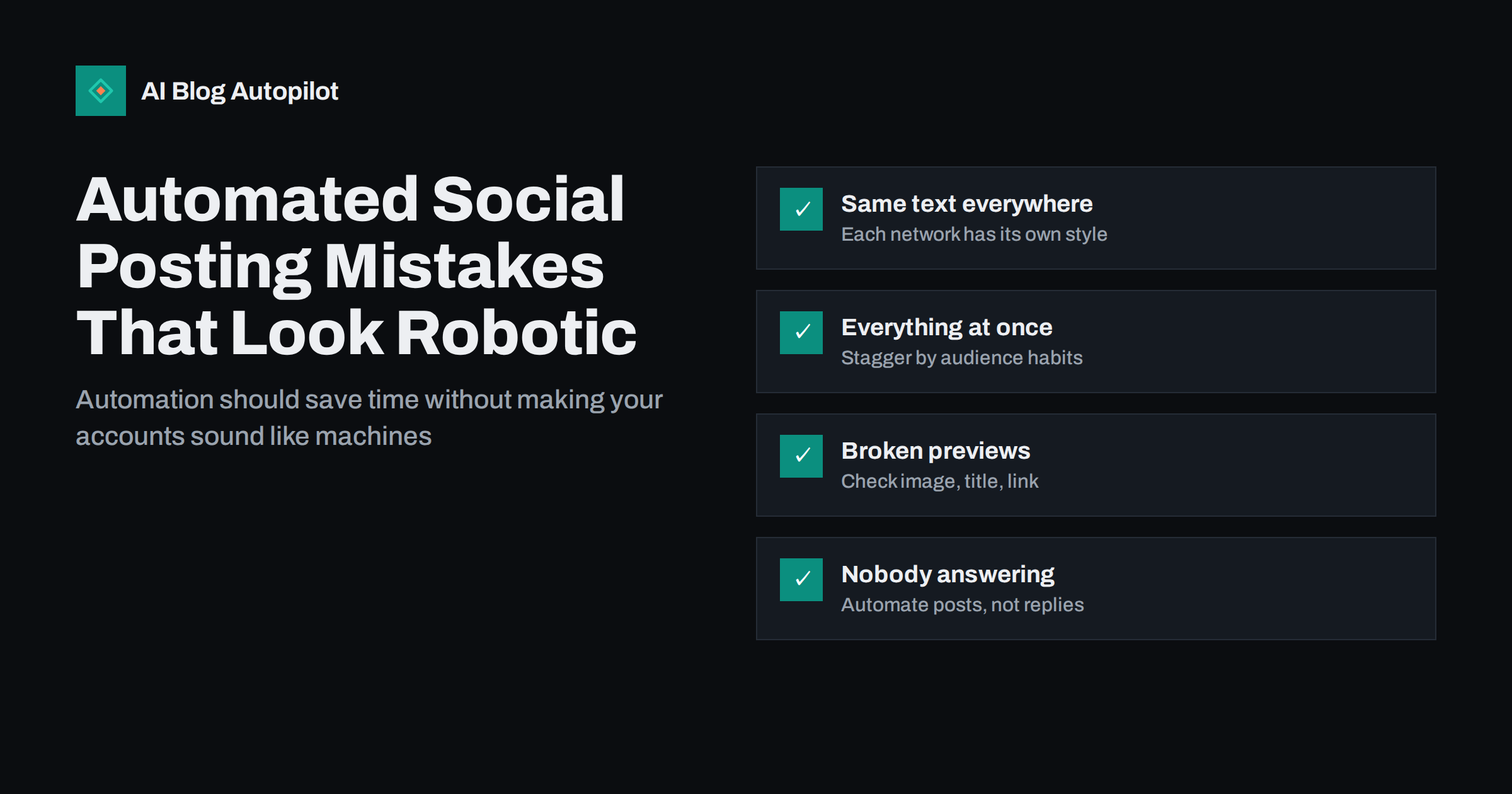
Short answer: automated social posting makes accounts look robotic when every network gets identical text, posts land at the same minute everywhere, link previews are broken, hashtags are stuffed in mechanically, old posts are reshared too often, and nobody replies to comments. Each of these has a simple fix: adapt text per network, stagger timing, check previews, use hashtags sparingly, space out reshares and keep a human on replies. Automation should handle the repetitive work, not the conversation.
Automating the sharing of blog posts is sensible. Nobody wants to log into six networks every time an article is published, and consistent sharing is one of the easiest ways to keep a blog visible. The problem is not automation itself. The problem is automation that is set up once and never looked at again.
Readers notice quickly when an account is on autopilot in the bad sense: posts that read like feed entries, links with missing images, replies left unanswered for weeks. This guide lists the most common mistakes and how to avoid each one.
Why a robotic feel costs more than it saves
A robotic account rarely fails dramatically. It fades. Followers learn that posts are announcements rather than conversation and stop engaging. Many networks use engagement to decide how widely to show a post, so fewer reactions mean fewer people see the next one. Over months, an account can post consistently and still reach a shrinking audience.
There is also a trust cost. Prospective customers often look at a company’s social accounts to judge whether it is active and responsive. A feed of identical links with unanswered questions underneath suggests nobody is home, which is the opposite of what consistent posting was meant to achieve.
Mistakes in what gets posted
Identical text on every network
The fastest way to look automated is to publish exactly the same text, with the same hashtags and the same link, on every network. Each platform has different conventions and audiences, and a post written for one rarely fits another.
- Professional networks reward a few sentences of context and a clear point of view.
- Short-form networks need a sharp line and the link, with little else.
- Visual networks depend on the image, with text as support.
- Sõnumikanalid such as Telegram suit a brief, direct note.
- Community networks punish anything that looks like promotion without contribution.
The fix is to have each network’s post written for that network: different length, tone and emphasis. Even small variations, such as a different opening line or angle, make a feed feel attended to.
Mechanical hashtags
Automation often appends the same block of hashtags to every post, or turns every category and tag from the blog into a hashtag. The result is a string of irrelevant tags that looks like spam.
- Use hashtags only on networks where people actually search or follow them.
- Choose a few specific, relevant tags rather than many generic ones.
- Vary them according to the article’s topic.
- Check that tags generated from blog categories make sense as hashtags. “Uncategorized” does not.
Broken or ugly link previews
A link post is only as good as its preview. When the preview shows no image, the wrong image, a generic site logo or a truncated title, the post looks careless, and fewer people click.
Previews are generated from the page’s Open Graph and similar tags. Common causes of problems include:
- No featured image set on the post, or an image too small for the network’s preview size.
- The network fetching the page before the image was ready, then caching the incomplete preview.
- A theme or plugin outputting two conflicting sets of social tags.
- Security settings blocking the network’s preview crawler.
Check a few previews after any theme or plugin change, and use each network’s preview or debugging tool, where one exists, to refresh a cached preview. The Open Graph protocol site documents the tags networks read.
Only posting links
An account that publishes nothing but links to its own blog reads like an RSS feed with a profile picture. Mix in other kinds of posts: a tip from an article written out in full, a question to followers, a behind-the-scenes note, a useful resource from someone else. Many networks also favour posts that keep people on the platform, so native posts often reach more people than links.
A reasonable balance for many businesses is to automate the link sharing of new and evergreen articles and add a few native, personal posts by hand each week.
Mistakes in timing and frequency
Everything at the same minute
When a new article appears simultaneously on every network, followers who use several platforms see the same announcement repeatedly at once. It also ignores the fact that audiences on different networks are active at different times.
Stagger posts instead. A common pattern is to publish on the blog first, share to a professional network shortly after, then to other networks over the following hours or days, according to when each audience tends to be online. Staggering also spreads the article’s visibility over a longer period, which usually means more people see it overall.
Resharing the same post too often
Resharing older articles is a good idea. Evergreen posts deserve more than one moment of attention, and new followers have never seen them. But resharing becomes a problem when the same article appears every few days, or when the reshare uses the exact same text each time.
- Space reshares out. Weeks or months between appearances, depending on how often you post.
- Change the angle. Lead with a different point from the article each time.
- Reshare only evergreen content. Announcements, event posts and time-bound offers should not be recycled after they expire.
- Retire posts that are out of date, or update them before they come round again.
Posting during a crisis or major news
Scheduled posts do not know what is happening in the world or in your business. A cheerful promotional post published during a major news event, a service outage or a sensitive moment for your industry can look tone-deaf.
Know how to pause your automation quickly. Most tools have a pause or approval mode. When something significant happens, pause, review what is scheduled and resume when appropriate.
Mistakes in looking after the setup
Nobody answering
This is the mistake that most clearly separates a healthy automated account from a robotic one. Posts go out on schedule, people comment or ask questions, and nothing comes back.
Social networks are conversations. Automating the publishing of posts is fine; automating the replies usually is not, and ignoring them entirely is worse. Set a simple routine: check notifications and comments on each network at least a few times a week, answer questions, thank people for useful additions, and pass support issues to whoever handles them.
A small number of real replies does more for how an account feels than dozens of perfectly scheduled posts.
Never checking whether it still works
Connections to social networks expire. Passwords change, tokens need renewing, networks change their rules. An automation that silently stopped working months ago leaves accounts that look abandoned, and one that fails on some networks but not others leaves gaps nobody notices.
- Look at each network’s feed once a week to confirm recent posts appeared as intended.
- Pay attention to any error reports or reconnection prompts from your tools.
- After changes to your site, such as a new theme or domain, check a fresh post on every network.
What good automation looks like
It helps to picture the goal. A well-run automated setup has a few recognisable traits:
- Each new article appears on every relevant network, written in that network’s style, at a time that suits its audience.
- Previews show the right image and title every time.
- Older, still-accurate articles resurface occasionally with fresh angles.
- Someone reads comments and messages several times a week and replies like a person.
- A few hand-written posts each week add personality that no schedule can.
- Failures are noticed within days, not months.
None of this requires much time once it is set up. It requires only that automation is treated as a system to look after, not a switch to flip once.
A quick monthly check
- Open each network and scroll through the last month of posts as a follower would.
- Check that previews look right and links work.
- Look for identical text across networks and repeated reshares.
- Review unanswered comments and messages.
- Confirm every connection is still active.
- Note which posts earned engagement, and adjust topics or wording accordingly.
How AI Blog Autopilot fits in
AI Blog Autopilot shares every article it publishes to your connected social networks, writing separate text, length and timing for each one, for example the blog at your chosen hour, LinkedIn thirty minutes later and other networks after that. Its content map shows every post per network, links to the live posts, and says exactly why if something failed, such as a network needing to be reconnected. Evergreen reshares are included on some plans. Replies and conversations stay with you. You can see how the social side works on the AI Blog Autopilot home page.
Related reading
- Auto-Post Every New Blog Article to Social Media Automatically
- Turning an Article Into Social Posts That Get Read
- Getting Your Team to Share Blog Posts on Their Profiles
- Quote Graphics From Blog Posts: Shareable Images That Work
The bottom line
Automation looks robotic when it repeats itself: the same text everywhere, the same minute, the same hashtags, the same reshare, and silence in the comments. Write for each network, stagger timing, check previews, use hashtags with care, space out reshares, keep a person on replies and check the whole setup monthly. Then automation does what it should: saves time while your accounts still sound like people.
KKK
Is it bad to automate social media posts?
No. Automating the sharing of blog posts saves time and keeps accounts active. It becomes a problem when posts are identical across networks, previews are broken or nobody responds to comments. Automate the publishing and keep people in the conversation.
Should I post the same text on every social network?
It is better not to. Each network has different conventions and audiences. Adapting the length, tone and angle for each one makes posts fit naturally and makes the account look attended to.
How often should I reshare old blog posts?
It depends on how often you post, but spacing reshares of the same article weeks or months apart and changing the angle each time works for most accounts. Reshare only evergreen articles, not expired announcements or offers.
Why does my shared link show no image?
Usually because the post has no suitable featured image, the social tags are missing or conflicting, or the network cached the preview before the image was available. Check the page’s Open Graph tags and use the network’s preview tool to refresh it.
Should I automate replies to comments?
Generally not. Automated replies tend to feel impersonal and can respond badly to questions or complaints. A short, regular routine of reading and answering comments by hand works better.