ENEnglish
 LTLietuviškai
 DEDeutsch
 FRFrançais
 RUРусский
 ESEspañol
 PLPolski
 ITItaliano
 UKУкраїнська
 CSČeština
 PTPortuguês
 JA日本語
 LVLatviešu valoda
 ETEesti
 HUMagyar
 IDBahasa Indonesia
 TRTürkçe
 HIहिन्दी
 ELΕλληνικά
 ARالعربية
 THไทย
 VITiếng Việt
 RORomână
 MSBahasa Melayu
 BNবাংলা
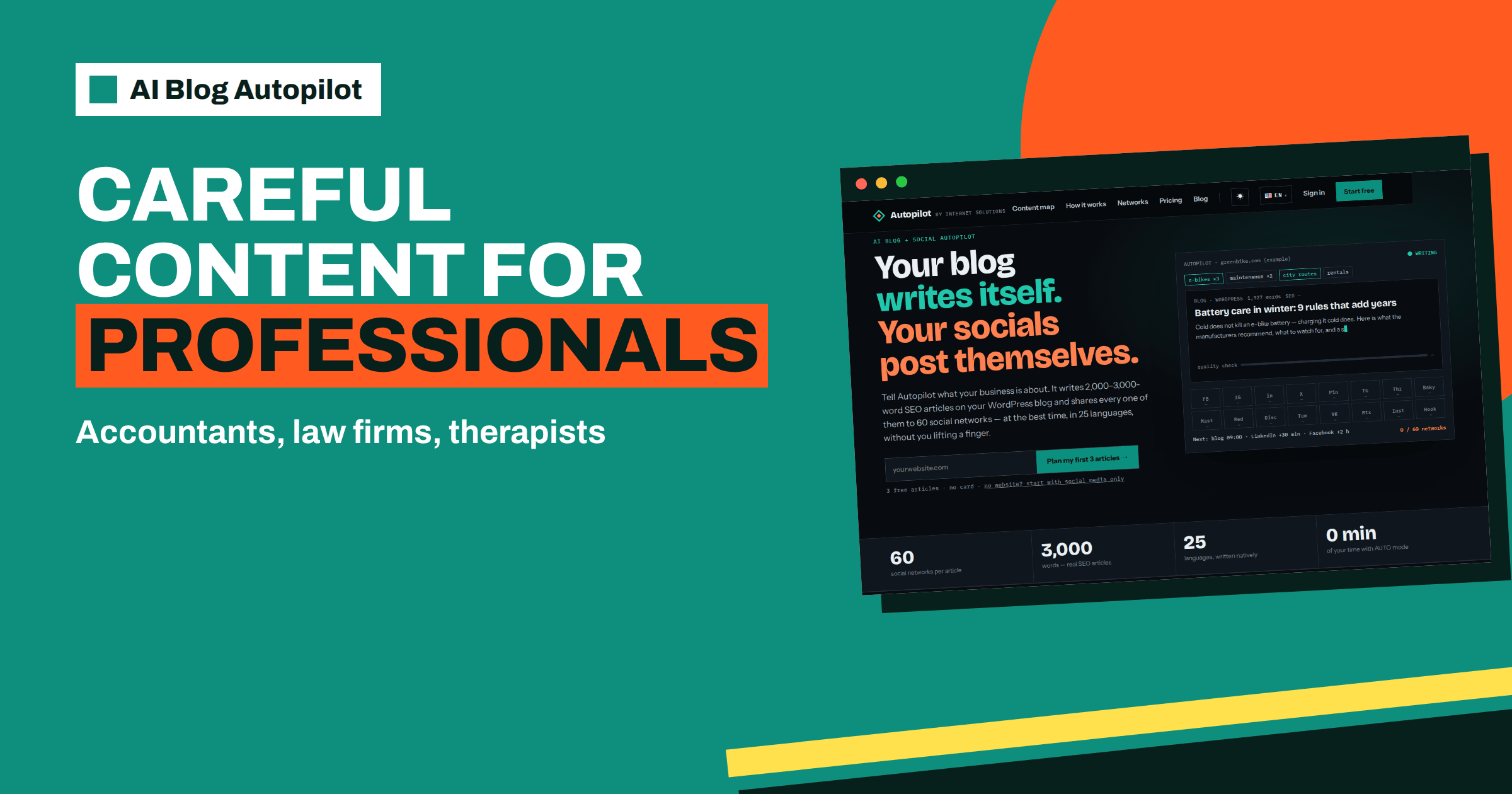
Short answer: a professional practice can use AI Blog Autopilot to publish regular, plain-language articles, but it should keep approval switched on, write a brief that states what the practice may and may not say, and have a qualified person read every article before it goes out. The product supports that choice, since AUTO is the default but approval is optional.
Accountants, solicitors, doctors, dentists, therapists, architects and consultants share a challenge: their clients search for answers online, yet the professionals have little time to write and strict rules about what they can publish. A blog that explains common questions in plain words builds trust and brings enquiries. A careless article can mislead a reader, break advertising rules or create a risk.
This guide explains how a practice can use the product responsibly. It draws on the product’s home and pricing pages for what the product does. Rules for your profession and country differ, and they are your responsibility, so treat this as a general framework, not professional or legal advice, and check your regulator’s guidance.
What the product does and does not do
The home page describes a product that writes 2,000 to 3,000 word articles with an FAQ, tags and SEO meta, runs an automatic quality check and publishes at the hour you choose, then shares to your networks. It states that the writer is instructed never to make up statistics, quotes or sources, and that weak articles wait for you instead of going live.
It does not know your regulator, your jurisdiction or your firm’s policies unless you tell it, and it does not provide professional advice. The quality gate checks length, structure, keyword and meta, not whether a statement about the law, tax or health is correct for a reader in a particular place. That judgement stays with you.
So the sensible model is: the product drafts and schedules, and a qualified person approves. That uses the product for the time-consuming parts while keeping the responsibility where it belongs. The article on YMYL topics on a business blog explains why health, money and legal subjects need extra care.
Keep approval on
For a practice, approval should not be a trial phase but a permanent setting, at least for any article that touches advice. The home page says AUTO is the default and recommended for most people, and that approval is optional for those who want to see every article first. A professional practice is exactly the case where seeing every article first is justified.
Make approval a defined step. Decide who reads the articles, how quickly and what authority they have to change or reject. For a small practice, the owner may do it. For a larger one, a senior colleague in each specialism may be better. Record each approval, with the date and the reviewer’s name, in the way your practice normally keeps records.
The Agency plan lists team and client approval, for firms that manage content for others, though a single practice rarely needs it. For a single office, the standard approval step is enough. The article on editorial review: draft, approve or full auto compares the modes.
Write a brief with rules
The product plans from topics with weight, keywords, audience and tone. For a practice, add a short list of rules to the way you describe each topic. Say that articles should explain general principles in plain language, avoid giving individual advice, avoid promising outcomes and encourage readers to seek advice for their own situation. Say what your practice does not do, such as areas of law you do not cover or treatments you do not provide.
List the claims you must never make. For some professions, that includes guarantees of results, comparisons with other practitioners, claims of being the best, unqualified statements about cures or outcomes and any use of client testimonials that rules do not allow. If you are unsure, ask your regulator or professional body.
Describe the audience in practical terms, for example people who have just received a letter, or owners of small businesses who file their own records. Choose a tone such as calm, clear and reassuring. The article on setting up topics in AI Blog Autopilot explains each setting.
Safe topic families
Many topics suit a practice well. Process articles explain what happens step by step: what to expect at a first appointment, how an engagement works, how long a typical process takes in general terms. Preparation articles list what to bring, what to prepare and what questions to ask. Glossary articles explain terms in plain words. Decision articles explain the options in a situation, without telling the reader what to choose.
Be cautious with topics that depend on current law, rates, thresholds or deadlines. These change, and an article that was right when written may mislead a year later. Where a figure matters, link to the official source and say that the reader should check the current position. Avoid stating specific rates or limits in the text unless you commit to reviewing them regularly.
Avoid case stories that could identify a client. Confidentiality rules are strict, and even an anonymised story can be recognisable in a small town. If you use examples, make them clearly hypothetical. The articles on a blog for a clinic or health practice, an accountant or bookkeeper and a law firm list safe topics for each profession.
A review checklist for the approver
Give the reviewer a short checklist so that approval is consistent. Is every statement of fact correct for the place where we practise? Does the article avoid individual advice? Are there any promises of outcomes? Does it make any comparison or claim that our rules restrict? Are figures, dates and thresholds either checked or linked to an official source? Does it mention anything we do not offer?
Add checks for tone and balance. Does the article treat the reader with respect, without scaring them or encouraging delay in seeking help? Does it include a clear next step, such as contacting the practice for advice on their own situation? Does the FAQ avoid answering questions that need individual assessment?
Keep notes on what you change. If the same correction appears twice, update the brief so that it does not recur. The aim is for the brief to improve until corrections are rare, though approval stays on. The article on how to edit an AI draft describes the passes that matter.
Privacy and client data
Keep client information out of the brief and out of the product. The topics you enter describe your services and audience, not individuals. Do not paste case details, names or documents into any setting. If you want to write about a type of situation, describe it in general terms.
Check how you describe privacy and data handling on your site, and make sure articles do not make statements about it that you have not verified. If an article mentions how you handle information, compare it with your policy pages. The privacy and terms pages for the product are linked in its footer if you need to review them for your own records.
When you share articles on networks, remember that comments may include personal details. Decide how your team will respond, which is usually by inviting the person to contact you privately, and avoid discussing individual cases in public threads.
Social posts for a practice
The networks page says Autopilot writes a separate text for each network: a professional post for LinkedIn, a short hook for X and Bluesky and a summary with bullet points for Telegram. For a practice, a professional network is often the first choice, with maybe one local network for community reach. Choose few and watch them.
Check the first social posts as carefully as the articles, since a short summary can lose the qualification that made the article safe. A post that says something is allowed, without the condition that applies, can mislead. If you notice this, adjust the tone settings and consider asking for more cautious wording.
Respond to comments in line with your practice’s policies, and be careful about giving advice in public. A friendly reply that invites the reader to book a conversation is usually better than an answer to a personal question.
Plan choice and workload
Most practices need a modest volume. The Starter plan lists 8 articles a month for 1 website at 19 euros, and that may be more than a small practice can review. Count the minutes your reviewer can give, and choose a number that leaves time to read carefully. Credits are monthly and do not roll over, so use what you can check and no more.
If you have branches in several countries, the Growth plan lists 3 languages and Pro lists all 25. Each language needs a reviewer who knows the rules there, which may be the limiting factor, so start with the main market.
The first three articles are free, with no card, so you can test how the output reads for your subject before you decide. The article on how to pilot an AI blog tool gives a thirty-day approach.
Finally, review the whole programme twice a year. Read a sample of published articles against the current rules and your current services, and update the brief and the list of forbidden claims. Regulations change, and so do practices. A short written review, signed off by the person responsible, shows that you take the responsibility seriously and gives you a record if a question is ever raised.
How AI Blog Autopilot helps
The product saves a practice the time of drafting, formatting and publishing, and leaves the professional judgement to the people qualified to make it. Try it on AI Blog Autopilot, and compare plans on the pricing page.
Related reading
- YMYL Topics on a Business Blog
- Blog Topics for a Law Firm
- Blog Topics for an Accountant or Bookkeeper
The bottom line
Use the product to draft and schedule, keep approval on permanently, write rules into the brief, avoid volatile figures and individual advice, and let a qualified person approve every article.
KKK
Should a professional practice use AUTO mode?
Approval is safer. AUTO is the default, but approval is optional and suits subjects where advice and regulation matter.
Does the product check legal or medical accuracy?
No. The quality gate checks length, structure, keyword and meta. A qualified person must check the substance.
Can I put client details in the brief?
No. Describe services and audiences in general terms and keep client information out of the product.
How many articles should a small practice publish?
As many as a qualified reviewer can read carefully. Starter lists 8 a month, but fewer may be wiser.
Is there a free trial?
Yes. The first 3 articles are free and need no card.