ENEnglish
 LTLietuviškai
 DEDeutsch
 FRFrançais
 RUРусский
 ESEspañol
 PLPolski
 ITItaliano
 UKУкраїнська
 CSČeština
 PTPortuguês
 JA日本語
 LVLatviešu valoda
 ETEesti
 HUMagyar
 IDBahasa Indonesia
 TRTürkçe
 HIहिन्दी
 ELΕλληνικά
 ARالعربية
 THไทย
 VITiếng Việt
 RORomână
 MSBahasa Melayu
 BNবাংলা
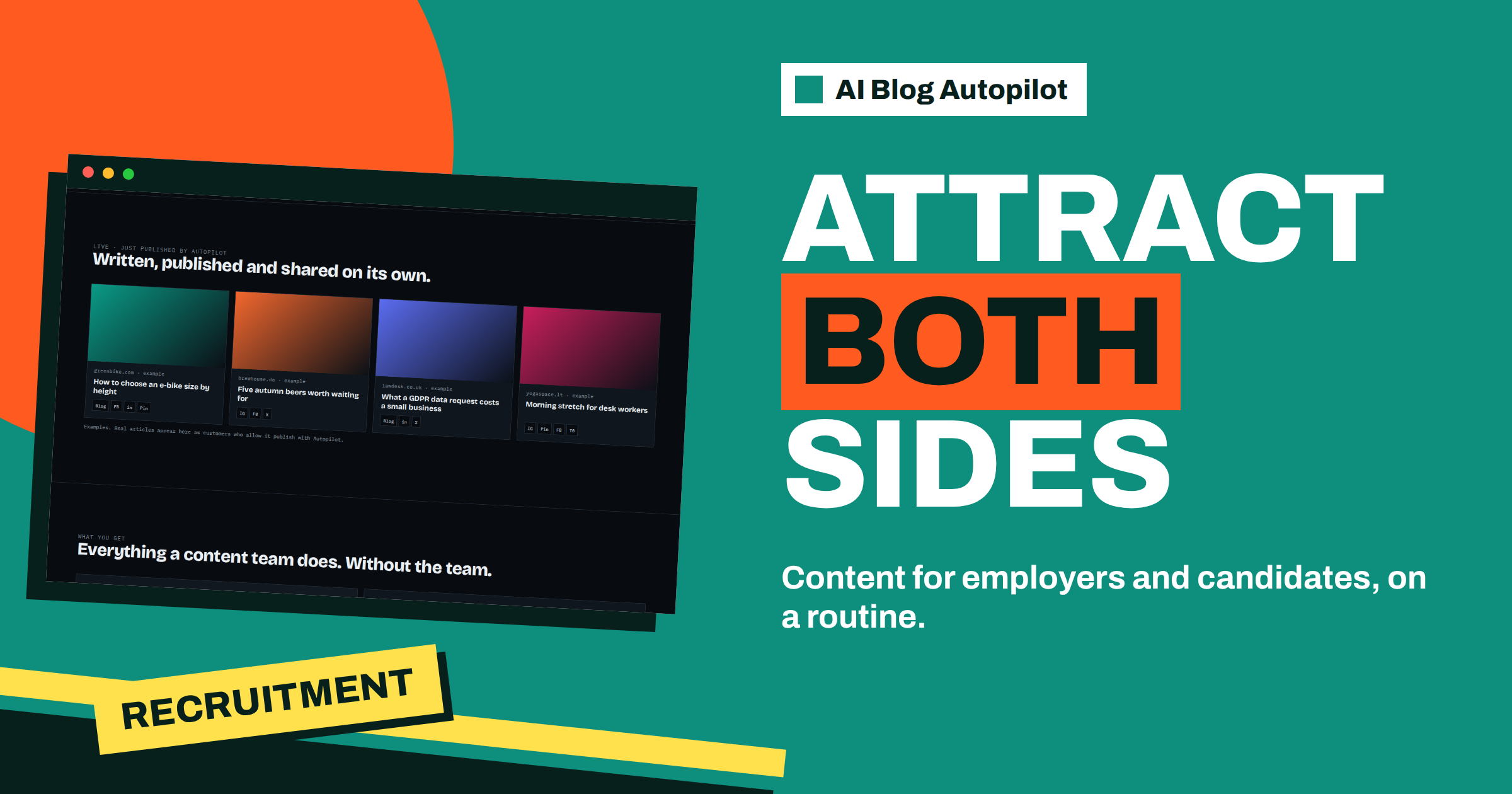
Short answer: A recruitment or staffing agency can use AI Blog Autopilot to publish guides for two audiences, employers who hire and candidates who search, and share each article to networks such as LinkedIn. Give the product separate topics for each side, a fact sheet that avoids unverified claims and a review step, and start on Starter with eight articles a month.
Agencies serve two groups at once. Employers want to know how to hire well, what the market looks like and what working with an agency involves. Candidates want to know how to write a strong CV, how to prepare for interviews and what a fair offer looks like. A blog that serves both builds a reputation on both sides of the market.
The difficulty is time. Recruiters spend their days on calls, shortlists and negotiations, and content is the first thing to slip. This guide shows how an agency can run a steady blog and social presence with AI Blog Autopilot. The product facts come from the home page, networks page and pricing page. Facts about your agency, such as sectors, fees and placements, are yours to supply.
Why content works in recruitment
Recruitment is a trust business. Employers choose an agency they believe understands their sector, and candidates choose recruiters who treat them fairly. Articles that show knowledge and honesty build that belief before a conversation starts.
Content also reaches people who are not looking today. A candidate who reads your interview guide in a quiet month may call you when they decide to move. A manager who reads your article on onboarding may think of you when a vacancy appears. This slow, steady visibility is hard to buy.
It also helps search. People search for terms such as salary guides, interview questions and how to hire in a specific sector. An agency that answers those searches in its own market earns attention. The article on blog topics for a recruitment agency offers a list of ideas.
Topics for employers
For employers, write about the decisions they face. How to write a job advert that attracts the right people, how to structure an interview, how to assess skills, how long hiring takes, how to make an offer and how to keep new hires in the first months. Add sector guides, such as hiring in logistics, accountancy or engineering.
Add practical explanations of how an agency works: what a shortlist involves, how fees are explained and what a manager should prepare before a first call. Be honest and avoid unproven numbers. If you quote a statistic, it must come from a source you can name.
Add local market content: typical conditions in your region, trends you see in your own placements without naming clients and tips for competing for scarce skills. These articles show that you know the market, and they give employers a reason to call you.
Topics for candidates
For candidates, write about the steps of a job search. CV and cover letter guides, interview preparation, questions to ask an employer, how to negotiate, how to change sector and how to handle gaps in a career. Add sector-specific advice and ideas for staying employable.
Add guides on working with recruiters: what to tell a recruiter, how to follow up and what to expect after an interview. Candidates who understand the process become better candidates, and they remember the agency that explained it.
Keep the tone respectful. Candidates are often anxious, and a warm, practical voice works better than a corporate one. Avoid promises about outcomes, such as a guaranteed job, and avoid wording that could discriminate. The article on inclusive language in blog posts offers useful guidance.
Set up the brief for two audiences
The home page says you give Autopilot topics with weight, keywords, audience and tone. For an agency, write two sets of topics. Give each its own audience description and tone. The employer voice may be confident and efficient, while the candidate voice may be encouraging and clear.
Decide the weights by what your business needs. If you struggle to find candidates, give more weight to the candidate side. If you want more vacancies, favour the employer side. Review the weights each quarter as your needs change.
Add a fact sheet: sectors you cover, regions, services, how you work and anything you do not do. Add rules, such as no salary figures unless they come from a stated source, no naming of clients and no claims about success rates. The home page says the writer is told never to make up statistics, quotes or sources, and your rules reinforce this. The article on how to write a content brief for AI offers a template.
Choose the networks
Recruitment depends on professional networks. LinkedIn is the obvious one, and the home page describes a professional post for LinkedIn that appears 30 minutes after the blog. The networks page lists LinkedIn among its social networks, and says each network gets its own text, length and timing.
Consider other channels for candidates. Facebook can reach local job seekers, and messaging channels such as Telegram or Viber may work in some markets. Team chats are for internal use and rarely suit recruitment. Choose the channels where your candidates and employers actually spend time.
Keep each profile consistent: agency name, specialities, region and contact. The article on using LinkedIn to distribute a business blog describes what works there. Also be careful with privacy: do not post anything that identifies a candidate or a client without clear consent.
Review, risk and plan
Recruitment content has special risks. Employment law, pay transparency and discrimination rules differ by country and change. Articles that touch them should be checked by someone who knows the rules in your market. State in the brief that articles must not give legal advice and should suggest checking local rules.
Start with approval on, which the home page says you can do at any time. Read each article for accuracy, tone and any claim you cannot support. After a few weeks, move to AUTO if the quality is steady. Look at the content map weekly to see that articles and posts went out.
For most agencies, Starter is the right beginning: 19 euros a month with 8 articles, 1 website, 5 social networks and 1 language, per the pricing page. If you serve several countries or languages, Growth lists 3 languages and 2 websites. Credits reset monthly and do not roll over, so choose a number you can review.
Consider a short story. A small agency placing office and finance staff has two recruiters and an office manager. They write a brief with four employer topics and four candidate topics, and add a rule against naming clients or quoting salaries without a source. The office manager reads each article on Friday, and a recruiter checks anything about hiring law. On LinkedIn, each article gets a professional post a little after the blog, and candidates begin to mention the CV guide in calls. After three months, one employer says he found the agency through an article on structuring interviews.
The lesson is that a recruitment blog works on both sides. Each article is a quiet introduction to people who may need you later.
Using content to support the sales conversation
A recruitment blog is not only for search. It is a tool for the conversation your team already has. When a recruiter talks to an employer about a difficult hire, a relevant article is a useful follow-up. When a candidate asks how to prepare for an interview, a guide you wrote saves ten minutes and shows care.
Keep a short library of the best articles by topic, so everyone on the team can find the right link quickly. Add the articles to your email signatures, proposals and welcome messages where it makes sense. A well-chosen link at the right moment does more than a generic brochure.
Listen to the questions that come up in calls, and pass them into the brief. If three candidates ask about salary negotiation in a week, that is a topic. If employers keep asking how long hiring takes, that is another. The blog then reflects the real market, and the recruiters see their own experience in the content, which makes them more likely to use it.
Measuring results in recruitment terms
Measure the blog with recruitment measures. Count new vacancies from employers who mention an article, candidate registrations that begin on an article page, enquiries from LinkedIn posts and the number of times recruiters send an article during a conversation. Ask each new contact how they found you, and keep a simple log.
Give it time. Content reaches people before they need a recruiter, so results often come months later. Judge after a quarter, not after a month, and compare the numbers with the effort. If one side of the market responds more, shift the weights towards it, and if neither does, look at topics, networks and the brief.
Review the plan too. If you outgrow eight articles a month, Growth lists 30 articles, 2 websites and 3 languages, which may suit an agency with several sectors or markets. Move up only when you can review the extra output.
A final point concerns consistency of voice between the two sides. An agency that sounds polished with employers and casual with candidates can look like two different companies. Describe a shared core, such as honest, practical and respectful, and let the tone vary only in warmth and detail. Review a sample from each side side by side every quarter, so that the brand stays recognisable to everyone who reads it.
How AI Blog Autopilot helps
The product writes for both audiences from one brief, adds FAQ, tags and SEO meta, runs a quality check and shares each article with a professional post on LinkedIn and native posts on other networks. Try it with the three free articles on AI Blog Autopilot, no card needed, and see the plans on the pricing page.
Related reading
- Blog Topics for a Recruitment Agency: Employers and Candidates
- Using LinkedIn to Distribute a Business Blog
- Choosing an AI Blog Autopilot Plan: Social to Agency
The bottom line
A recruitment agency should write for employers and candidates separately, give the product a fact sheet with firm rules on salaries and clients, share on LinkedIn, check legal topics locally and begin on Starter with approval on.
FAQ
Can one blog serve both employers and candidates?
Yes, with separate topics, audience descriptions and tones for each side in the brief.
Will the articles quote salaries or statistics?
Only if you provide sources. The home page says the writer is told never to make up statistics, quotes or sources.
Which network suits recruitment best?
LinkedIn is the usual choice, and the home page describes a professional post for it 30 minutes after the blog.
Should I check articles about employment law?
Yes. Someone who knows your local rules should review them, and the brief should rule out legal advice.
Which plan should an agency start with?
Many start with Starter, which lists 8 articles a month for 19 euros. Choose by what you can review.