ENEnglish
 LTLietuviškai
 DEDeutsch
 FRFrançais
 RUРусский
 ESEspañol
 PLPolski
 ITItaliano
 UKУкраїнська
 CSČeština
 PTPortuguês
 JA日本語
JA日本語 LVLatviešu valoda
 ETEesti
 HUMagyar
 IDBahasa Indonesia
 TRTürkçe
 HIहिन्दी
 ELΕλληνικά
 ARالعربية
 THไทย
THไทย VITiếng Việt
 RORomână
 MSBahasa Melayu
 BNবাংলা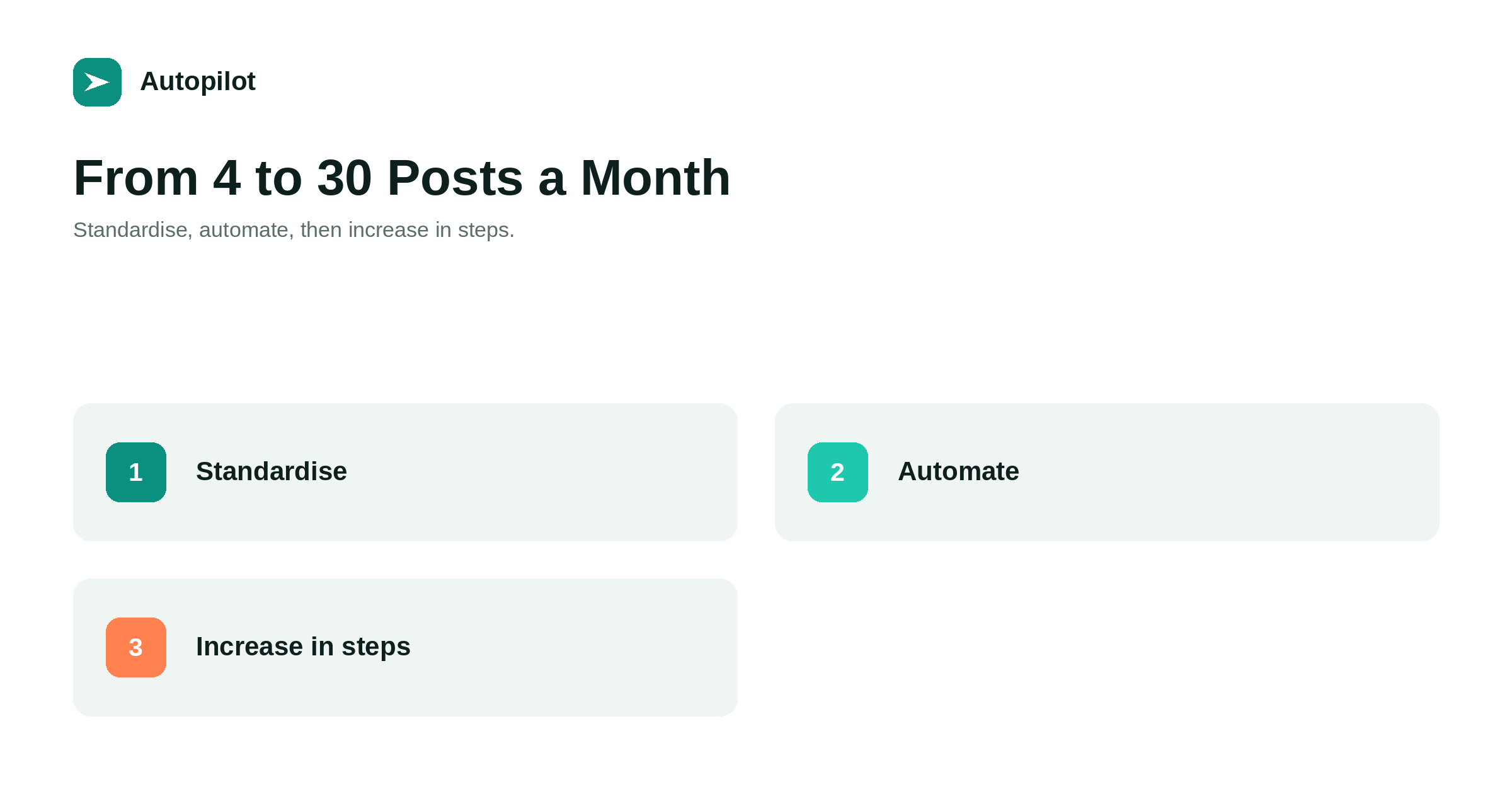
Short answer: at four articles a month, informal processes work; at thirty, they break. Before increasing, standardise the brief, voice guide, style guide and review checklist, and automate drafting, images, publishing and sharing. Plan topics a month at a time against a content inventory so articles do not overlap. Increase in steps — eight, then fifteen, then thirty — moving up only when review keeps pace and quality holds. Review capacity, not drafting, is usually the limit. More articles do not guarantee more results.
A blog that publishes four articles a month can run on good intentions: someone writes, someone reads it, it goes live. At thirty a month, the same approach produces overlapping topics, inconsistent quality and a review backlog that someone quietly stops clearing.
Scaling works when the process scales first and the volume follows.
Do you need thirty?
Start with the question of whether more volume serves the goal. For many businesses, eight good articles a month achieve more than thirty average ones.
Volume helps when there are genuinely many distinct questions to answer, several subjects or languages to cover, or a need to build coverage quickly in a new area. how often to publish covers choosing a pace.
What breaks as volume grows
Different things break at different volumes.
| Volume | What tends to break |
|---|---|
| 4–8 a month | Consistency when someone is busy |
| 10–15 a month | Topic overlap, informal review |
| 20–30 a month | Review capacity, voice consistency |
| 30+ a month | Planning, inventory, quality drift |
Knowing what will break next lets you fix it before it does.
Standardise first
Four documents carry most of the load at volume.
- A brief template with the question, reader, intent and forbidden claims — writing a brief an AI can use.
- A voice guide with rules and examples.
- A style guide for the small decisions — an editorial style guide.
- A review checklist covering accuracy, structure and additions.
With these, anyone on the team, or any tool, produces work that fits.
Automate the mechanical work
At thirty articles a month, doing images, formatting, publishing, social sharing and search engine notification by hand takes a large share of the working month. These steps have no judgement in them and should be automated.
Drafting can be automated too, with review. AI Blog Autopilot’s plans run from 8 articles a month on Starter to 30 on Growth and more on higher plans, as listed on the pricing page; whichever tool you use, the mechanical steps should not consume the time review needs.
Plan against an inventory
At volume, topic overlap is the most common quality problem. Plan a month of topics at once, check each against the content inventory, and make sure every article answers a distinct question.
a content inventory and planning a month of articles cover the tools.
Review is the real limit
Drafting at thirty articles a month is cheap. Reviewing thirty articles properly is not: at twenty minutes each, it is ten hours a month of someone knowledgeable.
Plan review capacity explicitly before increasing volume. Options include more reviewers, lighter review for low-risk categories once evidence supports it, and better instructions that reduce what review has to fix. draft, approve or full auto covers review levels.
Increase in steps
Move from four to eight, hold for a month, then fifteen, then thirty. At each step, check that review keeps pace, quality holds, and topics stay distinct.
If review falls behind or quality slips, stay at the current level until the process catches up. Jumping straight to thirty usually means thirty articles of unknown quality.
Quality checks at scale
At volume, spot checks supplement full review: a sample of published articles read closely each month, checked on a phone, with the findings fed back into the instructions.
quality control at volume covers the checks that keep quality from drifting.
Roles as volume grows
At four articles a month, one person often does everything. At thirty, it helps to separate roles even if the same small team fills them: someone who plans topics and maintains the inventory, someone who reviews for accuracy, and someone who checks published pages and distribution.
Separating roles makes it clear who is responsible for each part, and it prevents the most common failure at volume, where everyone assumes someone else checked. Write down who owns each step, even if the answer is the same name more than once.
Internal linking at volume
Thirty new articles a month means thirty new pages that need links in and out. Without a routine, many become orphans. Build it into the publishing step: each new article links to its pillar and two related articles, and its pillar links back.
Once a month, check for articles with no internal links pointing to them and add some. Internal linking as you publish covers the habit.
Distribution at volume
More articles also means more to distribute. Automatic social sharing handles the baseline for every article, but readers following your accounts do not want thirty near-identical posts a month. Vary the format, spread posts across the day and week, and hand-write promotion for the few strongest articles each month rather than for all of them.
Keeping the archive healthy
At thirty articles a month, the archive grows by several hundred pages a year. Schedule a light audit every six months to catch overlaps and outdated pages early, rather than waiting until the archive is too large to review comfortably.
When to scale back
If outcomes per article fall, review falls behind, or overlaps multiply, reduce volume. Scaling back is a sensible correction, not a failure.
Measure what volume produces
More articles should produce more of the outcome the blog exists for, not just more traffic. Track outcomes per article over time. If they fall as volume rises, the additional articles are not helping.
More volume does not guarantee better results. It creates more chances for good articles to be found, which only helps if the articles are good.
Related reading
If this was useful, these cover the questions that usually come next.
- Quality control at volume — the checks that must scale too
- How often to publish — whether you need 30 at all
- Draft, approve or full auto — review levels at scale
The bottom line
Decide whether more volume serves the goal. Standardise the brief, voice, style and review checklist, automate the mechanical work, and plan against an inventory. Treat review capacity as the real limit, increase in steps, spot-check quality, and measure outcomes per article as volume grows.
الأسئلة الشائعة
How do I increase blog output without losing quality?
Standardise briefs, voice, style and review, automate mechanical steps, plan against an inventory, and increase volume in steps as review keeps pace.
What is the main limit when scaling content?
Review capacity. Drafting is cheap; careful review of many articles takes significant time.
Should I jump straight to 30 articles a month?
No. Increase in steps, holding at each level until review and quality keep pace.
How do I avoid duplicate topics at volume?
Plan monthly against a content inventory, checking that each article answers a distinct question.
What should be automated when scaling?
Images, formatting, publishing, social sharing and search notification, and drafting with review.
Does publishing more guarantee more traffic?
No. More good articles create more chances to be found; more weak ones do not help.