ENEnglish
 LTLietuviškai
 DEDeutsch
 FRFrançais
 RUРусский
 ESEspañol
 PLPolski
 ITItaliano
 UKУкраїнська
 CSČeština
 PTPortuguês
 JA日本語
JA日本語 LVLatviešu valoda
 ETEesti
 HUMagyar
 IDBahasa Indonesia
 TRTürkçe
 HIहिन्दी
 ELΕλληνικά
 ARالعربية
 THไทย
THไทย VITiếng Việt
 RORomână
 MSBahasa Melayu
 BNবাংলা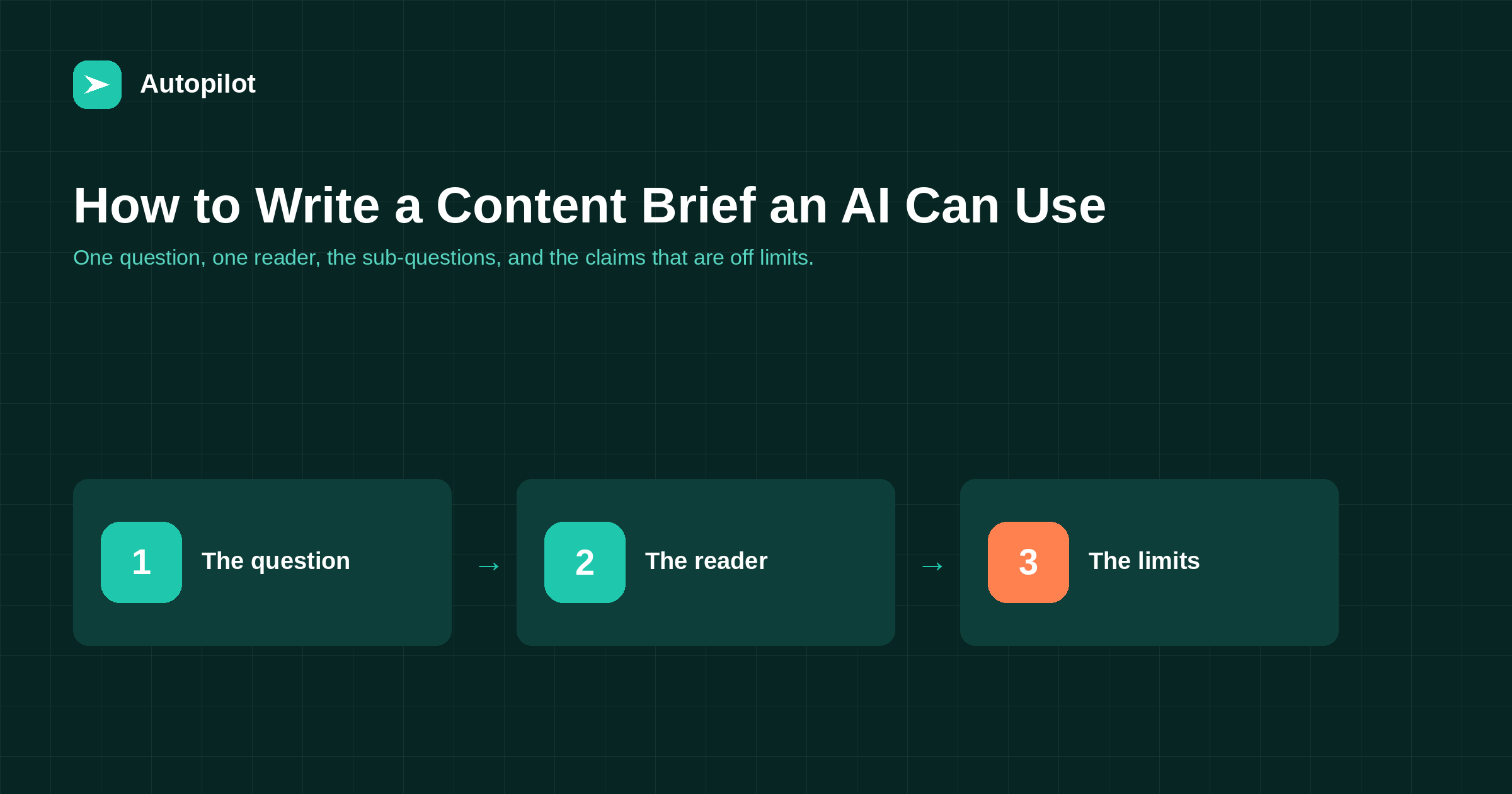
Short answer: write the question the article must answer, who is asking it, the sub-questions that become sections, and the claims that are off limits. That is the whole brief. A list of keywords is not a brief, and a word count is the least useful line in one, because length should follow the question rather than lead it. The same brief works whether a person or a tool writes the draft, which is a good test of whether it is written well.
Most disappointing articles are traceable to the brief, not the writer. "Write about email marketing, 2,000 words, include the keyword five times" will produce exactly what it describes: two thousand words about email marketing that answer nothing in particular.
A good brief is short and specific. Here is what goes in it.
The four lines that matter
1. The question. One sentence, phrased the way a reader would ask it. Not "email marketing" but "how often should we email our list without people unsubscribing?". If you cannot phrase it as a question, the topic is not ready.
2. The reader. Who is asking, and what they already know. An article for a marketing director and an article for a shop owner answer the same question differently, and the difference is not vocabulary but which steps you can skip.
3. The sub-questions. Three to six things the reader will want to know next. These become the sections, which is why listing them is the single highest-value line in a brief.
4. The limits. Claims that must not appear: numbers you cannot support, competitors you will not name, promises you cannot keep.
What to leave out
Briefs get worse as they get longer. Three common additions that subtract.
Keyword lists with counts. Search engines stopped counting a long time ago, and writing to a count produces sentences bent around a phrase. Name the query once, in the question.
Word counts. The right length is whatever answering the sub-questions honestly takes, which is the argument in how long a post should be. A range is fine as a sanity check; a target is an instruction to pad.
Adjectives about tone. "Engaging, authoritative, friendly" means nothing operationally. Two example sentences you would and would not publish mean a great deal.
Tone, in a way that is actually usable
Tone travels best as rules and examples rather than descriptions.
- One sentence you would publish. Real, from your site.
- One you would not. Usually the marketing sentence that makes everyone wince.
- Words you never use. Every company has three or four.
- How you refer to the reader. Second person, third person, plural.
- Whether you admit limits. Most brands say yes and then never do it; if you mean it, say so explicitly.
Five lines, written once, applied to everything afterwards.
A brief that works, next to one that does not
| Weak brief | Usable brief | |
|---|---|---|
| Topic | Email marketing | How often to email a list without losing subscribers |
| Reader | Everyone | Shop owner with a list of a few thousand |
| Structure | Not specified | Six named sub-questions |
| Length | 2,000 words | As long as the six sections need |
| Keywords | Five mentions of the phrase | The question, phrased naturally |
| Limits | None | No open rate benchmarks we cannot source |
The right-hand column takes about ten minutes and is reusable: the reader, the tone and the limits stay the same across every article, so only the question and the sub-questions change.
Reusing the brief across a whole blog
Split the brief in two. The standing part — reader, tone, limits, structure conventions — is written once and applies to everything. The per-article part is the question and its sub-questions, which is small enough to write in two minutes.
That split is exactly how an automated blog is configured: the standing brief is set up once, and each topic in the queue carries its own question. Autopilot works this way, with the article structure — sections, FAQ, meta description — applied consistently so only the thinking changes per piece. The details of what each plan allows are on the pricing page.
One more habit worth adopting: when an article comes back wrong, fix the brief rather than the article. Fixing the article solves one problem; fixing the brief solves it for every article after.
The rules worth writing down once
Beyond tone, most teams have a handful of standing rules that exist only in someone’s head until the day they are broken. Writing them into the standing brief takes ten minutes and prevents the whole category of problem.
The ones that come up most often: which competitors may be named and how; whether prices may appear in articles at all, or only a link to the pricing page; whether statistics require a source link; how the company name is written; and whether the articles speak as a company or as a person.
None of these are creative decisions, which is exactly why they should be written down rather than re-litigated per article. Once they are in the standing brief, every future piece inherits them, including the ones written on a week when nobody had time to check.
One brief, many languages
If you publish in more than one language, keep the standing brief shared and the sub-questions separate. Tone, limits and structure conventions travel; the questions usually do not, because markets ask different things and phrase them differently. Translating a brief produces articles that answer an English question in another language, which is the most common reason a multilingual blog underperforms despite being well written.
The bottom line
A brief is four things: the question, the reader, the sub-questions and the limits. Write the standing half once and the per-article half in two minutes. Leave out the keyword counts and the word targets, because both push writing away from the answer. When something comes back wrong, fix the brief, and the problem stops recurring.
الأسئلة الشائعة
How long should a content brief be?
Short. A question, a reader, three to six sub-questions and any limits. If it runs past a page, most of it is standing information that belongs in a shared brief instead.
Should I include keywords at all?
Name the query once, phrased as the question. Lists with target counts produce awkward writing and have not helped rankings for years.
Do I need a different brief for each language?
The standing part translates; the sub-questions often do not, because markets ask different things. That is the argument for writing natively rather than translating.
Who should write the brief?
Whoever talks to customers. The sub-questions come from real conversations, which is why a brief written by someone who never hears from customers tends to be generic.
Can I skip the brief if the topic is obvious?
You can, and the article will be obvious too. The sub-questions are what separate a useful piece from a competent summary of what everyone already knows.
What if the article still comes back wrong?
Change the brief, not the article. A fix applied to the brief improves everything published afterwards; a fix applied to one article improves one article.