ENEnglish
 LTLietuviškai
 DEDeutsch
 FRFrançais
 RUРусский
 ESEspañol
 PLPolski
 ITItaliano
 UKУкраїнська
 CSČeština
 PTPortuguês
 JA日本語
 LVLatviešu valoda
 ETEesti
 HUMagyar
 IDBahasa Indonesia
 TRTürkçe
 HIहिन्दी
 ELΕλληνικά
 ARالعربية
 THไทย
 VITiếng Việt
 RORomână
 MSBahasa Melayu
 BNবাংলা
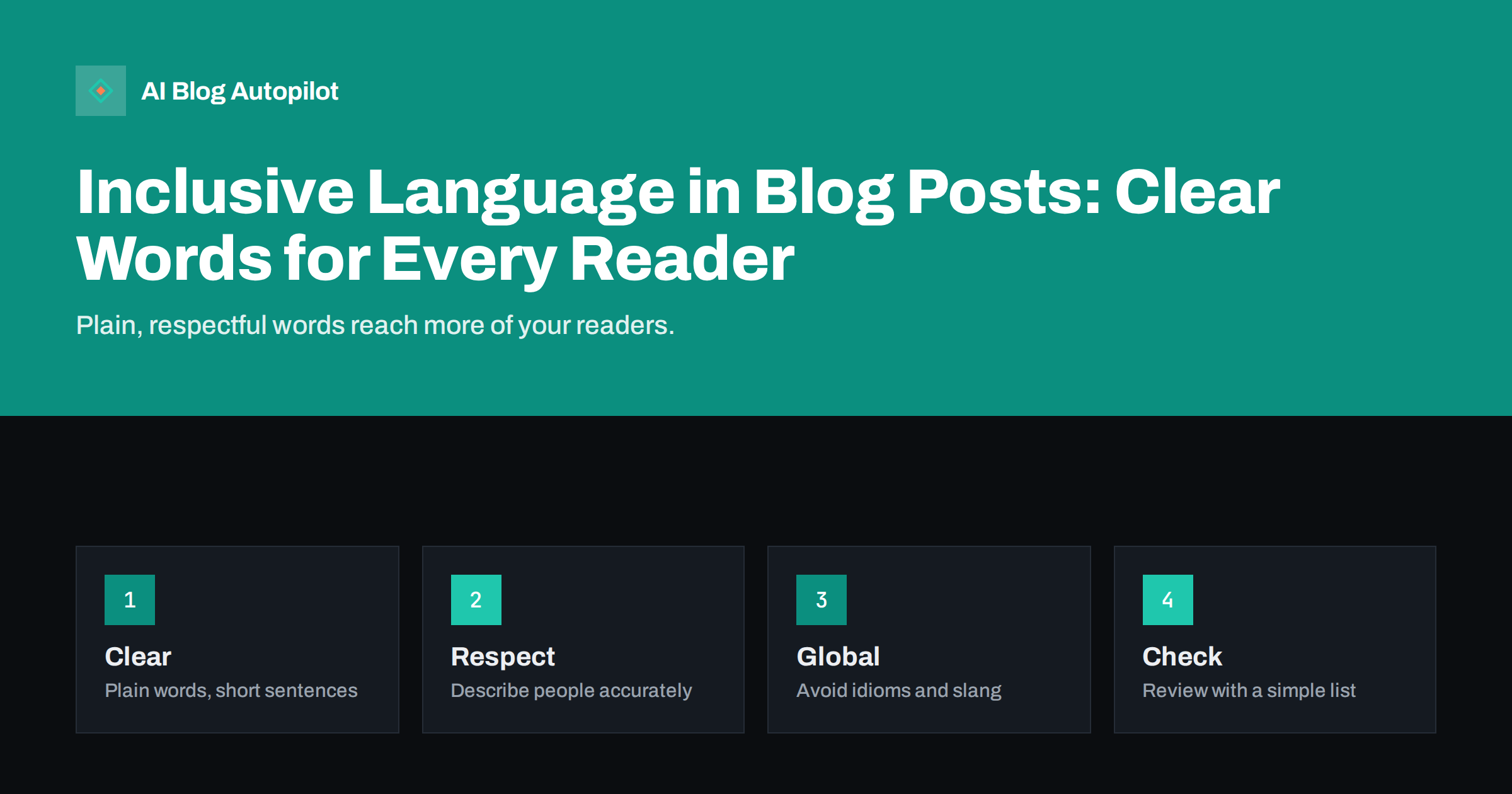
Short answer: inclusive language is writing that is clear, accurate and respectful, so that more people can understand your article and feel it was written for them. In practice, it means plain words, no unneeded assumptions about gender, age, ability or culture, describing people the way they describe themselves and avoiding idioms that confuse international readers. It does not mean stiff wording or long disclaimers, and it fits well with good business writing.
A blog post reaches people with different backgrounds, languages, abilities and experiences. Some read in a second language, some use assistive tools, some are new to your field and some are experts. Words that seem neutral to the writer may confuse, exclude or annoy part of that audience.
This guide sets out a practical approach for business blogs. It avoids political arguments and focuses on a simple question: will this sentence be understood and accepted by the people I want to reach? Teams that ask this question tend to write better articles for everyone.
Why it matters for a business blog
Readers who feel addressed stay longer, trust more and are more likely to act. Readers who feel ignored or talked down to leave, and they rarely tell you why. An article that assumes the reader is a man, or young, or a native speaker of English, may lose buyers who are none of these.
There is also a practical side. Clear and simple language is easier to translate, easier to read aloud with a screen reader and easier for search and AI systems to interpret. The advice in the guide to readability and reading level overlaps with inclusive writing at almost every point.
Finally, there is reputation. A careless phrase in a published post can cause complaints, and an automated or hurried process can make this more likely. A short review step is cheaper than an apology.
Read your draft aloud before you publish it. Sentences that make you stumble usually make readers stumble as well, and they are the best candidates for a rewrite. If you can, ask someone outside your field to read the first two paragraphs and tell you what they understood.
Write plainly
The first rule of inclusive writing is also the first rule of clear writing: use common words, short sentences and one idea per paragraph. Replace jargon with plain terms, or explain it the first time it appears. Spell out abbreviations at first use, and avoid insider shorthand that only your team knows.
Prefer active verbs and direct statements. “Send us the file” is easier to understand than “the file should be forwarded to us by the client”. Plain sentences also reduce the chance that a reader with a different mother tongue will misread your meaning.
Avoid long strings of nouns, double negatives and sentences that make the reader wait for the point. If a sentence takes two readings to understand, rewrite it. The article on writing for non-native English readers contains many examples of simple changes that keep the tone natural.
Be careful with assumptions about people
Many sentences assume things about the reader. “Ask your wife”, “when you were at school” or “as a young entrepreneur” all assume facts that may not be true. Rewrite them so that they fit any reader: “ask your partner”, “in your early career” or “as an entrepreneur”.
When you refer to an individual of unknown gender, use “they” or rewrite the sentence in the plural or in the second person. Avoid titles and forms that mark gender when they are not needed. For job titles, prefer neutral forms, such as “chair” or “salesperson” where they are natural in your market.
Examples matter. If every example in your article features the same kind of person, such as a male manager and a female assistant, you are reinforcing an assumption. Vary names, roles and situations in a natural way, and keep the examples relevant to the point.
Avoid stereotypes about age, nationality, religion and other characteristics, even in jokes or as shorthand. Describe a situation by what happened and not by who was involved, unless the detail is relevant.
Take care with images that accompany the text. If every picture shows the same type of person, or if people appear only in stereotyped roles, the visuals may undo the care you took with the words. Choose photos and illustrations that show a range of people doing real work, and write alt text that describes what matters without guessing about identity.
Describe people and abilities accurately
When you need to refer to a group, use the term that the group itself uses, and avoid labels that define a person by a condition. Many style guides suggest naming the person first, or describing the situation, such as “people who use screen readers” instead of “the blind”. Preferences differ between communities and countries, so check a trusted source when you are unsure.
Do not use medical or disability terms as casual metaphors. Phrases that compare a problem to an illness or a condition are common, but they can hurt people who live with it. Choose a plain word for the problem instead, such as “unreliable”, “confusing” or “broken”.
Describe accessibility as a feature that benefits everyone and not as a favour for a small group. If you write about a product or a service, state clearly what it offers for users with different needs, and do not claim more than is true. The article on accessibility for a blog covers the technical side of a page that works for all readers.
Think globally
If your readers live in several countries, local references can exclude them. Sports metaphors, cultural events, holidays, local brands and idioms do not travel well. “Hit a home run”, “drop the ball” or “a Hail Mary” mean nothing to many readers, and they are hard to translate.
Write dates, numbers and units in a way that cannot be misread. Spell out the month, say which currency you mean and give both metric and other units when your audience needs them. Use “autumn” or “fall” depending on your market, or choose a form that is clear in context.
Be wary of humour and wordplay. Both depend heavily on culture and language, and automated translation often breaks them. If you publish in several languages, have each version checked by a native speaker, as discussed in the guide to translating or writing natively in each language.
Think about reading level as part of inclusion. A dense article full of long sentences excludes people with less time, less background or a different first language. You do not need to write for children. You need to write so that an intelligent reader who is new to the subject can follow. Define terms, give one example for each abstract idea and keep paragraphs short enough to scan.
Be careful with calls to action. Phrases such as “don’t miss out” or “only fools ignore this” use pressure and shame, and they push away careful readers. A calm invitation, such as “read the full guide” or “see how it works”, is easier to accept and works just as well.
Avoid tone problems that exclude
Some phrases make readers feel stupid or unwelcome: “obviously”, “simply”, “just”, “everyone knows” and “as any professional would say”. If something is obvious to you, it may not be to the person reading it, and this kind of word can make them feel behind. Remove them and explain the point.
Watch for terms of war and violence in everyday business writing, such as “kill the competition” or “attack the market”, if they do not fit your brand. This is a matter of taste and audience, but a calmer choice of words often reads better and reaches a wider group.
Address the reader as an equal. Offer help, give reasons and respect the reader’s time. The guide on adjusting tone for different readers shows how to keep one voice while changing the level of detail.
Test your pages with real tools. Run a text through a readability check, listen to the article with a screen reader for a minute and look at how it appears on a small screen. Hearing the text read aloud often reveals phrases that look fine on the page but sound clumsy or confusing. These checks take minutes and teach writers a lot about how other people experience their words.
Be consistent across channels. If your blog uses plain, respectful language but your social posts or your emails use slang and assumptions, readers will notice the mismatch. Put the same rules in the guidelines for every channel, and make sure that anyone who writes on your behalf, including agencies and freelancers, has read them.
Build it into your editing process
Add a short inclusive-language check to your style guide and your pre-publication list. A good version has five questions: Are the words plain? Does any sentence assume something about the reader? Are people and groups described accurately? Would an international reader understand every phrase? Are the examples varied and relevant?
Keep a list of words and phrases you want to avoid, with suggested alternatives. Share it with writers and editors, and update it when you learn something new. The article on an editorial style guide in one page shows where such a list fits.
Ask readers. A line in your contact page that invites feedback gives people an easy way to point out a problem. Respond politely, correct the text if the comment is right and thank the person. Do not turn a good-faith note into an argument.
How AI Blog Autopilot helps
AI Blog Autopilot lets you set topics, audience and tone, and it writes full articles in 25 languages with FAQ sections, tags and SEO meta. Add your own language rules to the tone settings and review drafts with the checklist above before they go live. See the pricing page for plans and the languages available on each.
Related reading
- Readability: Writing So People Finish the Article
- Writing for Non-Native English Readers Without Dumbing Down
- An Editorial Style Guide in One Page
The bottom line
Write plainly, avoid assumptions, describe people accurately and think about readers in other places. A short checklist in your editing process makes it routine.
الأسئلة الشائعة
Does inclusive language mean using stiff or formal wording?
No. It usually means plainer wording. Clear, short sentences reach more readers.
Is inclusive language a ranking factor?
Not directly. It helps readability, trust and engagement, which support how a page performs.
What should I do about idioms?
Replace them with plain statements if your readers are international, or explain them when they add colour to the text.
How do I refer to a person whose gender I do not know?
Use “they”, rewrite the sentence in the plural or address the reader directly.
Who should check a draft for these issues?
The editor can do it with a short checklist, and a native speaker should review each language version.