ENEnglish
 LTLietuviškai
 DEDeutsch
 FRFrançais
 RUРусский
 ESEspañol
 PLPolski
 ITItaliano
 UKУкраїнська
 CSČeština
 PTPortuguês
 JA日本語
JA日本語 LVLatviešu valoda
 ETEesti
 HUMagyar
 IDBahasa Indonesia
 TRTürkçe
 HIहिन्दी
 ELΕλληνικά
 ARالعربية
 THไทย
THไทย VITiếng Việt
 RORomână
 MSBahasa Melayu
 BNবাংলা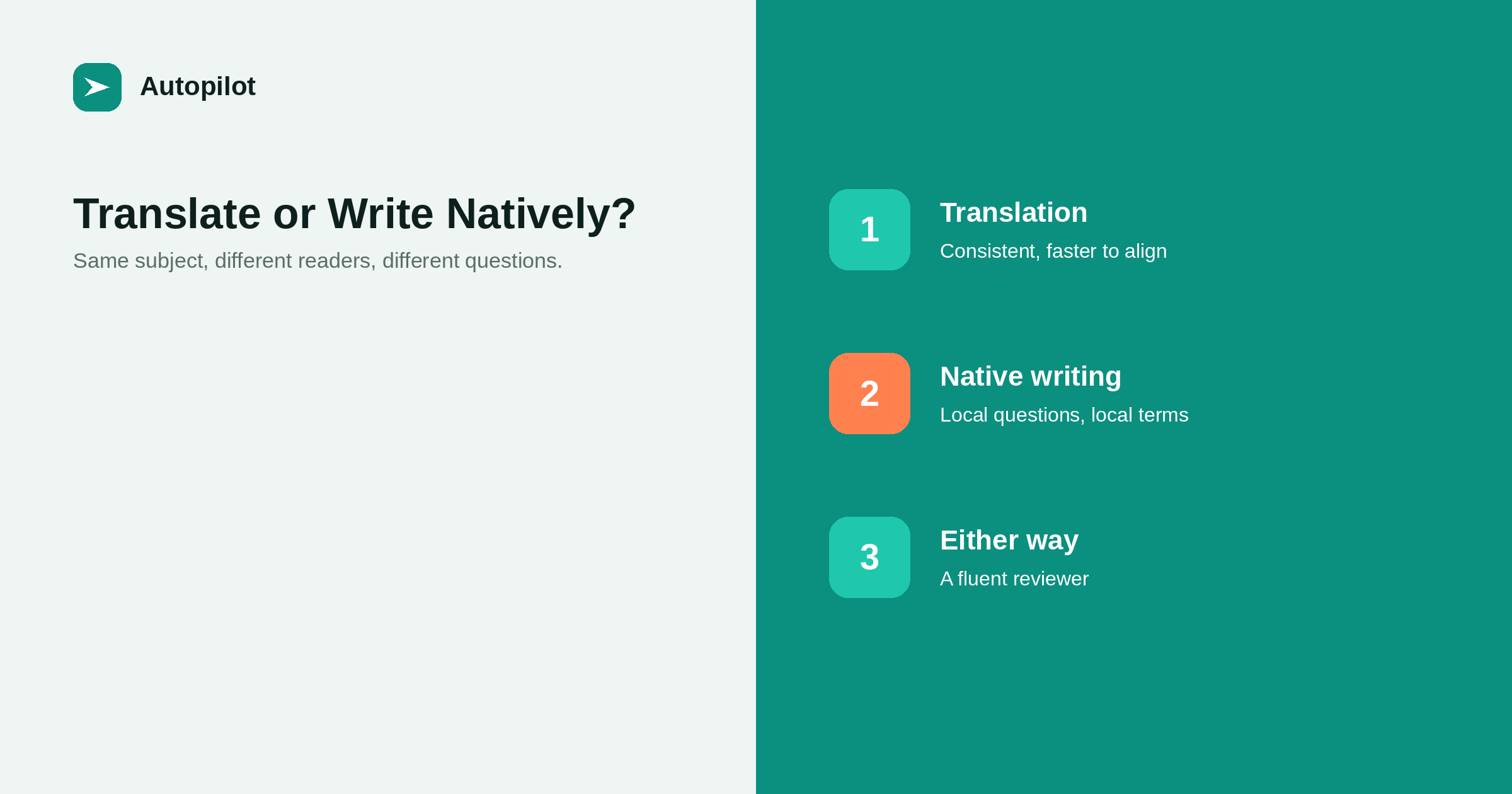
Short answer: translation keeps every language version aligned with the original, which suits product documentation, legal pages and anything that must say exactly the same everywhere. Writing natively in each language starts from what local readers search for, the terms they use, and local examples, which usually reads better and matches local search behaviour more closely, at the cost of versions diverging. Many sites combine them: translate core pages, write blog articles natively. Either way, have someone fluent review what is published.
When a blog expands into more languages, the first instinct is to translate the English articles. It is logical, consistent, and often produces articles that read like translations and answer questions local readers are not asking.
The alternative — writing natively in each language from local research — has its own costs. The right choice depends on what the content is for.
What translation does well
Translation keeps versions aligned. Every reader gets the same information, updates can be applied across languages systematically, and the versions link neatly with hreflang.
That is essential for some content: product documentation, pricing, terms, policies, and anything where differences between versions would cause confusion or legal risk.
Where translation falls short
For blog articles meant to be found in search, translation has predictable weaknesses.
- Different questions. Readers in another market often ask different questions, or the same question in terms that do not map directly.
- Different search terms. The literal translation of an English phrase may not be what people search for locally.
- Foreign examples. Currencies, regulations, platforms and cultural references that do not apply.
- Translated tone. Sentence structures that read naturally in English but awkwardly elsewhere.
What native writing does well
Writing natively starts from local research: the questions local readers ask, the terms they use, the regulations and examples that apply to them. The article is written for that reader from the beginning.
It usually reads better, matches local search behaviour more closely, and can cover subjects that matter locally but have no English equivalent. It is the approach this blog’s publishing tool is built around — publishing in several languages covers the reasoning.
The costs of native writing
Native versions diverge. The German article on a subject may differ in structure and emphasis from the English one, which is intended, but it means updates cannot simply be copied across.
It also needs local topic research for each language, and a fluent reviewer for each. And when versions diverge substantially, they should not be linked with hreflang as equivalents — hreflang explains why.
A combined approach
Many businesses use both, by content type.
| Content | Approach |
|---|---|
| Product pages, pricing, terms | Translate, keep aligned |
| Help documentation | Translate, adapt examples |
| Blog articles | Write natively from local questions |
| Core guides on universal subjects | Translate and localise, or write natively |
That keeps the pages where consistency matters consistent, and lets the pages meant to attract local readers be written for them.
Localisation, in between
Localisation is translation plus adaptation: changing examples, currencies, regulations and references to suit the market, and rephrasing where a literal translation reads badly.
It works well for evergreen guides on universal subjects, where the questions are similar across markets but the details differ. It still starts from the English structure, so it will not surface questions only local readers ask.
Automation and languages
Automated drafting makes both approaches cheaper. The difference between them is in the instructions: translate this article, versus research and write an article for readers in this market on this subject.
Either way, a fluent reviewer matters more than in a single language, because errors of idiom, terminology and local fact are harder for a non-speaker to spot. AI Blog Autopilot writes in 25 languages from the Pro plan, listed on the pricing page; the review step still applies.
Local research for each language
Writing natively depends on knowing what local readers search for. The same free methods work in any language: search suggestions, the people also ask box, related searches, and Search Console filtered by country once you have some traffic.
Local customers and partners are the best source of all. A short conversation with someone who sells in that market usually reveals questions and terms that no amount of translation would have produced. Record them in the same question bank you use for your main language, marked by market.
Local competitors are worth reading too, for the same reasons as in your main market: to see what is covered, what is missing, and what format the results favour.
Keeping versions manageable
Natively written versions diverge, so keep a simple record of which articles exist in which languages, which are linked as equivalents, and when each was last reviewed. Without it, a site in several languages quickly becomes hard to maintain, with outdated versions nobody remembers to update.
Terminology lists
For each language, keep a short list of your key terms and how you translate or render them: product names, feature names, technical terms. Some should stay in English; others have established local equivalents that readers expect.
The list keeps terminology consistent across articles and reviewers, and it is one of the most useful instructions to give any writer or tool working in that language. A reader who meets three different words for the same feature in three articles loses trust quickly.
Deciding
Ask what each piece of content is for. If it must say the same thing everywhere, translate. If it exists to be found by local readers searching local questions, write natively. If it is a universal guide, localise.
No approach guarantees visibility in another market. Content that answers local readers’ actual questions in their own language simply has a better chance.
Related reading
If this was useful, these cover the questions that usually come next.
- Publishing in several languages — the wider approach
- Choosing which languages to publish in — the decision before this one
- Hreflang — linking versions correctly
The bottom line
Translate content that must be identical everywhere, such as product pages, pricing and terms. Write blog articles natively from local questions and terms, and localise universal guides. Link versions with hreflang only when they are genuinely equivalent, and have a fluent reviewer check every language you publish.
الأسئلة الشائعة
Should I translate my blog posts or write new ones?
For articles meant to attract local readers, writing natively from local questions usually works better. Translate content that must be identical in every language.
What is the difference between translation and localisation?
Localisation adapts a translation for a market, changing examples, currencies, regulations and phrasing, while keeping the original structure.
Do translated articles rank well?
They can, but they may target terms local readers do not use and miss questions local readers ask. Native articles tend to match local search behaviour more closely.
Should natively written versions be linked with hreflang?
Only if they genuinely answer the same question. Substantially different articles should be treated as separate pages.
Do I need a fluent reviewer for each language?
Yes, ideally. Errors of idiom, terminology and local fact are hard for non-speakers to spot.
Can automation handle multilingual content?
It can draft in many languages, either by translating or by writing natively. Review by a fluent speaker remains important.