ENEnglish
 LTLietuviškai
 DEDeutsch
 FRFrançais
 RUРусский
 ESEspañol
 PLPolski
 ITItaliano
 UKУкраїнська
 CSČeština
 PTPortuguês
 JA日本語
 LVLatviešu valoda
 ETEesti
 HUMagyar
 IDBahasa Indonesia
 TRTürkçe
 HIहिन्दी
 ELΕλληνικά
 ARالعربية
 THไทย
 VITiếng Việt
 RORomână
 MSBahasa Melayu
 BNবাংলা
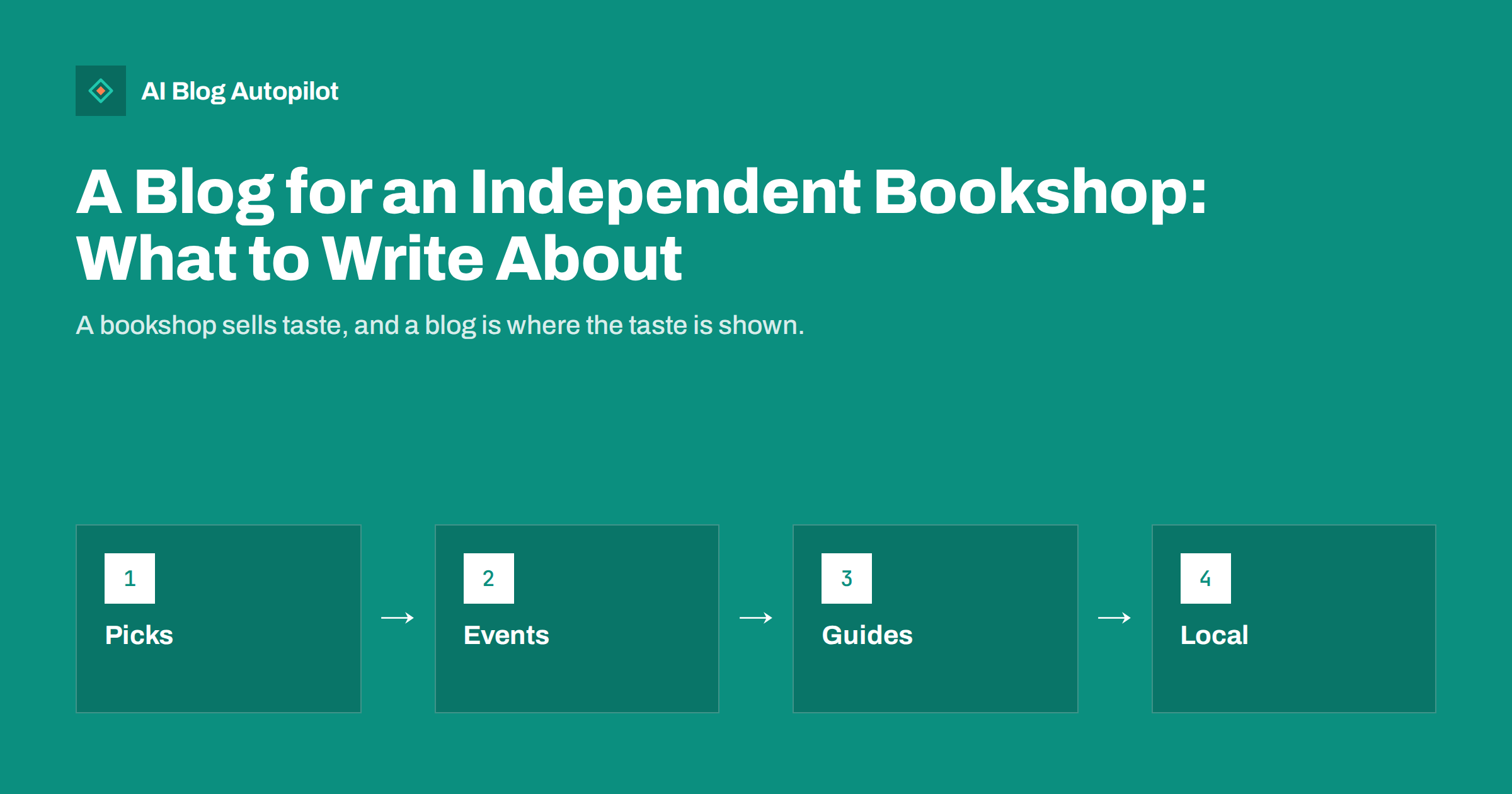
Short answer: an independent bookshop blog works when it shows the judgement of the people behind the counter: honest recommendations with reasons, pages for events and book clubs, gift and reading guides, and clear answers about ordering and opening hours. Write like a bookseller talking to a customer, link each page to the books or events it describes, and keep the facts current.
Online retailers can list every title, but they cannot tell a reader which book suits a difficult flight or a twelve-year-old who does not like reading. That is the independent shop’s advantage, and a blog is a way to show it to people who have never visited. The aim is not to compete on catalogue size. It is to be the trusted voice for a town, a genre or a reader’s next choice.
Recommend with reasons, not just titles
A list of covers is easy to find anywhere. A recommendation that says who the book is for, what it is like and what to expect is something only a person who has read it can write. Describe the mood, the pace, the length and the kind of reader who will enjoy it, and mention honestly who might not. Readers trust a bookseller who admits that a famous novel is hard going in the middle.
Keep the tone personal and attach a name to each pick, so that regulars learn whose taste matches theirs. Short pieces of two or three hundred words are enough. Avoid quoting long passages or copying the publisher’s blurb, which is not your own writing and gives readers no reason to prefer your page. The advice in our guide to writing a fair comparison article applies when you set two books side by side.
Build reading lists around real needs
People search for books by situation more often than by title: books for a long train journey, novels set in a particular country, first science fiction for a teenager, gentle reads for a hospital stay. Each of these can become a page with ten or twelve books, a line on each and a reason for the choice. Such pages are useful, shareable and easy to update when new books arrive.
Group the lists by genre, age and occasion, and keep a permanent page for each so that it can grow over the years. Add the date of the last update and remove titles that are no longer easy to buy. Where a book is out of print, say so rather than sending readers to a dead end. Our piece on seasonal content planning helps you time gift lists before the holidays.
Do not be afraid of short reviews. A recommendation of one hundred and fifty words, written the week you finish the book, has a freshness that a polished essay often lacks. Consider a regular feature such as a staff pick of the month or a “book I pressed into every hand this week”, which gives readers a reason to return and gives you a simple format to repeat without much planning.
Be generous with the categories that large sellers neglect: translated fiction, poetry, local history, small presses, children’s picture books and books in other languages spoken in your area. Customers interested in these subjects often struggle to find a trustworthy guide, and a shop that writes about them well becomes the first place they check. Mention when a title is hard to find elsewhere, and offer to order it.
Give every event its own page
Signings, readings, children’s story hours and book clubs bring people into the shop, and each deserves a page that remains after the evening. Include the date, the time, the place, the price or whether it is free, how to reserve, whether the venue is accessible and what happens if the author cancels. Add a short note on who the author is and why the shop chose them.
After the event, update the same page with a short report, a photograph and the books discussed, instead of deleting it. That gives a record of your cultural role and a source of content for later years. Our guide to event recaps as blog posts describes how to write them so that they keep earning visits. Always ask permission before showing the faces of guests, especially children.
Plan the year around the dates when people buy books for others. Gift lists for the winter holidays, summer reading, school reading lists, prize announcements and back-to-school titles all follow a predictable calendar. Write the page a month or two before the date, share it early and update it as stock arrives. Remember that a prize shortlist can change the demand for a book overnight, so a page that explains the shortlist and says which titles you have in stock is of real use to customers.
Answer ordering and stock questions
Many customers do not know that a shop can order any book in print. A clear page that explains how to ask for a title, how long it usually takes, whether you post books, how to pay and how to reserve a copy turns a vague hope into a purchase. Place this information where people will find it, and repeat the key points in a short FAQ.
If you offer gift vouchers, subscriptions or a monthly book box, give each its own page with the price, the terms and the date of the last check. Avoid promises about delivery that you cannot keep at busy times, and say plainly when the last orders for the holidays are accepted. Honest limits earn more repeat business than optimistic claims.
Think about what a visitor needs to know: whether the shop is easy to reach on foot, where to park, whether the entrance has steps, whether children’s books are on the ground floor and whether there is somewhere to sit with a coffee. These details are seldom on a catalogue site, and they decide whether a person who has never visited will make the trip. Photographs of the entrance and the main room reassure readers and reduce uncertainty.
Write about your town and your community
A bookshop is part of a place. Guides to local authors, books set in the region, school partnerships, reading groups and the history of the building give the shop a story that national sellers cannot copy. They also attract links from local groups, libraries and newspapers, which is useful for search and for visibility in the community.
Use the same details on your pages and on your Google Business Profile so that the opening hours, address and phone number always match. Our article on reusing blog posts locally shows how to share new pages there. For a wider plan, read our blog strategy for a local business.
Let readers take part
Readers love to talk about books. Invite them to send a short recommendation, vote on the next book club title or share what they read on holiday, and publish the best contributions with their permission. Keep the rules simple: a name or initials, a few sentences and your right to edit for length. This builds loyalty and gives you content that costs little to produce.
Moderate carefully and avoid spoilers by asking contributors to mark them. If you accept longer guest reviews, label them clearly as a reader’s view. The approach is described in our guide to customer stories and contributions on a business blog, and it works well alongside simple polls on social media.
Turn posts into a newsletter
For a bookshop, email is often the most valuable channel, because readers who sign up want to hear from you. A monthly message with three recommendations, the next events and one personal note is enough. Pull the content from the blog so that you write each item once and use it twice. Our guide to building a newsletter from your blog posts shows the steps.
Ask for permission clearly, keep a simple way to unsubscribe and never add people because they bought a book once. Keep the message short and let the writing carry the personality. A small list of engaged readers is worth far more than a large list that never opens the email.
Measure the results in simple terms. Count the people who mention a page at the counter, the visits to the ordering page, the sign-ups to the newsletter and the attendance at events that were announced online. You do not need a complicated report. A short note each quarter on what worked, what was ignored and what customers asked about is enough to decide what to write next, and it keeps the blog tied to the business rather than to guesswork.
Keep the work sustainable
Booksellers are busy, and the blog should fit around the shop. Set a modest rhythm, such as two pages a month, and write ahead of busy periods. Keep a notebook at the till for questions customers ask and books they ask about, and turn the best of them into pages. Share the writing among the staff so that no one carries it alone and so that readers meet more than one voice.
Review the site twice a year. Update the event pages, check the opening hours, remove titles that have gone out of print and refresh the photographs. Accuracy matters more than volume, and a small blog that is always correct builds trust that a large neglected one loses.
How AI Blog Autopilot helps
AI Blog Autopilot writes full SEO articles for your WordPress blog from the topics, keywords, audience and tone you set, with FAQ sections, tags and SEO meta included, and it shares each one to your social networks. For a shop with no time to write, reading lists and local guides keep appearing while you serve customers. Approval mode lets you read each article first, which matters for event dates, prices and the titles you recommend. See the pricing page for plans.
Related reading
- Blog Strategy for a Local Business
- Building a Newsletter From Your Blog Posts
- Customer Stories and Contributions on a Business Blog
- Webinar and Event Recaps as Blog Posts That Earn Search Traffic
The bottom line
A bookshop blog should show the shop’s taste and its place in the town. Recommend with reasons, build lists around real needs, give each event a lasting page, explain ordering, involve readers and feed a short newsletter. Keep it accurate and sustainable.
الأسئلة الشائعة
What should a bookshop blog publish first?
Start with a page explaining how to order any book, your opening hours and one reading list for a popular occasion such as holiday gifts.
Can I reuse publisher blurbs?
It is better to write your own short description. Your own words show your judgement and avoid copying text that appears on many other sites.
How do I promote events on the blog?
Give each event a page with date, place, price and booking details, then share it and update it afterwards with a short report.
How often should a small bookshop post?
Two useful pages a month, written ahead of busy periods, are enough. Regular and accurate beats frequent and rushed.
Is a newsletter better than social media for a bookshop?
Often it is more reliable, because readers choose to receive it. Many shops use both and draw the content from the same blog posts.