ENEnglish
 LTLietuviškai
 DEDeutsch
 FRFrançais
 RUРусский
 ESEspañol
 PLPolski
 ITItaliano
 UKУкраїнська
 CSČeština
 PTPortuguês
 JA日本語
 LVLatviešu valoda
 ETEesti
 HUMagyar
 IDBahasa Indonesia
 TRTürkçe
 HIहिन्दी
 ELΕλληνικά
 ARالعربية
 THไทย
 VITiếng Việt
 RORomână
 MSBahasa Melayu
 BNবাংলা
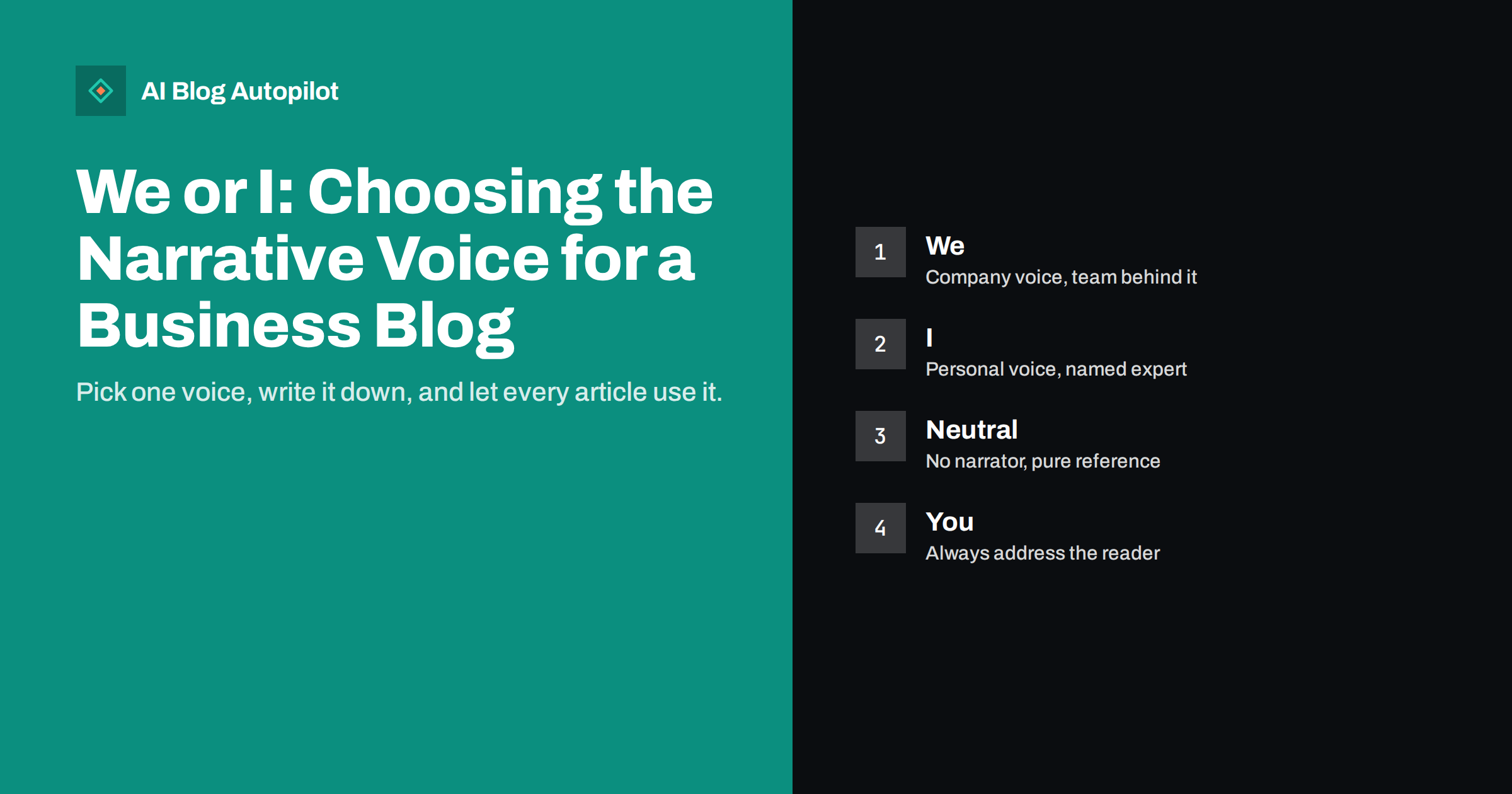
Short answer: “we” is the right default for most business blogs, because it presents the content as the view of a company with a team behind it and works regardless of who wrote the article. “I” suits blogs built around one named expert, founder or consultant, where the person is the reason readers trust the content. A neutral voice with no narrator suits documentation, glossaries and reference articles. Whichever you choose, address the reader as “you”, decide the voice once, write it into your style guide and apply it to every article, including the ones produced with automation, so that the blog sounds like one source rather than several.
The question seems small, and most blogs settle it by accident: the first writer used “I”, the second used “we”, a later one avoided both, and now the archive sounds like a group of strangers. Readers notice. The narrative voice tells them who is speaking, how much weight to give the opinions in the text and what kind of relationship the blog offers. It also affects how automated articles are perceived, since a byline, a voice and the sentence “we” are claims about who stands behind the words. This article sets out the options, the trade-offs and how to decide for your own blog.
The three voices and what each signals
“We” says that a company is speaking. It carries the credibility of an organisation, it does not depend on any individual staying in the job, and it lets several authors contribute without the voice changing. Its weakness is distance: “we” can sound corporate, and it invites the question of who exactly “we” are.
“I” says that a person is speaking. It is warm, direct and credible when the person is a recognised expert or the founder whose name is the brand. It also carries risk: it needs a real, named person behind it, it dates quickly if that person leaves, and it is awkward when articles are written by others on their behalf.
Neutral uses no narrator at all. “The settings page shows”, “a canonical tag tells search engines”. It reads as reference material, which is exactly right for documentation, definitions and explainers that should feel like the manual rather than an opinion. Over a whole blog it can feel impersonal, and it offers nowhere to put experience, judgement or stories.
Most blogs end up with one primary voice and a defined exception, such as “we” for the blog and neutral for the help centre.
Which voice suits which business
The choice follows from who readers should trust and why.
- Companies with a team and a product: “we”. Readers want to know the organisation stands behind the advice, and the team changes over time.
- Consultants, coaches, lawyers, accountants and other named professionals: “I”, with the name and credentials visible. The person is the product.
- Agencies: “we” for the agency’s own blog; the voice of the client when writing for them.
- Founder-led brands where the founder is public: “I” for personal essays and opinion, “we” for product and company news, with both clearly labelled.
- Documentation, glossaries and support articles: neutral, whoever the company is.
- Multi-author expert blogs with real bylines: “I” per author, with “we” reserved for editorial notes and company statements.
Our article on bylines and author bios covers the related question of who should sign an article, including an automated one.
“You” is not optional
Whatever narrator you choose, the reader should be “you”. Second person keeps advice concrete, forces the writer to think about the reader’s situation and makes instructions clearer. “Check your robots.txt file” is better than “site owners should check their robots.txt files” in nearly every context. The exception is reference material, where “the” and passive constructions are sometimes clearer. Avoid “one”, which is stiff, and avoid switching between “you” and “readers” or “site owners” within an article. Also avoid using “we” to mean the reader and the writer together, as in “we all know that”, which is a filler construction and blurs who “we” means elsewhere in the text.
Opinion, experience and the voice
The narrator matters most when the article contains judgement. “We recommend” is a company position, which implies that the company would defend it. “I recommend” is a personal position, which implies experience. Neutral text cannot recommend at all without hiding who is recommending, which is why reference articles tend to describe options rather than choose between them. Decide what your blog is for. If it exists to share opinions and experience, it needs a narrator. If it exists to document, it may not. Many business blogs get the balance wrong by writing opinion pieces in neutral voice, which produces hedged articles that never say what the company thinks, or by writing documentation in “we”, which fills procedures with unnecessary “we suggest” and “we believe”.
Experience is also a signal that search engines and AI assistants increasingly look for. A sentence such as “when we migrated our own site in 2024, the redirects took two weeks to settle” is only possible with a narrator, and it is exactly the kind of first-hand detail that distinguishes a real source from a rewrite. Keep such sentences truthful; invented experience in any voice is worse than none.
Automation and the voice question
When articles are written with help from software, the narrator becomes a claim about who stands behind the text. “We” remains honest as long as the company sets the topics, checks the facts and takes responsibility for what is published; it describes the organisation, not the typist. “I” is harder: an article written by a tool and signed by a named person in the first person implies that person’s direct experience and judgement, so it should be used only when that person has actually reviewed the article and agrees with every “I” in it. Neutral voice is the safest for fully automated reference content. Whatever you choose, put the rule in the brief or settings that the tool follows, including which pronoun to use, how to refer to the company and whether personal anecdotes are allowed, and then check that the output obeys it. Our article on disclosure of AI use discusses whether and how to tell readers how content is produced.
Keeping the voice consistent
Consistency is a process problem more than a writing problem.
- Write the decision down in your style guide: the narrator for articles, for documentation and for news, with examples of correct and incorrect sentences.
- Define how the company is named: “we” in running text, the full company name at first mention in each article, the product name for the product.
- Brief every writer and every tool with the same rule, and put it near the top of the brief, since voice errors are easy to make and hard to fix in bulk.
- Add a voice check to editing, looking for stray “I” in a “we” blog, “we” in neutral documentation and switches within one article.
- Decide what to do with the archive. Old articles in a different voice can be left as they are if they are clearly dated and bylined, or edited gradually during content refreshes.
- Review the rule when the business changes, for example when a founder-led blog becomes a company blog, and announce the change rather than letting it happen quietly.
Our article on an editorial style guide in one page shows where the voice rule fits alongside the others.
Common mistakes
- Switching narrator mid-article, usually because a section was pasted from another document.
- Using “we” without ever saying who “we” are. An about page and an author line fix this.
- “I” articles with no real person behind them, which is a trust problem waiting to be discovered.
- Royal “we” from a sole trader, which can feel evasive; if you are one person, say so, or use “I”.
- Passive voice to avoid the question, producing “it is recommended that” and “mistakes were made” prose that no reader enjoys.
- Talking about the company in the third person in the company’s own blog, as if a press release had wandered in.
Most of these are caught by a single read-through with the voice rule in front of you. A simple search for ” I ” and ” we ” in a finished draft takes seconds and shows immediately whether an article has drifted. For a large archive, a crawler that exports article text lets you count pronouns per article and find the outliers without reading everything. Fix the worst offenders first, which are usually the most visited articles, and leave the rest to the normal refresh cycle.
How AI Blog Autopilot helps
AI Blog Autopilot writes SEO articles from the topics, keywords, audience and tone you set, so the voice you decide on can be stated once in your settings and applied to every article it writes for your WordPress blog. Approval mode lets you read each article before it goes live, which is where a voice check belongs, and the quality check reviews length and structure before publishing. Plans are listed on the pricing page.
Related reading
- How to Write Brand Voice Guidelines an AI Can Follow
- Adjusting Tone for Different Readers Without Losing Your Voice
- Bylines and Author Bios: Who Signs an Automated Post
- An Editorial Style Guide in One Page
The bottom line
Choose “we” for a company blog, “I” for a blog built around a named person, and a neutral voice for documentation. Address the reader as “you” in every case. Use the narrator to carry real opinion and real experience, keep “I” honest when automation is involved, write the rule into your style guide and check every article against it. One consistent voice makes a blog read as a single trustworthy source, which is what readers, search engines and AI assistants are all trying to identify.
FAQ
Should a one-person business write “we” or “I”?
“I” is more honest and more engaging when there is one person. “We” is acceptable if you work with contractors or partners and say so on your about page.
Can a blog mix “we” and “I”?
Yes, if the split is deliberate and labelled: for example, “we” for company articles and “I” for signed opinion pieces by named authors. Avoid mixing within one article.
Is neutral voice better for SEO?
No voice is better for search by itself. What helps is clear, consistent writing with genuine experience and expertise, which is easier to show with a narrator.
What voice should automated articles use?
“We” is honest when the company sets the topics and takes responsibility. “I” should be used only when the named person has reviewed and agrees with the article. Neutral voice suits reference content.
Should old articles be rewritten to match the new voice?
Not urgently. Edit them during regular content refreshes, and make sure each old article shows its date and author so that the difference is understandable.