ENEnglish
 LTLietuviškai
 DEDeutsch
 FRFrançais
 RUРусский
 ESEspañol
 PLPolski
 ITItaliano
 UKУкраїнська
 CSČeština
 PTPortuguês
 JA日本語
JA日本語 LVLatviešu valoda
 ETEesti
 HUMagyar
 IDBahasa Indonesia
 TRTürkçe
 HIहिन्दी
 ELΕλληνικά
 ARالعربية
 THไทย
THไทย VITiếng Việt
 RORomână
 MSBahasa Melayu
 BNবাংলা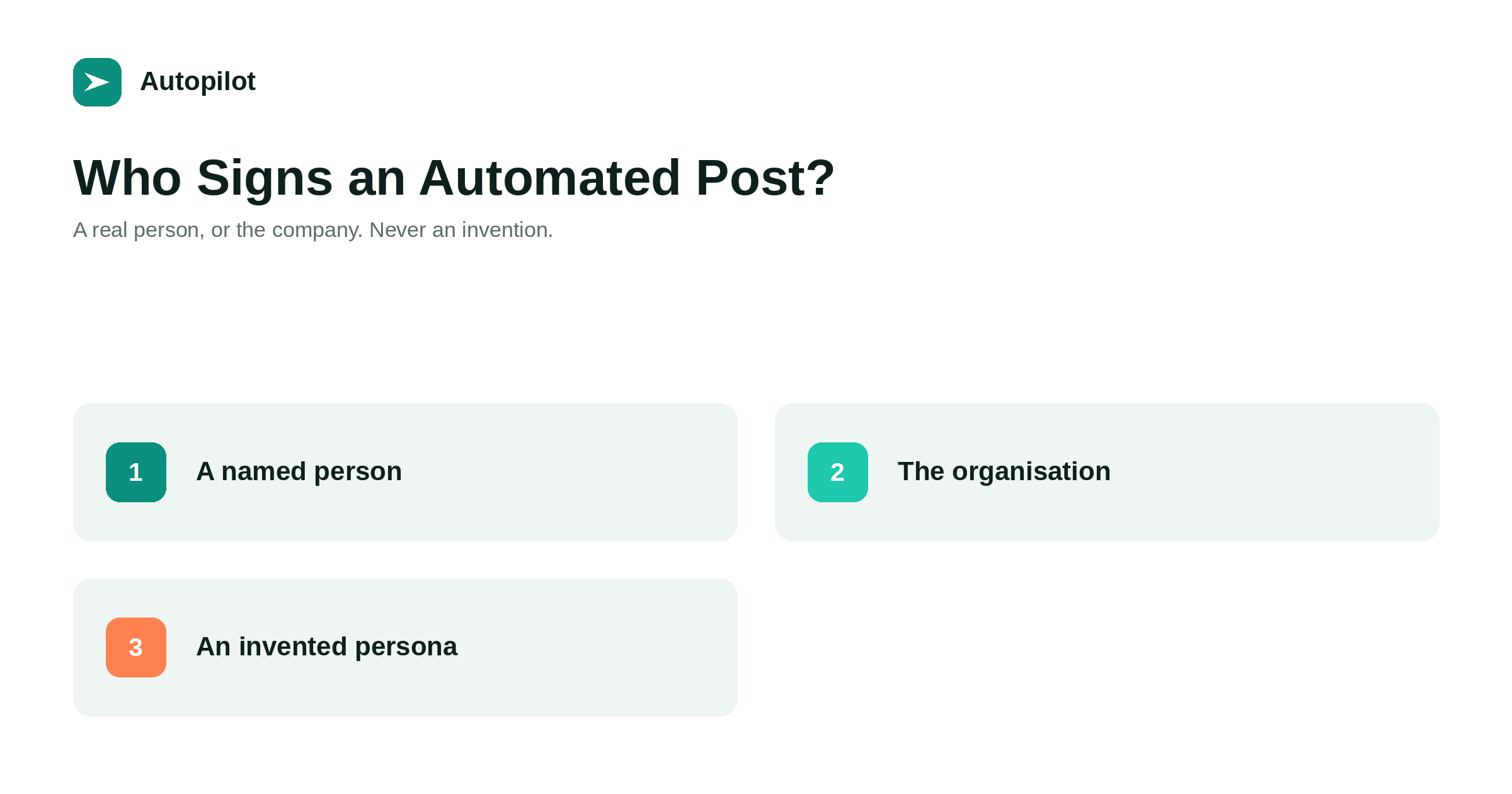
Short answer: name whoever is accountable for the page. If a person reviewed and approved it, they sign it. If nobody reviewed it individually, the organisation is the author, which is honest and perfectly acceptable. Do not invent a person, and do not attach a stock photograph to a name that does not exist — it adds nothing and it is trivially discoverable. The bio should say why this author can speak to the subject in two or three sentences, and link to something verifiable such as a company page or a professional profile.
A byline is a promise: this person or organisation stands behind what the page says. That promise does not become less meaningful because a draft was generated, and it does not require pretending a human wrote every sentence.
The question is therefore not how to make a byline look convincing. It is who is genuinely accountable, and how to say that plainly.
Three honest options
There are only three defensible answers, and which applies depends on your review process rather than on your preferences.
- A named person who reviewed it. They read the article, checked the claims and approved it. They are accountable, and their name belongs on it.
- The organisation. Nobody read this specific article individually, but the company published it and will answer for it. Author: your company name.
- A named person who wrote or substantially added to it. The ordinary case, and the strongest.
The option that is not on the list is a fictional person. It is a misrepresentation, it fools nobody who looks, and the upside it is supposed to provide does not exist — see experience, expertise and trust for what raters are actually asked to assess.
Why the organisation byline is fine
People worry that an organisational byline looks weak. In practice it is the most common byline on the internet, and it is what most documentation, most support content and most company blogs use.
It is also more honest than a named individual who did not read the page. If you are publishing twenty articles a month and one person’s name is on all of them, that name is doing the same work as a company name while implying something that is not true.
What makes an organisational byline credible is the organisation being real and reachable: a company page, a registered name, an address, a way to contact a person. That is a site-level job and it is worth more than any individual bio.
What belongs in a bio
Two or three sentences, and every one of them should be checkable.
| Include | Skip |
|---|---|
| What the person does, and where | Passionate about content |
| Why they can speak to this subject | Coffee lover |
| Relevant qualifications, if any exist | Invented credentials |
| A link to a company or professional profile | A link to nothing |
| How long they have done this work | Award-winning, unspecified |
A bio that could belong to anybody is doing no work. The test is whether a reader who doubted the article would be reassured by it.
Photographs
A real photograph of a real person is a small positive. A stock photograph attached to a name is a clear negative, because it is a lie that is easy to catch with a reverse image search and it puts every other claim on the site in question.
If you do not want to use photographs, do not use photographs. A company logo or nothing at all is entirely normal, and nobody has ever distrusted an article for lacking a headshot. This is the same principle that applies to featured images for automated posts: no invented elements, because the cost of being caught is much larger than the benefit of looking polished.
Multiple contributors, which is usually the truth
On a blog with automation the honest description of how an article came to exist often involves more than one party: a brief written by someone, a draft produced by a tool, a review by an editor, sometimes a subject expert consulted for one section.
Many publishers handle this with two fields: an author and a reviewer, or written by and reviewed by. It costs nothing, it is accurate, and for subjects where standing matters it is considerably stronger than one name.
If your setup supports only one author field, use the accountable party and put the rest in the bio or in a short note at the foot of the article.
Author pages are worth building properly
A byline that links nowhere is half a signal. The page it links to should exist, list the person’s articles, and say enough for a reader to judge them.
Three practical points. Keep the URL stable, because author archives accumulate links and changing them means redirects. Make sure the page is indexable if you want it to carry weight, and noindexed if you have dozens of near-empty ones. And connect it to the rest of the site properly rather than leaving it as an orphan, which is the same argument made in internal linking as you publish.
If you have one author, one good page is enough. There is no benefit in inventing five to look like a newsroom.
The disclosure question
Should the page say that automation was involved? Search guidelines do not require it. Some industries and jurisdictions do, and some audiences would rather know.
A middle position works for most people: do not annotate every article, but publish an editorial policy page that describes how content is produced, who reviews what, and how corrections are handled. Link it from the footer. That is one page, it answers the question for anyone who asks, and it is far more credible than a badge on each post.
Whatever you choose, be consistent. The failure mode is a site that implies human authorship everywhere and then has to explain itself.
Related reading
If this was useful, these cover the questions that usually come next.
- Experience, expertise and trust — where the byline fits into the wider picture
- Draft, approve or full auto — who reviewed it decides who signs it
- Fact-checking before you publish — what a byline is actually promising
The bottom line
Name whoever is genuinely accountable: the reviewer, the writer, or the company. An organisational byline is honest and common, and far better than a real name on twenty articles that person never read. Write bios that are checkable, use real photographs or none, and publish one editorial policy page rather than a badge on every post.
FAQ
Who should be the author of an AI-assisted post?
Whoever is accountable for it. If a person reviewed and approved the article, their name goes on it. If nobody reviewed it individually, the organisation is the author, which is honest and widely used.
Is it acceptable to use a made-up author name?
No. It misrepresents the page, it is easy to discover, and it provides none of the benefit people imagine. Use a real person or the company name.
Does a company byline look less trustworthy than a person?
Not if the company is real and reachable. Most documentation and support content on the internet carries an organisational byline. What matters is that a reader can find out who you are and how to contact you.
What should an author bio contain?
Two or three checkable sentences: what the person does, why they can speak to the subject, any relevant qualification, and a link to a real profile. Personality filler adds nothing.
Should I use written by and reviewed by separately?
If your setup allows it, yes. It describes what actually happened, and for subjects where standing matters it is stronger than a single name.
Do I have to disclose that content was generated?
Search guidelines do not require it, though some industries and jurisdictions do. A single editorial policy page explaining how content is produced and reviewed, linked from the footer, answers the question better than a label on each post.