ENEnglish
 LTLietuviškai
 DEDeutsch
 FRFrançais
 RUРусский
 ESEspañol
 PLPolski
 ITItaliano
 UKУкраїнська
 CSČeština
 PTPortuguês
 JA日本語
JA日本語 LVLatviešu valoda
 ETEesti
 HUMagyar
 IDBahasa Indonesia
 TRTürkçe
 HIहिन्दी
 ELΕλληνικά
 ARالعربية
 THไทย
THไทย VITiếng Việt
 RORomână
 MSBahasa Melayu
 BNবাংলা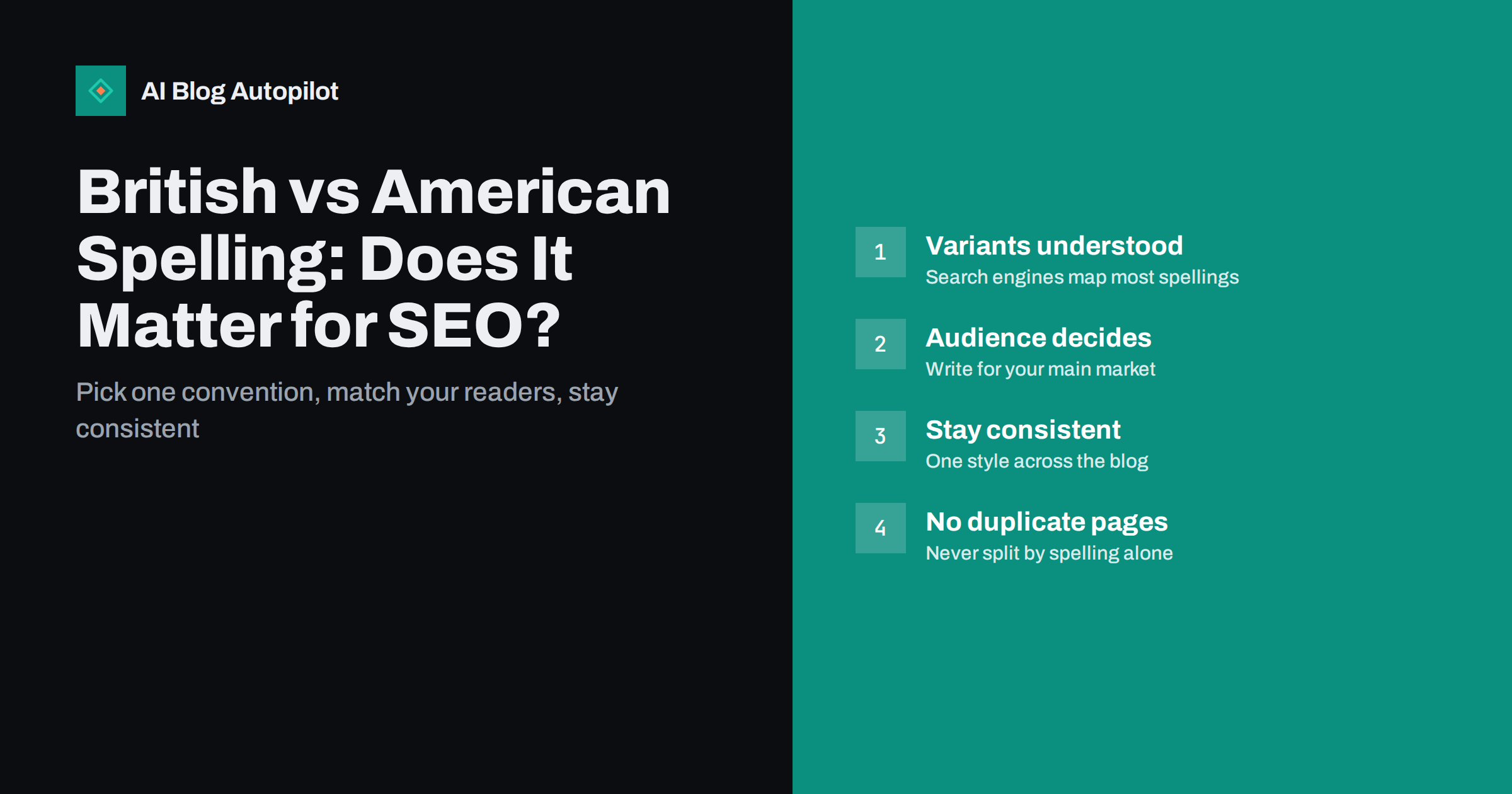
Short answer: for most words, British and American spelling makes little difference to SEO, because search engines recognise common variants such as colour and color or optimise and optimize as the same word. The choice matters more for readers than for rankings: write in the convention your main audience uses, apply it consistently across the blog, and use the other spelling only where it is part of a fixed term or a real search phrase. Never create near-identical pages that differ only in spelling.
English-language blogs serve readers in the UK, the US, Ireland, Australia, Canada, India and many other places, and each has its own habits. Writers often worry that choosing “organisation” will cost them American traffic, or that “optimize” will look foreign to British clients. The real picture is calmer than that, but there are a few cases where the choice does matter. This guide explains how search engines handle spelling variants, when to pay attention and how to set a sensible policy for your blog.
How search engines handle spelling variants
Modern search engines understand language rather than matching exact strings. They routinely treat common variants as equivalent:
- -our and -or: colour and color, behaviour and behavior.
- -ise and -ize: optimise and optimize, organisation and organization.
- -re and -er: centre and center, metre and meter in the measurement sense.
- Doubled consonants: travelling and traveling, cancelled and canceled.
- Other pairs: catalogue and catalog, programme and program in most senses.
A person searching for “color palette ideas” can find a page that says “colour palette ideas”, and the reverse. You can see this in practice: search results for either spelling often overlap heavily. Search engines also use the searcher’s location and language settings to decide which results fit best, so regional relevance plays a part alongside spelling.
That does not mean the variants are identical in every respect. Results for the two spellings can differ somewhat, and a British searcher may see more British sources partly because of location, not spelling. But for a typical blog post, the spelling convention is a minor factor compared with relevance, quality and usefulness.
When spelling does matter
There are situations where the choice affects how well a page matches searches:
- Different words, not just different spellings. Some pairs are different vocabulary: “car park” and “parking lot”, “CV” and “resume”, “mobile phone” and “cell phone”, “VAT” and “sales tax”. Search engines connect some of these, but the concepts may also differ, and the page should use the term its readers search for.
- Words with different meanings. “Program” and “programme” overlap only partly: in British English, “programme” is used for a TV programme or a schedule of events, while “program” is used for software. “Tyre” and “tire” differ, and “tire” also means to become weary.
- Fixed names and terms. Product names, organisation names, legal terms and standards keep their official spelling, whatever your convention. The “World Health Organization” keeps its z even on a British blog.
- Region-specific topics. An article about UK tax rules for sole traders should use British spelling and terms; an article about US state regulations should use American ones. Readers expect it, and the spelling reinforces that the page is about their situation.
Other varieties of English
British and American are not the only conventions. Australian, New Zealand, Irish, South African and Indian English mostly follow British spelling, with local vocabulary of their own. Canadian English mixes the two: it often uses British forms such as “colour” and “centre” together with American “-ize” endings. For most blogs, these details matter less than local vocabulary and examples. An Australian reader notices “sunscreen” versus “sunblock” or “ute” versus “pickup truck” far more readily than an -ise ending.
There is also the so-called Oxford spelling, used by some publishers and international organisations, which combines British spelling with “-ize” endings. It is a legitimate choice, but it looks inconsistent to readers who do not know the convention, so most business blogs are better served by a plainer British or American style.
If you write for a specific market, a quick way to calibrate is to read a few well-regarded local publications in your industry and note the terms they use. Their vocabulary is usually a good guide to what your readers type into search engines.
Choosing a convention for your blog
The decision is mostly about your readers:
- If most customers are in one country, use that country’s convention. A business serving mainly UK clients should write British English; one serving mainly US clients, American English.
- If your audience is international, pick either and apply it consistently. Many international businesses choose American spelling because it is widespread in software and online content; many European businesses choose British spelling because it is taught more widely there. Either is fine.
- If you publish separate regional versions, adapt spelling, vocabulary, currency and examples for each, and connect them with hreflang, as explained in the guide on hreflang for multilingual blogs.
Look at your analytics and Search Console country data before deciding. If most of your search impressions already come from one market, that is a strong hint. Your own sales and support conversations are another: the words customers use in emails are the words they use in search.
Consistency matters more than the choice
A blog that switches between “optimise” and “optimize” from one paragraph to the next looks careless, and it makes readers wonder whether the content was assembled from different sources. Consistency signals editing and care. Put the decision in your editorial style guide, along with related choices:
- Spelling convention: British, American, or another variety such as Australian or Canadian.
- Date format: 28 September 2026 or September 28, 2026.
- Number and currency formats.
- Quotation marks and punctuation style.
- Preferred terms where vocabulary differs, such as “holiday” or “vacation”.
Set your spell checker, word processor and CMS to the same variety, so they flag inconsistencies rather than introducing them.
Consistency also extends beyond the article text. Titles, meta descriptions, image alt text, button labels and FAQ questions should follow the same convention. These are exactly the places that are often written quickly by different people or generated by plugins, and they are also what searchers see first in the results. A quick review of a few recent posts’ titles and descriptions usually reveals whether the convention has slipped.
Keyword research across spelling variants
Keyword tools usually show data per country, and they may list both spellings separately. A few things to keep in mind:
- Check volume in the country or countries you actually serve, not global totals.
- Treat spelling variants of the same word as one topic. Do not plan separate articles for “colour schemes” and “color schemes”.
- Pay attention to vocabulary differences, which can reveal genuinely different searches.
- Use the variant your main audience searches for in the title and main heading; the other variant can appear naturally in the text if it fits, for example when you mention the term used elsewhere.
The guide on how many keywords one article should target explains how to group related phrasings into one page.
What not to do
- Do not create duplicate pages that differ only in spelling, such as one article with “optimise” and a copy with “optimize”. They compete with each other and add nothing for readers.
- Do not stuff both spellings into every paragraph to “catch” both searches. It reads badly and search engines already understand the variants.
- Do not change your whole archive overnight for SEO reasons. If you switch convention, update gradually as you revise articles, prioritising titles and introductions.
- Do not mix conventions within a page, except for fixed names and quotations.
- Do not change URLs just to switch spelling. A slug with “optimize” works fine on a British blog, and changing it means redirects and lost signals for no benefit.
Spelling, AI writing tools and editing
AI writing tools and translation tools often default to American spelling unless told otherwise. If your blog uses British spelling, state the convention clearly in your brief or instructions, and check drafts for drift, especially in words like “organization”, “analyze” and “center”. The same applies to date formats and vocabulary. An editing pass that includes a spell check set to the right variety catches most issues quickly. The guide to editing AI drafts covers the other checks worth doing.
How AI Blog Autopilot fits in
AI Blog Autopilot writes each article from the topics, keywords, audience and tone you set, and it writes directly in each of its 25 languages rather than translating from English. Describing your audience and preferred style in the setup helps keep conventions consistent across articles, and optional approval lets you review posts before they go live if you want to check spelling yourself. See how Autopilot works on the home page.
Related reading
- How to Write Brand Voice Guidelines an AI Can Follow
- Search Intent: The Four Types and What Each Needs
- Choosing Which Languages to Publish In
The bottom line
British or American spelling rarely makes or breaks a blog post in search, because search engines understand common variants. Write for your main audience, choose one convention and apply it consistently, use the local term where vocabulary really differs, and never split content into spelling duplicates. Readers notice consistency far more than search engines notice the letters.
FAQ
Does Google treat colour and color as the same word?
For search purposes it generally recognises them as variants of the same word, so a page using one spelling can rank for searches using the other. Location and other signals can still make results differ slightly between countries.
Should I use British or American spelling on my blog?
Use the convention of your main audience. If readers are spread internationally, either works as long as you apply it consistently throughout the blog.
Do I need separate UK and US versions of my articles?
Only if the content genuinely differs, for example because of laws, prices, products or vocabulary. Separate versions that differ only in spelling are near-duplicates and are not worth creating.
Should I include both spellings in an article to rank for both?
No. Search engines already understand common variants, and repeating both spellings makes the text awkward. Use your chosen convention and mention another term only when it reads naturally.
What about words that are completely different, like CV and resume?
These are vocabulary differences, not spelling variants. Use the term your main audience searches for, and consider mentioning the other term once if many readers use it.
Will changing my blog from American to British spelling hurt rankings?
It is unlikely to have a noticeable effect, since the variants are understood as equivalent. If you switch, do it gradually as you revise articles and keep titles and URLs stable.