ENEnglish
 LTLietuviškai
 DEDeutsch
 FRFrançais
 RUРусский
 ESEspañol
 PLPolski
 ITItaliano
 UKУкраїнська
 CSČeština
 PTPortuguês
 JA日本語
 LVLatviešu valoda
 ETEesti
 HUMagyar
 IDBahasa Indonesia
 TRTürkçe
 HIहिन्दी
 ELΕλληνικά
 ARالعربية
 THไทย
 VITiếng Việt
 RORomână
 MSBahasa Melayu
 BNবাংলা
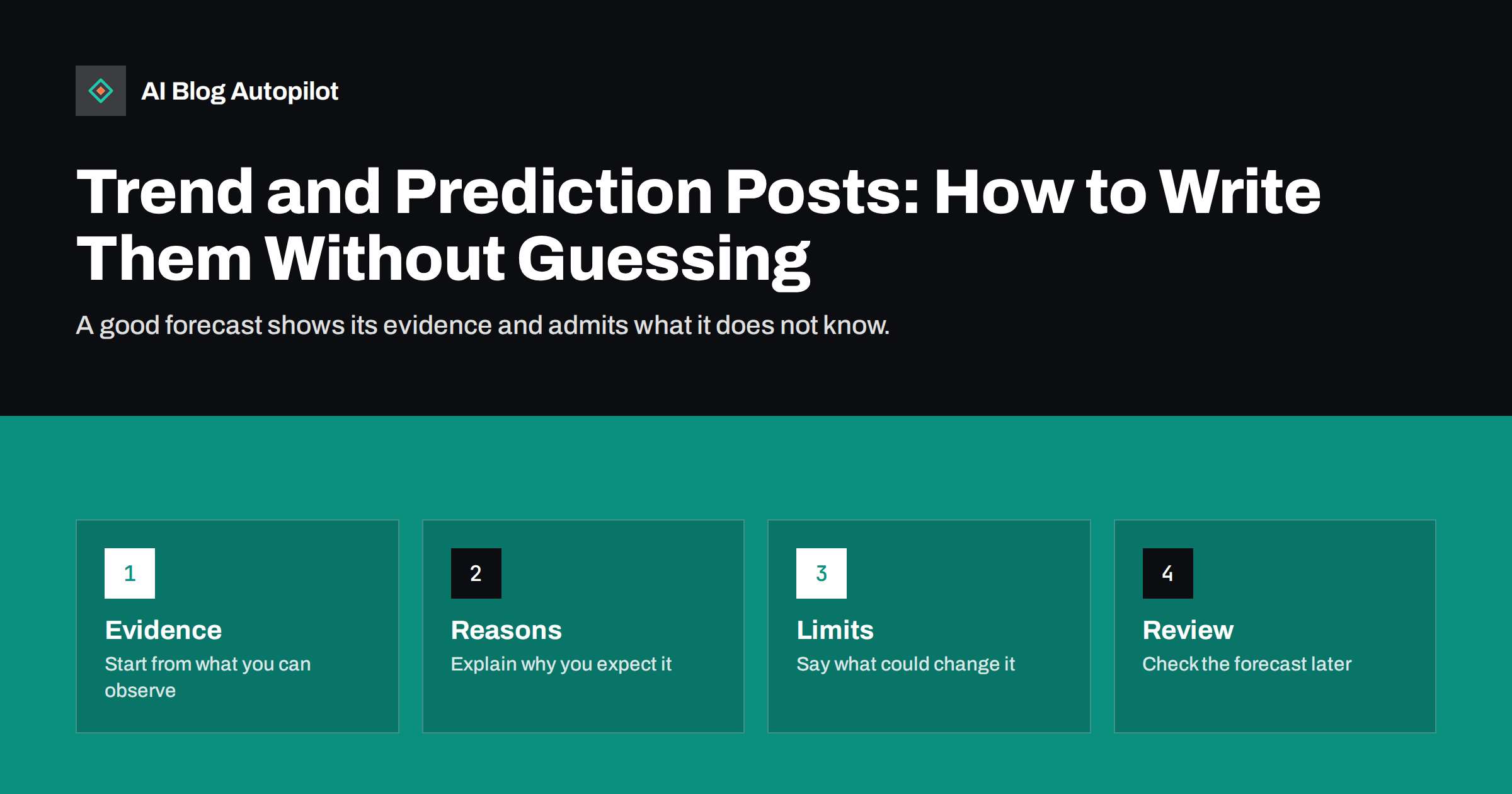
Short answer: a trend or prediction post is credible when it starts from evidence you can see, such as your own data, customer questions and published figures, explains the reasons behind each expectation, separates fact from opinion and states what could prove it wrong. Keep the number of predictions small, avoid dates and numbers you cannot support and set a reminder to review the post and tell readers how it turned out.
Every year, blogs fill with lists of what will happen next. Most are forgotten by spring, and some turn out to be embarrassing. Yet readers do search for them, and they can be useful when written with care: they help people plan, they show that you follow your field and they invite discussion. The difference between a useful forecast and noise is how honestly it is built.
Why readers look for forecasts
People who search for trends are usually making a decision. A business owner wants to know what to budget for next year, a manager wants to know whether to learn a new skill and a hobbyist wants to know if a tool is worth the time. They are not asking for a crystal ball. They want an informed view from someone who sees the field closely.
That is why generic lists perform poorly over time. A post that says “video will grow” or “customers want personalisation” is true but tells nobody what to do. A post that says “we see more customers asking about delivery times in the first message, so we expect that clear delivery pages will matter more” is specific and checkable, and it gives the reader something to act on.
Search engines and AI assistants also favour posts that show their basis. A claim that points to its source and explains its reasoning is easier to quote than one that states a vague opinion. See how to add original data to blog posts for ways to build that base.
Start with evidence, not hunches
Collect what you already have. Your own sales questions, support emails, search reports and analytics show what people ask for now, and changes in those questions are early signs of a trend. Note which topics are growing in your reports, which tools customers mention more often and what has changed in how people phrase their problems.
Add outside evidence with care. Public statistics, industry reports and the search interest data in Google Trends for blog topics can support a point, but check the date, the method and the sample, and cite the source in the text. Avoid the habit of copying a number from a blog that copied it from another blog. See evidence for marketing claims for a checklist.
Talk to people. A few short conversations with customers, suppliers or colleagues can give you a fresh quote or example that no competitor has. Interviews are described in interviewing experts for content. A trend post with three real voices is much stronger than one with none.
A short example shows the pattern. Imagine a blog for a garden centre. Its owner notices that questions about watering restrictions and drought-tolerant plants have grown in emails and in the search reports for three seasons in a row. The post could expect that customers will ask for low-water planting plans before they ask for colour schemes. It gives the three seasons of questions as evidence, explains that water costs and local rules push people in that direction, tells readers what to plan for and says that a wet year could slow the change.
A structure that works
Open with the short answer: the two or three changes that you expect and the reason that you picked them. Then give each prediction its own section with the same simple pattern. First, what you see now. Second, why you think it will continue or grow. Third, what it means for the reader. Fourth, what would change your view.
Keep the list short. Three well-argued expectations are worth more than fifteen shallow ones, and a short list is easier to review later. If you have many ideas, split them across several posts or keep the weaker ones for notes.
Use plain headings that describe the claim, for example “Customers will compare delivery options before price”, not “Trend 1”. Headings in the form of statements are easier to scan and for assistants to quote, as discussed in answer-first writing.
It also helps to name the time frame. A forecast for the next quarter, the next year and the next five years are different things, and each needs a different level of confidence. Short horizons can rest on data you have today. Longer ones are closer to scenarios, and it is honest to present them as such, with a sentence about what would make each scenario more or less likely.
Separate fact from opinion
Readers should always be able to tell what is known and what is your view. Use clear language: “our data shows” for facts, “we expect” or “we think” for forecasts, and “it is possible that” for weaker ideas. Do not dress up an opinion as a fact by adding a number that you cannot support.
Avoid invented precision. A phrase such as “40 percent of businesses will switch by next year” is a claim that needs a source. If you do not have one, write “many” or describe the direction without a figure. A forecast with honest limits is more trusted than one with exact but hollow numbers. Our guide to naming your own methods shows how to present your own approach without overselling it.
Be careful with sensitive areas. Predictions about health, money or law can affect real decisions, so keep them general and point to qualified advice, as covered in YMYL topics on a blog.
Think about the formats that suit a forecast. A comparison table of what has changed over three years, a simple chart of your own numbers or a short quote from a customer can make a section clearer than another paragraph. Use them sparingly, and describe each one in words as well so that readers with assistive tools and AI assistants can use the point. See screenshots, diagrams and charts for practical tips.
Timing and updating
Forecast posts have a natural season, but the best ones are built to last. Rather than placing the year in the address, use a lasting address and show the date in the title or the opening, as explained in year in blog titles. That lets you update the same page each year, so that it collects links instead of resetting them.
Add a review note to your calendar. After six or twelve months, return to the post and add a short section, “what happened”. Which expectations came true, which did not and why? This turns a weak point of the format into a strength. Readers respect a blog that checks its own work, and the page gains new, original content that others cannot copy.
If a prediction was clearly wrong, say so. Do not delete it quietly. A visible correction, in line with how to handle corrections on a blog, builds trust and teaches readers how to treat your next forecast.
Do not forget your regular readers. A forecast post is a good moment to ask them what they expect, through a short survey or a question at the end. Their answers can become a section in the review, and the exchange tells you which topics deserve a full article next. A small poll of ten replies is not a statistic, so describe it as what readers told you, but it is real and local evidence.
Mistakes to avoid
The first is the list of obvious things. If every reader would have guessed the point, it is not worth a section. The second is copying other forecasts and rewording them, which adds nothing and may look like plagiarism. The third is overpromising: a headline that claims to reveal the future sets expectations that a careful post cannot meet.
The fourth is ignoring your own interest. If you sell a service connected with the trend, say so, and make sure that the argument would still hold if you did not. A forecast that only happens to favour your product loses trust at once. The fifth is forgetting the reader’s next step. End each section with what a reader could do this month, even if it is a small test.
The sixth is writing it all in one go at the end of the year. Keep a running note through the year: surprising customer questions, numbers that moved and examples that fit. When it is time to write, you will have material, and the post will sound like you.
Turning the post into a series
A forecast post can feed a small series. One article may state the expectations, later ones can test each of them with an example or a short experiment, and a final one can review the results. This builds a habit of returning to your blog and gives you reasons to update your internal links, as described in blog post series and SEO.
It also gives you material for social posts and the newsletter. One expectation with its reason fits a single short post, and a link to the full article gives curious readers a place to go.
How AI Blog Autopilot helps
AI Blog Autopilot writes full SEO articles for your WordPress blog from the topics, keywords, audience and tone you set, with FAQ sections, tags and SEO meta included, and it shares each one to your social networks. Forecasts rest on your own observations, so use approval mode to read each article first and add the examples and the data that only you have. See the pricing page for plans.
Related reading
- Original Research Posts for Small Blogs
- Annual Round-Ups: When They Are Worth Writing
- How to Write an Opinion Piece
The bottom line
Choose a few expectations, support each with evidence and reasons, mark opinion as opinion, state what could change your mind and come back later to say what happened.
FAQ
How many predictions should a post include?
Usually three to five. A short list can be argued well and reviewed later.
Should I put the year in the address?
A lasting address that you update each year is better, with the year shown in the title or opening.
Can I use numbers without a source?
Avoid it. If you have no source, describe the direction in words and say that it is your estimate.
What if a prediction turns out wrong?
Say so in a review section. Honest corrections build more trust than silence.
Do prediction posts help SEO?
They can attract searches and links when they are specific, sourced and kept current, but weak generic lists rarely do.