ENEnglish
 LTLietuviškai
 DEDeutsch
 FRFrançais
 RUРусский
 ESEspañol
 PLPolski
 ITItaliano
 UKУкраїнська
 CSČeština
 PTPortuguês
 JA日本語
JA日本語 LVLatviešu valoda
 ETEesti
 HUMagyar
 IDBahasa Indonesia
 TRTürkçe
 HIहिन्दी
 ELΕλληνικά
 ARالعربية
 THไทย
THไทย VITiếng Việt
 RORomână
 MSBahasa Melayu
 BNবাংলা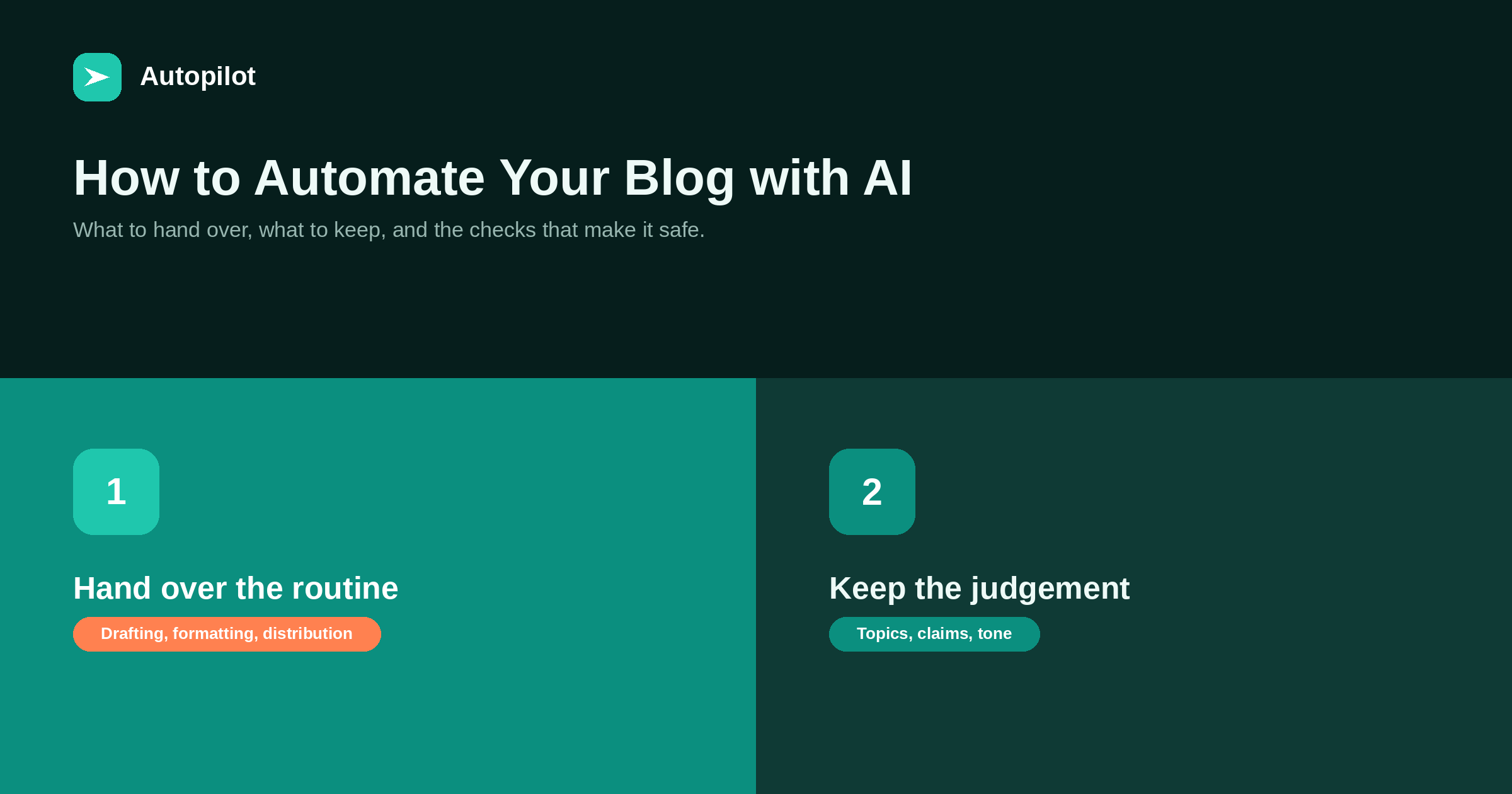
Short answer: automate the repetitive half of blogging and keep the judgement. Let AI handle drafting, structure, meta descriptions, FAQ blocks and distribution; keep topic choice, factual claims and brand voice under your control. The practical setup is a topic list you approve, an article length that suits the query, a review step you can switch off once you trust the output, and automatic sharing so nothing sits unpublished. Quality does not fall because a machine typed the words — it falls when nobody decided what the article was for.
Blog automation has a bad reputation, and it earned it honestly. The first wave of tools produced pages that existed only to occupy a keyword, and readers and search engines both learned to recognise them. What changed is not that the writing got magically better, but that the expensive part of blogging turned out to be everything around the writing: deciding what to cover, keeping a schedule, formatting for the web, writing the meta description nobody enjoys writing, and remembering to share the thing once it is live.
This guide is about splitting a blog into those two halves. One half is judgement and should stay with you. The other half is process, and process is what automation is genuinely good at.
What actually takes the time
Ask anyone who has tried to publish weekly and they will tell you the writing was rarely the bottleneck. The bottleneck was the twenty minutes spent staring at a blank list of topics, the hour lost to reformatting, the meta description written badly at 11pm, and the week where nothing went out because one person was on holiday.
Break a single article into its real steps and the pattern is obvious:
- Choosing the topic — judgement. Needs to know your business.
- Researching the angle — judgement, with help.
- Drafting 2,000 words — process, once the angle is set.
- Structure, headings, FAQ — process, entirely.
- Meta description and excerpt — process.
- Publishing to the CMS — process.
- Sharing to social networks — process.
- Deciding whether the claim is true — judgement, always.
Six of those eight are process. That is the honest scope of blog automation: not replacing the writer, but removing the six steps that were never creative work in the first place.
The setup that works
A working automated blog has four moving parts, and they are easier to reason about separately.
1. A topic list you approve
Everything downstream inherits the topic. A list of twenty subjects you actually want to be known for will produce a better blog than any clever prompt applied to a list you never read. Weight the topics: some deserve four articles a month, some deserve one a quarter.
2. A length that matches the query
Depth is not word count, but a question with several sub-questions needs room. Autopilot writes articles up to 3,000 words, which is enough for a full guide with an FAQ section; short definitional questions do not need that and should not get it.
3. A review step you can turn off
Start with articles landing as drafts and read every one. After a month you will know which categories you trust unattended and which still need eyes. Turning review off should be a decision you make, not a default you discover.
4. Distribution that runs without you
An article nobody sees is a cost, not an asset. Automatic sharing to your social accounts is the step most often skipped and the cheapest to fix, because it needs no writing at all.
Where automation goes wrong
Three failures account for most of the bad automated blogs on the internet, and all three are avoidable.
Publishing without a purpose. Thirty articles a month with no plan is thirty articles competing with each other. Two pieces covering the same question split their own traffic and neither ranks; the fix is a topic list with real coverage rather than variations on one idea.
Unverified specifics. Percentages, study results, prices and quotes are exactly what a generated draft is worst at and what readers check first. The rule that holds up: either the number comes from a source you can link, or the sentence is rewritten without it.
Never reading the output. Automation you do not monitor is not automation, it is abandonment. Reading four articles a month at random is enough to catch drift early.
A realistic comparison
The table below is the honest version of what changes when you automate, based on the steps rather than on marketing claims.
| Step | Fully manual | Automated with review | Unattended |
|---|---|---|---|
| Topic choice | You | You | You, from the topic list |
| Drafting | You, hours | AI, minutes | AI, minutes |
| Structure and FAQ | You | AI | AI |
| Meta description | Often skipped | AI, then checked | AI |
| Fact checking | You | You | You, after publishing |
| Publishing | Manual | One click | Automatic |
| Social sharing | Often forgotten | Automatic | Automatic |
The middle column is where most blogs should start. The right-hand column suits categories where the risk of a wrong sentence is low — explainers, how-tos, recurring updates — and suits regulated or claims-heavy subjects poorly.
What Autopilot does in this setup
For transparency, here is the part our own product handles, so you can judge the rest of the advice on its merits. AI Blog Autopilot writes 2,000–3,000-word SEO articles with an FAQ section and a meta description, publishes them to your WordPress site, and shares every new article to your social networks automatically, with the publishing side handled by PostRSS. Content can be written natively in 25 languages, and it works without a website too, if social posts are all you need.
The first three articles are free, so the sensible test is to run them on topics you already know well — you will spot a weak article faster on familiar ground. Plans start with Starter for a single site and go up to Agency for teams running many; monthly credits do not roll over, so pick the tier that matches what you will actually publish rather than the one that looks generous. The current limits are on the pricing page.
Related reading
- What Is an AI Blog Writer? How Automated Article Generation Actually Works
- Setting Up a New Blog for SEO: The First Day
- How to Find the Content Gaps Your Blog Has
The bottom line
Automating a blog is a sorting exercise before it is a technology decision. Sort the work into judgement and process, hand over the process, keep reading a sample of the output, and make sure every published article reaches an audience the same day. Do that and the volume goes up without the quality going down; skip the sorting and you will produce a great deal of content that nobody, human or machine, has any reason to read.
FAQ
Does automating a blog hurt SEO?
Not by itself. Search engines judge whether a page is useful, not how it was typed. What hurts is publishing pages with no purpose, duplicated angles or unverified claims — all of which are possible by hand too, just slower.
How much should I review before I stop reviewing?
A month of reading every article is a reasonable minimum. After that, keep reading a sample. Categories with factual or regulatory risk should stay under review permanently.
What should never be automated?
Claims about your own product, anything involving prices, legal or medical guidance, and responses to a live situation. Those need a person who knows the current facts.
How many articles a month is sensible?
Enough to cover your topic list properly and not one more. A blog that publishes eight useful articles beats one that publishes thirty overlapping ones, and it costs less.
Do I need a website to start?
No. Autopilot works without a site, publishing only to social networks, which suits brands whose presence is entirely social. Adding a site later does not mean starting over.
How do I keep the brand voice?
Give the tone once, in writing, along with a few examples of what you would never say. Voice drifts when nobody has written it down, whoever is doing the typing.