ENEnglish
 LTLietuviškai
 DEDeutsch
 FRFrançais
 RUРусский
 ESEspañol
 PLPolski
 ITItaliano
 UKУкраїнська
 CSČeština
 PTPortuguês
 JA日本語
JA日本語 LVLatviešu valoda
 ETEesti
 HUMagyar
 IDBahasa Indonesia
 TRTürkçe
 HIहिन्दी
 ELΕλληνικά
 ARالعربية
 THไทย
THไทย VITiếng Việt
 RORomână
 MSBahasa Melayu
 BNবাংলা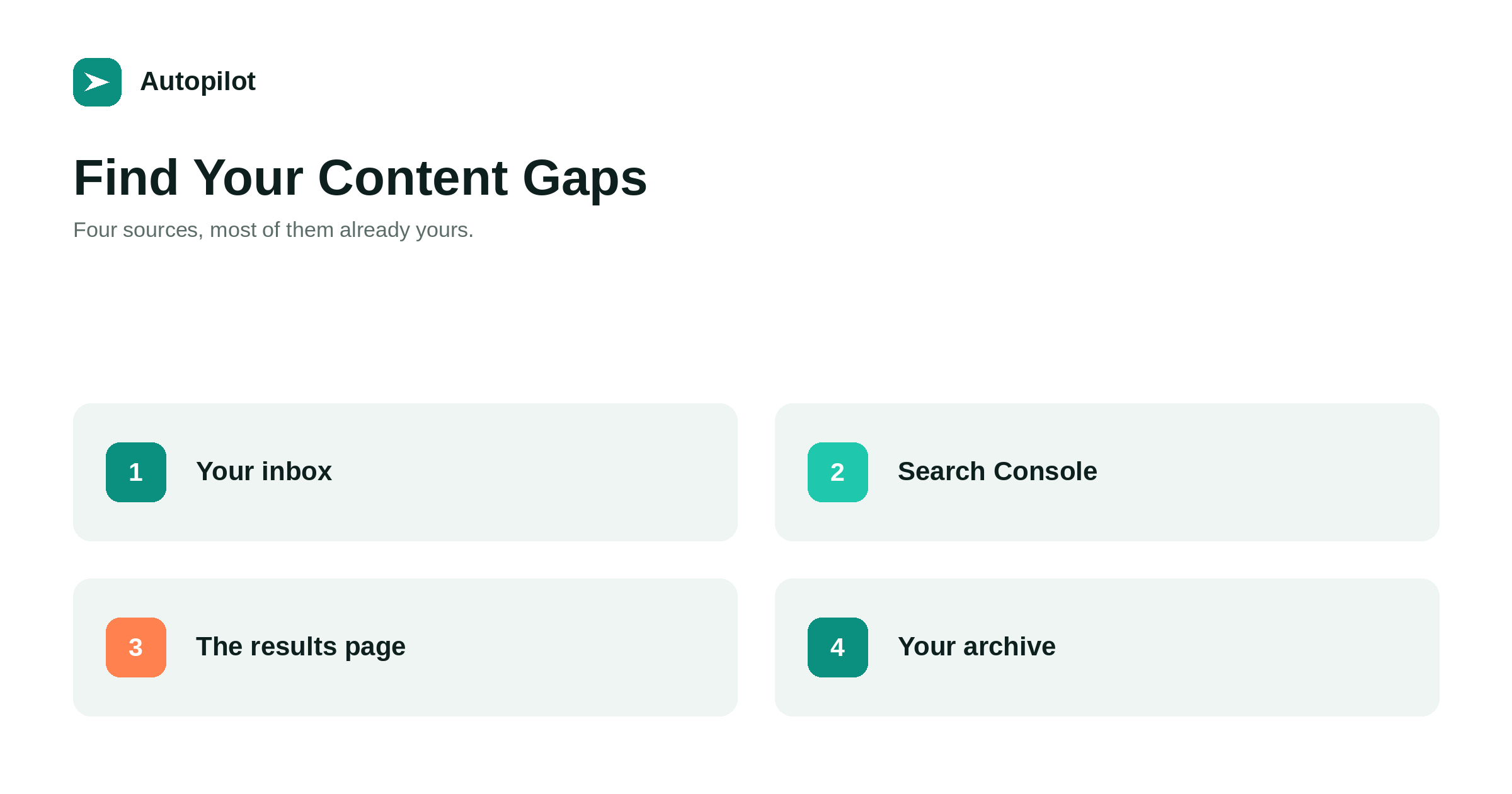
Short answer: a content gap is a question your readers have that your site does not answer well. Find them in four places: the questions customers ask you by email, chat and phone; Search Console queries where you appear but no page is really about that query; results pages where the existing answers are thin or outdated; and your own archive, where articles mention subjects in passing that deserve a page of their own. The first source is usually the richest and the most neglected, because it is in an inbox rather than a tool.
Gap analysis sounds like something that needs a subscription and a consultant. The most useful version needs neither: most of the missing questions are already visible to you, just not in the place you usually look for topics.
The work is collecting them in one list and then being strict about which are real.
Source one: the questions you already answer privately
Every business answers the same questions repeatedly by email, in chat, on sales calls and in support tickets. Each of those is a page that should exist and usually does not.
Spend thirty minutes going through the last two months of messages and write down every question, in the customer’s words rather than yours. The phrasing matters: customers ask how do I stop it posting twice, not how to configure deduplication.
Two things make this source valuable beyond volume. These questions come from people close to buying, and your answer contains exactly the first-hand detail that adding something original argues every article needs. It is the rare source that improves both coverage and quality at once.
Source two: Search Console
Once a site has any traffic, Search Console shows the queries you appear for. Some of them are queries where you have no real page.
Open the queries report, filter to the last three months, and sort by impressions. Look for queries where your ranking page is only loosely related: you appear for how to write alt text because an article on images mentions it once. That is a search engine telling you that you are the nearest thing it has, and that a dedicated page would probably do better.
Positions between 12 and 30 are the richest band. the Search Console reports that matter walks through the report itself.
Source three: badly answered results
Search a question in your field and read what ranks. Sometimes it is excellent and there is no point competing. Often it is not.
| What you see ranking | What it tells you |
|---|---|
| A forum thread | Nobody has written a proper page |
| An article from several years ago | The answer may have changed |
| Pages that mention it in passing | No page is actually about this |
| A thin page from a large site | Authority, not quality, is holding it |
| Several good, current, specific pages | Probably not a gap; move on |
The last row matters as much as the others. A gap list that includes questions already answered well by five good pages is a list of articles that will not be read. learning from what already ranks goes further into reading those pages properly.
Source four: your own archive
Read your existing articles looking for sentences that gesture at a subject without explaining it: that is a topic for another day, depending on your setup, which is beyond the scope of this article.
Each of those is a promise you made and did not keep, and it is also a gap with a built-in internal link: once the new article exists, the old sentence becomes the natural place to link it from, which is exactly how internal linking as you publish should work.
This source also surfaces the opposite problem — subjects you have covered three times — which is worth noting for a different kind of cleanup.
Deciding which gaps are real
A raw list will have fifty items. Most of them should not become articles.
Three tests cut it down. Is it a distinct question? If it is a variation of something you already answer, improve that page instead — see how many keywords one article should target. Can you answer it with some authority? A gap in a subject you know nothing about is not your gap. Does the answer matter to someone who might become a customer? Not every article must sell, but a blog of questions nobody in your market asks is a hobby.
What survives is usually fifteen to twenty-five real gaps, which is a quarter or more of work.
Recording them so they get written
A gap list that lives in a document nobody opens produces nothing.
Record each surviving gap with four fields: the question in the reader’s words, where it came from, which existing page it relates to, and a one-line note on what a good answer would include that the current results do not. That last field is what stops the eventual article from being a paraphrase of whatever ranks.
Then move them into the schedule, as in planning a month of articles. A gap is only closed when the page is published and the related older page links to it.
How often to repeat this
A full pass is worth doing quarterly. The inbox source is worth a standing habit: a shared note where anybody who answers a customer question can drop it, which turns the richest source into a continuous one.
The Search Console pass changes most as a site grows, because the more pages you have, the more queries you appear for loosely. On a young site it may show little; after six months it is usually the best source you have.
None of this promises that a filled gap will rank. It makes sure the articles you write answer questions people actually have, which is the precondition for everything else.
Related reading
If this was useful, these cover the questions that usually come next.
- Learning from what already ranks — the outside view of the same exercise
- Planning a month of articles — turning a gap list into a schedule
- Long-tail keywords — why small gaps are worth filling
The bottom line
Collect gaps from your inbox, Search Console, badly answered results and your own archive. Cut the list with three tests: distinct question, genuine authority, relevant reader. Record what a good answer would add, schedule the survivors, and link each new page from the old sentence that first mentioned it.
FAQ
What is a content gap?
A question your readers have that your site does not answer well — either not at all, or only in passing inside an article about something else.
What is the best source of content gaps?
Usually your own customer conversations: support tickets, sales calls, chat and email. Those questions come from people close to buying, in their own words, and your answers contain first-hand detail no research can supply.
How do I use Search Console to find gaps?
Sort the queries report by impressions and look for queries where the page you appear with is only loosely related. Positions between 12 and 30 on such queries often mean a dedicated page would do better.
How do I know a gap is worth filling?
It should be a distinct question rather than a variation of one you already answer, you should be able to answer it with some authority, and the answer should matter to someone in your market. If five good current pages already answer it, move on.
How many gaps should I expect to find?
A raw list often has fifty items and fifteen to twenty-five survive honest filtering. That is usually a quarter or more of publishing.
How often should I look for gaps?
A full review quarterly, plus a standing shared note where anyone who answers a customer question can add it. The inbox source works best as a habit rather than an exercise.