ENEnglish
 LTLietuviškai
 DEDeutsch
 FRFrançais
 RUРусский
 ESEspañol
 PLPolski
 ITItaliano
 UKУкраїнська
 CSČeština
 PTPortuguês
 JA日本語
 LVLatviešu valoda
 ETEesti
 HUMagyar
 IDBahasa Indonesia
 TRTürkçe
 HIहिन्दी
 ELΕλληνικά
 ARالعربية
 THไทย
 VITiếng Việt
 RORomână
 MSBahasa Melayu
 BNবাংলা
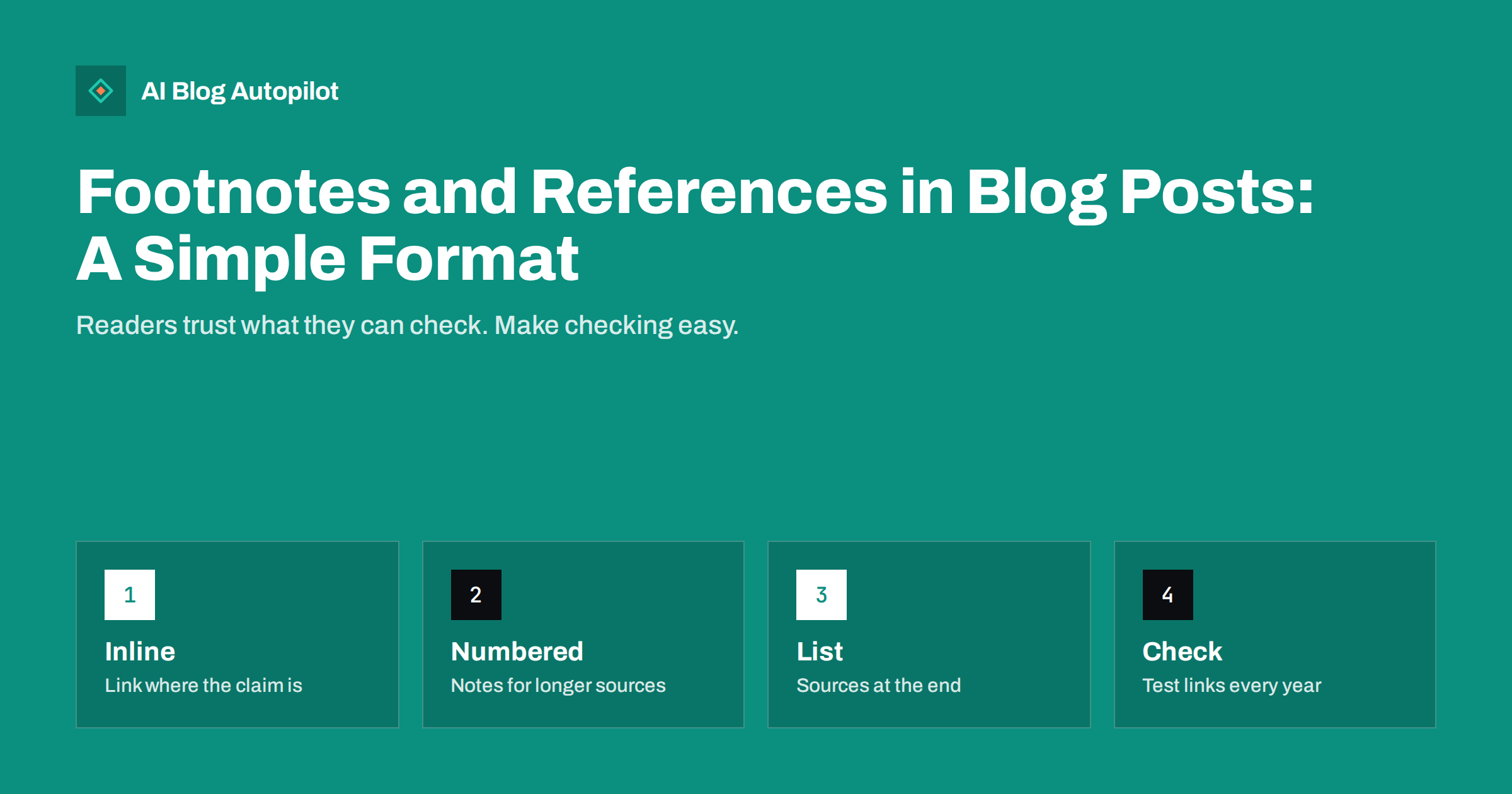
Short answer: for most blog posts, the simplest way to cite a source is a plain link inside the sentence that makes the claim. Use numbered notes only when a post draws on many sources or needs longer explanations, and add a short sources list at the end for articles with research. Name the source, keep links working and say clearly what comes from where.
Readers and search engines both value pages that show where their facts come from. Yet many blogs either give no sources or bury them in a pile of links at the bottom. A good format is one that readers can follow without effort and that you can maintain without a long process. This article compares the common options and shows how to choose one that suits your posts.
One more benefit is speed. When a post is reviewed by an editor or a client, clear sources let the reviewer check facts in minutes. Without them, a review turns into a search for where each number came from, and mistakes are more likely to slip through.
Why citing sources matters
A claim without a source is only an opinion. A claim with a source can be checked, and that changes how readers feel about the whole page. People who work in fields where accuracy matters, such as health, money or law, expect to see where information comes from. Even in lighter topics, a visible source suggests care.
It also protects you. If you quote a number and the number is wrong, a clear source shows that you took it from a place that readers can assess. If you reuse someone’s idea or data, naming them is both fair and honest. This links to the standards described in E-E-A-T for automated blogs, where evidence and transparency support trust.
Finally, sources help assistants and search tools understand your content. Pages that point to their origins make it easier for systems to see what is original and what is reported. Read citing sources for AI answers for how this works from the other direction.
Write the link text before you choose the link. If you can describe the source in a few words, the link text will write itself, and the sentence will remain clear to readers who use a screen reader and hear the links read out one after another.
Option one: the inline link
The inline link is the best default. You write the claim and link a few words in the sentence to the source. The reader can click if they wish, and nothing interrupts the flow if they do not. The link text should describe the source, such as the name of the organisation or the report, not a phrase like “click here”.
Keep the sentence honest. Say who said it and what it is: “According to the survey of small businesses published by the national statistics office” is more useful than a bare link. If a number comes from a specific year, say the year. A reader should know the age and the origin of a figure before they click.
Use few external links in one paragraph. Many links in a row make the text hard to read, and each one sends readers away. Choose the sources that really support the claim and skip the ones that are only loosely related. The guide to external links in blog posts offers more detail on what to link and how.
If your notes include explanations as well as sources, label them differently. A note that gives a source is a reference. A note that adds a side comment is a footnote. Mixing both under one number confuses readers, so keep a clear difference or avoid side comments altogether.
Option two: numbered notes
Numbered notes work well when a post is long, technical or based on many sources. A small number appears after the claim and leads to a note at the end of the article. The notes can include the full name of the source, the date, the page and a link. This keeps the text clean and gives space for details that do not fit in a sentence.
The cost is effort for the reader. Each number asks them to jump down the page and back. On a phone this can be awkward. If you use notes, make the numbers links that jump to the note and add a link that returns to the place in the text. Do not use notes for a single source or for casual statements.
Keep the format the same in every article. If one post uses square brackets, another uses superscripts and a third uses plain numbers, readers will not know what to expect. Add the rule to your editorial style guide so that every writer follows it.
Group a long list under short headings, such as official sources, industry reports and further reading. Grouping tells readers which sources carry the most weight and keeps a long list from turning into a wall of links.
Option three: a sources list at the end
A sources list is a short section near the end of the article that names the main sources. It suits research-based posts, round-ups and any article where several documents feed the whole argument and not single sentences. List each source with its name, its date and a link, in a consistent order.
A list does not replace inline citation for key claims. If you quote a specific number, say where it comes from at that point. The list serves as a record and as a place for background reading. Together, the two give both quick checking and a full picture.
Keep the list proportionate. Five well-chosen sources are better than twenty that you have not read. If a source is not worth naming, it is probably not worth listing. For posts that gather many statistics, see statistics round-up posts for how to present and verify them.
Be especially careful with statistics that are repeated across many websites. Often the same number is copied from site to site until nobody remembers where it began. Trace it back to its origin before you use it, and if you cannot find the origin, avoid presenting the figure as fact.
Choose good sources
Prefer primary sources: the organisation that did the research, the official page of a rule or the original document. A news article about a study is a secondary source, and it may have errors or leave out important details. When you can, go to the original and cite it.
Check the date and the context. A figure from many years ago may no longer apply, and a result from a narrow group may not describe a wider one. If you use an older source because nothing newer exists, say so in the text.
Be careful with sources that are not neutral, such as a company reporting on its own product. They may still be useful, but say who made the claim and why they might care. If a source asks for money or sells a related service, mention that where it matters. A fair presentation keeps your own credibility intact. If you use paid or sponsored links, follow the rules in nofollow, sponsored and UGC links.
When you summarise an idea instead of quoting it, name the author and make clear that the summary is yours. Readers should be able to tell where the original thinking ends and your own begins. This simple habit prevents most disputes about credit.
Quotes, data and images
Quotes need extra care. Keep them short, put them in quotation marks or a block quote, and name the speaker and the place where the words appeared. Do not change the words, and do not use a quote in a way that changes its meaning. If you got the quote in an interview, say so.
For data, say where it came from and what it measures. If you made a chart from someone else’s numbers, credit the data and explain any changes you made. If the data is your own, say how you collected it and how many cases it covers. The article on how to add original data to blog posts shows how to present your own findings.
Images also have sources. Credit photographers, illustrators or libraries where the licence asks for it, and state the licence clearly. A short credit line below the picture is usually enough.
A short reminder in your editorial calendar is enough to keep this up. Once a year, open the posts that receive the most visits, click each source and fix what has moved. Those pages are the ones where an old or dead source does the most harm.
Keep sources alive
Links break over time. Pages move, reports are removed and websites close. A post that cites ten sources will have a few dead links within a couple of years. Check your most important posts at least once a year, and replace or remove broken sources. The methods in broken links: find and fix help you do it quickly.
If the original page is gone, look for a newer version or an archived copy, and say in the note that you are using the archived copy. If you cannot find the claim anywhere, think again about whether to keep it. A claim without a source is weaker than no claim at all.
When you make a change in a post, note it. A small line such as “Updated in October to replace a broken link” tells readers that you care. See handling corrections for wording that works.
How AI Blog Autopilot helps
AI Blog Autopilot writes full SEO articles for your WordPress blog from the topics, keywords, audience and tone you set, with FAQ sections, tags and SEO meta included, and it shares each one to your social networks. Approval mode lets you read each article first, which is the right moment to check every figure and add the source that backs it. See the pricing page for plans.
Related reading
The bottom line
Link inside the sentence for most claims, use numbered notes for heavy research and add a short sources list when needed. Name sources clearly, prefer originals and check links once a year.
FAQ
Do blog posts need footnotes?
Not usually. Inline links work for most posts. Use numbered notes only for long or research-heavy articles.
How many sources should a post have?
As many as the claims need. A few strong sources are better than a long list of loose ones.
Should source links open in a new tab?
It is a style choice. Be consistent, and make the link text describe the source.
What if a source disappears?
Look for a newer version or an archived copy and say so in the note. If you cannot find the claim anywhere, consider removing it.
Do citations help SEO?
Not as a direct ranking switch, but they support trust and make your content easier to check and reuse.