ENEnglish
 LTLietuviškai
 DEDeutsch
 FRFrançais
 RUРусский
 ESEspañol
 PLPolski
 ITItaliano
 UKУкраїнська
 CSČeština
 PTPortuguês
 JA日本語
 LVLatviešu valoda
 ETEesti
 HUMagyar
 IDBahasa Indonesia
 TRTürkçe
 HIहिन्दी
 ELΕλληνικά
 ARالعربية
 THไทย
 VITiếng Việt
 RORomână
 MSBahasa Melayu
 BNবাংলা
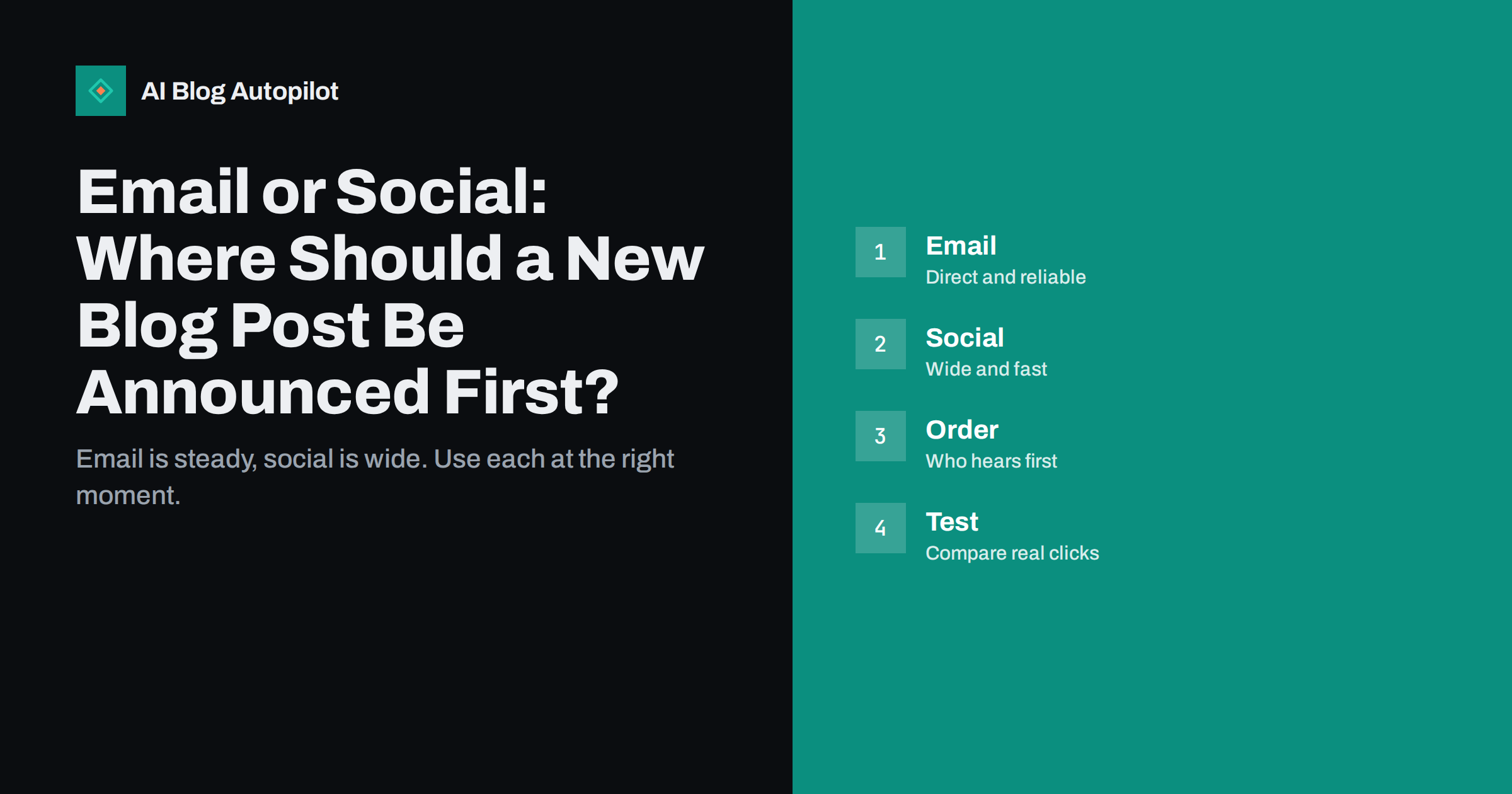
Short answer: for most blogs, the best approach is to use both, in a planned order. Email reaches people who chose to hear from you and does not depend on a feed, so it is a good first announcement for your most engaged readers. Social media reaches new people and spreads the post wider, and it works well after or alongside the email. Test the order for a few weeks, because the right answer depends on your audience and your goal.
Each time you publish an article, you face a small decision. Whom do you tell first, and how? Some publishers send an email within minutes and share to social later. Others post on social first to catch the early burst of attention. The decision may look minor, but over a year it shapes how many people read your posts and how close they feel to your blog.
This article compares email and social, explains what each channel does best and suggests a simple sequence that you can test on your own audience, without spending more time than you do now.
Email has weaknesses too. Messages can land in spam folders or promotional tabs, some readers never open them and a poorly kept list collects dead addresses. Keep the list clean by removing people who have not opened anything for a long time, and ask new subscribers to confirm their address. A smaller, active list gives better results than a large, tired one.
What email does well
Email goes to people who asked for it. They gave you an address, which is a stronger sign of interest than a follow. There is no feed that decides whether the message is shown, although inboxes have their own filters, and the message stays until the reader opens or deletes it.
You also own the list. If a social network changes its rules or closes, your email list remains with you, as long as you respect the rules on consent and privacy. This steadiness is the main reason why many experienced publishers treat email as their core channel.
Email allows more space and more control. You can write a short introduction, show a clear button and send a message in the format that you choose. Open and click numbers are easier to read than the reach figures of some networks. The guide to building a newsletter from your blog posts describes how to set up the habit.
Remember that each network has its own audience and habits. Followers on a professional network may want lessons and opinions, while followers elsewhere may want visuals or quick tips. When you decide what to send first, think about where your best readers already are, not where your posts could in theory reach the most people.
What social media does well
Social media reaches beyond your list. A good post can be shared by people who have never heard of you, and that is the only way for many small blogs to be seen by strangers. It is also quick and informal, which suits comments, questions and short reactions.
Social is useful for timing and for conversation. If an article responds to news or a trend, a post on a network can reach readers while the topic is fresh. Replies and shares add social proof, and they may bring more people to the article. The practical side is covered in turning blog posts into social posts.
The weaknesses are the short life of a post and the lack of control over who sees it. A fraction of your followers will notice a given post, and the share changes with the network. That is why social is a good partner for email, but a weak sole channel.
Who should hear first
There is no universal order. If your list is small but loyal, it may be nice to send the email first, since your most engaged readers will feel that they get news before others, and their early visits and shares can give the post a start on social. If your list is large and your posts are time-sensitive, you might share on social at the same moment so that the post is not stale by the time that others see it.
Think about what you want from the first hours. If you want early comments and shares, a well-timed social post can bring them. If you want quick, reliable visits from people who care, email is better. Many publishers send the email and a first social post close together, then add further social posts later.
Whatever you choose, keep a gap between the channels in mind. If the same people are on both, they may see the same message twice. A different angle or wording on each channel helps, and so does a different time, as explained in the best time to share a blog post.
Give each message one clear action. In an email, it is the click on the link. On social, it may be a click, a reply or a share, but pick one. Messages that ask for three things at once tend to get none of them, and a single, simple request is easier for the reader to follow.
Wording that fits each channel
An email can carry a warm opening and a clear reason to click. A good subject line is short and specific, and the preview text adds a hook. The advice in email subject lines that get a new blog post opened applies directly. Keep the body brief, and make the link easy to find.
A social post should be native to the network. Lead with the most interesting point, and shape the length and tone to the place. A professional network invites a short lesson, a visual network a strong image and a fast feed a single clear line. Do not paste the same text everywhere.
Do not give away the whole article in either channel. A teaser that tells readers what they will learn, and why it matters to them, works better than a full summary. But avoid clickbait, which breaks trust.
Tracking what works
Tag your links so you can see where visits come from. A simple tag for email and another for each network is enough, as described in UTM tags for social shares. Without tags, many visits appear as direct traffic, and you cannot tell which channel did the work.
Look at more than clicks. Compare time on the page, the number of pages read and the number of sign-ups or enquiries for each source. A channel that brings fewer visits but more engaged readers may be more valuable than one that brings a crowd that leaves at once.
Give each test a fair chance. Run one order for four weeks, then switch, and compare. Keep other things as equal as possible. A single post cannot tell you much, but a pattern over many posts can.
For a small team, automation helps. A scheduled email and scheduled social posts can all be prepared in advance, so that publishing day is not a rush. Check the links and the times once before the day, and look at the result in the evening to catch any problem, such as a broken link or a wrong image.
Building a simple sequence
A reasonable starting plan is this. On the day of publication, send the email to your list in the morning. Share the post on your main social network a few hours later, with a wording that differs from the email. On the following days, share it again on other networks, with a new angle each time. After a few weeks, include it in a roundup or a reshare, as in resharing old blog posts.
If you publish often, do not send an email for every post. A weekly or monthly digest may suit your readers better, and social can carry the single posts. Ask your readers what they prefer, and watch the unsubscribe rate.
Write the plan down, so that anyone on the team can follow it. Put the day, the time and the channel for each step. When you change it, note the date, and compare the results.
Offer a choice where you can. Some readers want every post, others prefer a summary, and a short preference page lets them decide. This lowers the rate of unsubscribes, and it tells you what your audience values, which is helpful when you plan new articles.
Respecting readers and rules
Email carries more legal duties than a social post. You need consent to send marketing messages in many countries, you must offer an easy way to leave and you must handle addresses with care. Use a reputable email service, and follow the rules of your country. The article on privacy and analytics on a business blog touches on related points.
On social media, follow the rules of each network, avoid excessive posting and do not tag people without a reason. Over-promotion tires followers on any channel, so keep a balance between your own articles and other useful content.
If readers complain that they see the same thing too often, listen. A small reduction in frequency often improves results, since people pay more attention to messages that they do not expect to repeat.
How AI Blog Autopilot helps
AI Blog Autopilot publishes each article to your WordPress blog at the hour you choose and then shares it to your social networks, with text and timing for each network, for example LinkedIn 30 minutes later, Facebook after two hours and Pinterest the next day. That takes care of the social side, so you can focus on the email you send to your own list. See the pricing page for plans.
Related reading
- Building a Newsletter From Your Blog Posts
- How to Promote a Blog Post After You Publish It
- UTM Tags for Social Shares: Tracking Which Posts Bring Readers
The bottom line
Use email for your most engaged readers and social for wider reach, in a planned order. Tag your links, compare results for several weeks and adjust the sequence.
FAQ
Should I send the email or post on social first?
There is no fixed rule. Many publishers send the email first for their most engaged readers, then share on social a few hours later, but you should test both orders.
Do I need an email list if I have many followers?
It is wise to have one. A list is a direct line that does not depend on any network’s feed or rules.
Can I send the same text by email and on social?
It is better not to. Adapt the wording and the length to each channel, and vary the angle.
How do I know which channel works better?
Tag your links and compare visits, time on the page and sign-ups from each source over several weeks.
Should every new post get its own email?
Not necessarily. If you publish often, a weekly or monthly digest may be better, with single posts shared on social.