ENEnglish
 LTLietuviškai
 DEDeutsch
 FRFrançais
 RUРусский
 ESEspañol
 PLPolski
 ITItaliano
 UKУкраїнська
 CSČeština
 PTPortuguês
 JA日本語
JA日本語 LVLatviešu valoda
 ETEesti
 HUMagyar
 IDBahasa Indonesia
 TRTürkçe
 HIहिन्दी
 ELΕλληνικά
 ARالعربية
 THไทย
THไทย VITiếng Việt
 RORomână
 MSBahasa Melayu
 BNবাংলা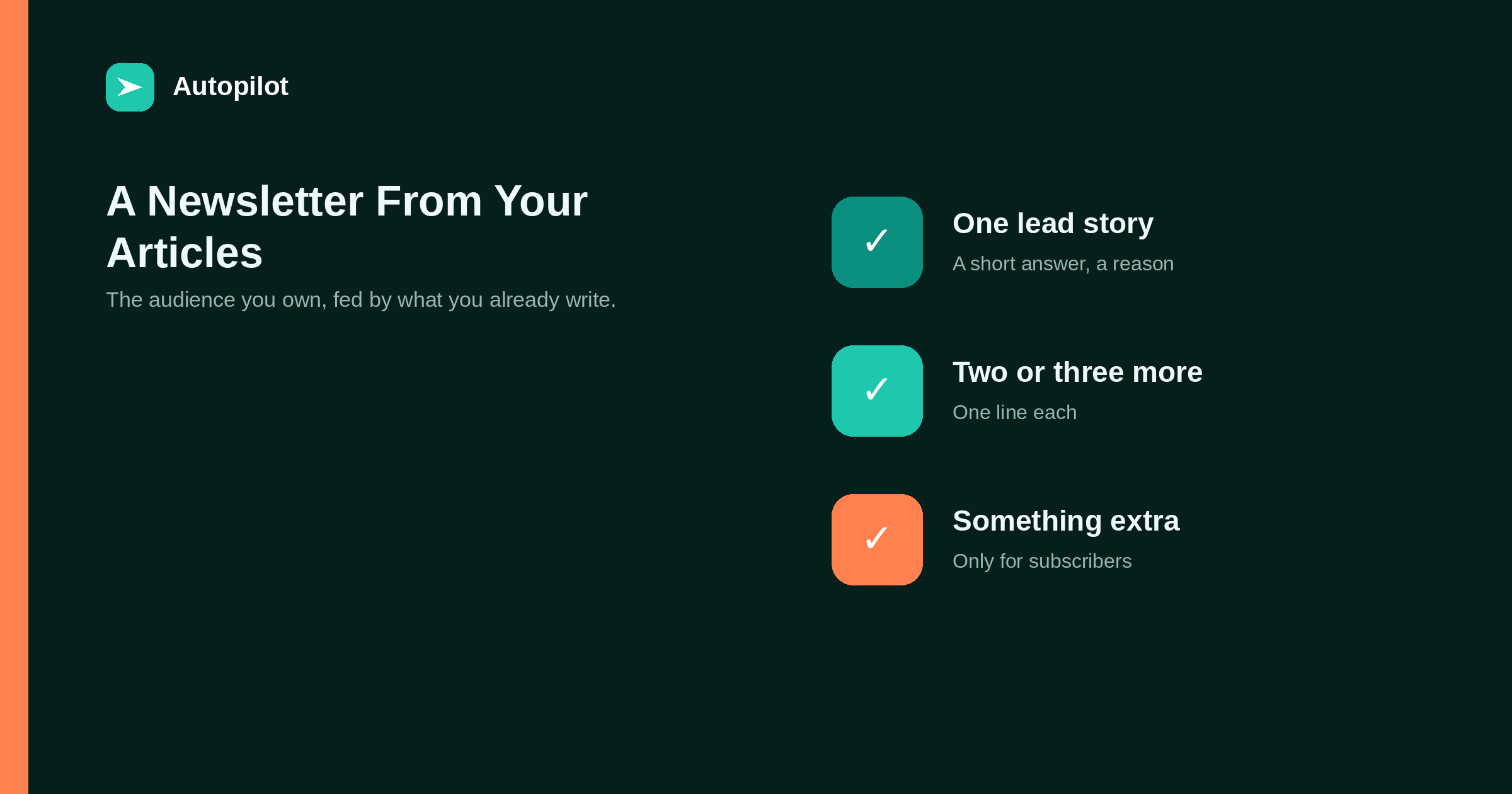
Short answer: send a regular email built around your recent articles: one lead item with the article’s short answer and why it matters, two or three shorter items with a line each, and one thing that is only in the newsletter — a behind-the-scenes note, a customer question, an opinion. Send at a pace you can keep, usually weekly, fortnightly or monthly. Invite sign-ups inside relevant articles rather than with pop-ups on arrival. Subscribers are an audience you own, unlike search or social reach.
Search traffic depends on algorithms and social reach depends on feeds, both controlled by someone else. A newsletter list is the one audience a business actually owns.
A blog is the easiest way to feed a newsletter, because the hard work — the substance — is already done. The skill is presenting it so the email is worth opening rather than a list of links.
Why it is worth doing
Subscribers have chosen to hear from you, so they read more of what you send and are closer to acting on it than someone arriving from a search result.
They are also a buffer against change. When a search update moves traffic or a network changes how posts are shown, the list is still there. For a business blog measured on enquiries, subscribers are frequently among the most valuable readers — the argument in traffic against leads.
The structure of an issue
A simple structure works for most business newsletters.
| Part | Content | Length |
|---|---|---|
| Lead item | The short answer from one article, plus why it matters now | 80–150 words |
| Two or three more | One line each on other recent articles | One sentence each |
| Subscriber-only | A note, an opinion, a question from a customer | A short paragraph |
| One call to action | The single thing you want them to do | One line |
The subscriber-only part is what turns the email from a digest into something people open. Without it, subscribers learn they can get the same by visiting the blog.
Avoiding a list of links
The most common newsletter is a heading, five article titles and five links. It is quick to produce and easy to ignore.
Give something in the email itself. The lead item should be useful even if nobody clicks: the answer, the key point, the decision. The link is for people who want the full reasoning.
The short answer at the top of each article is almost ready-made for this, which is one reason to write it carefully — see introductions that do not waste time.
How often to send
At a pace you can keep. Weekly suits a blog publishing several articles a week; fortnightly or monthly suits a slower one.
Consistency matters more than frequency. A monthly newsletter that arrives reliably builds more trust than a weekly one that appears three times and then goes quiet. If you are unsure, start monthly and increase once it is routine.
Growing the list
Sign-ups come mainly from readers who have just found an article useful.
- Inside relevant articles, after the section that solved the reader’s problem, with a line on what the newsletter contains.
- At the end of articles, as a natural next step.
- On a dedicated page showing a past issue, so people know what they will get.
Avoid pop-ups on arrival, which interrupt readers before they have any reason to subscribe and are a poor experience on phones — reading on a phone covers why.
Consent and the basics
Only send to people who have agreed to receive the newsletter, make unsubscribing a single click, and say who you are and why they are receiving it. In many jurisdictions these are legal requirements, not courtesies.
Use a proper email service rather than your own mail server, so messages are delivered reliably and unsubscribes are handled automatically.
Automating the routine part
Most email services can build a draft from your blog’s RSS feed, pulling in recent articles automatically. That saves time on the mechanical part.
Use it as a starting point, not the finished email. Replace the automatic excerpts with the articles’ short answers where useful, write the lead item and the subscriber-only note by hand, and choose the single call to action. Fifteen minutes turns an automated digest into a newsletter people look forward to.
A sample issue
To make the structure concrete, a monthly issue for a business publishing a few articles a month might read like this.
A two-line greeting, then the lead item: the short answer from the month’s most useful article, one sentence on why it matters right now, and the link. Then three one-line items on the other articles. Then a short paragraph that exists only in the email — a customer question from the month and how you answered it, or an observation that did not fit any article. Then one call to action, such as a reply with your own question.
It takes fifteen minutes to write once the articles exist, and it reads like a note from a person rather than a feed.
Measuring it
Opens are an unreliable measure now, because many email clients load images automatically or block them. Clicks, replies and unsubscribes are more useful.
Replies are especially valuable: they are conversations with people interested enough to write back, and they are a rich source of topics — the method in finding the gaps in your blog. A newsletter does not guarantee enquiries, but it keeps you in touch with the readers most likely to become customers.
Related reading
If this was useful, these cover the questions that usually come next.
- Repurposing an article — the newsletter as one format among several
- Traffic against leads — why subscribers are worth more than visitors
- Turning an article into social posts — the other main distribution channel
The bottom line
Build each issue around one useful lead item from a recent article, two or three one-line mentions, one subscriber-only note and a single call to action. Send at a pace you can keep, invite sign-ups inside relevant articles rather than with pop-ups, respect consent, and measure clicks and replies rather than opens.
FAQ
Should a business blog have a newsletter?
Usually yes. Subscribers are an audience you own, unaffected by search or social algorithm changes, and they are often closer to acting than other readers.
What should a blog newsletter contain?
A lead item with the short answer from one article, brief mentions of other recent articles, something only available to subscribers, and one call to action.
How often should I send a newsletter?
At a pace you can sustain: weekly for frequent publishers, fortnightly or monthly otherwise. Consistency matters more than frequency.
How do I get newsletter subscribers from my blog?
Offer sign-up inside relevant articles after the reader has been helped, at the end of articles, and on a page showing a past issue. Avoid pop-ups on arrival.
Can a newsletter be generated automatically from blog posts?
Most email services can draft one from your RSS feed. Treat it as a starting point and add a hand-written lead item and subscriber-only note.
Are open rates a reliable measure?
Less than they were, because many email clients load or block images automatically. Clicks, replies and unsubscribes are more informative.