ENEnglish
 LTLietuviškai
 DEDeutsch
 FRFrançais
 RUРусский
 ESEspañol
 PLPolski
 ITItaliano
 UKУкраїнська
 CSČeština
 PTPortuguês
 JA日本語
JA日本語 LVLatviešu valoda
 ETEesti
 HUMagyar
 IDBahasa Indonesia
 TRTürkçe
 HIहिन्दी
 ELΕλληνικά
 ARالعربية
 THไทย
THไทย VITiếng Việt
 RORomână
 MSBahasa Melayu
 BNবাংলা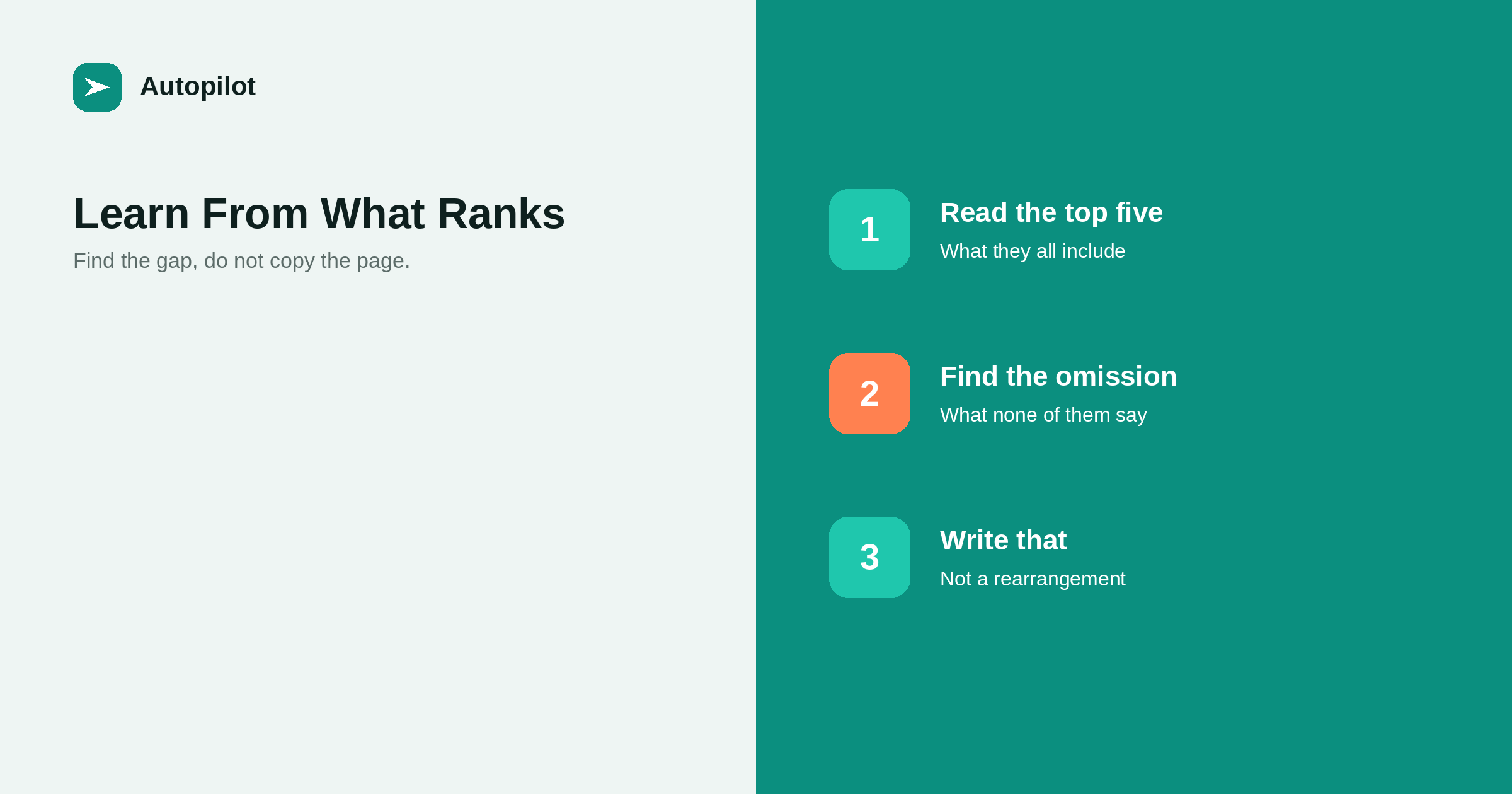
Short answer: read the five pages ranking for your query and note three things: what all of them include, which tells you what the query requires; what none of them include, which is your opportunity; and what format they share, which tells you the intent. Then write the article that covers the requirements properly and adds the missing part. Do not rearrange their sections or paraphrase their points — that produces a weaker version of pages that already have a head start, and it is the most common reason a well-researched article goes nowhere.
Looking at what already ranks is the most useful research you can do before writing, and the most misused. Done well, it shows you what the query demands and where the existing answers fall short. Done badly, it produces a sixth version of the same article.
The difference is whether you are reading for the gap or for the template.
What the ranking pages tell you
Before reading any page in detail, look at the set.
The format they share is the clearest signal of intent. If all five are step-by-step guides, the query wants steps. If they are comparisons, it wants a comparison. This is the single most important observation and it takes thirty seconds — search intent explains why it matters.
Who they are tells you the difficulty. Five pages from large, long-established sites is a different proposition from a forum thread and two small blogs.
How recent they are tells you whether freshness matters and whether the answers may have gone stale.
Read for requirements and omissions
Now read the pages, but with a specific grid in mind.
| Question | What it gives you |
|---|---|
| What do all five cover? | The minimum the query requires |
| What do most cover? | Probably expected, check why |
| What does only one cover? | A possible differentiator |
| What does none cover? | Your opportunity |
| What do they get wrong or leave vague? | Your credibility |
The last two rows are the point of the exercise. The first three just stop you from publishing something that obviously misses a requirement.
Where the omissions usually are
Across most subjects, ranking pages share the same weaknesses, and knowing them speeds up the reading.
- No first-hand detail. Everybody summarises; nobody says what happened when they did it.
- No trade-offs. Every option is presented as good.
- No numbers you can check. Or numbers with no date and no source.
- The hard part skipped. The setup is explained; the thing that goes wrong is not.
- Outdated specifics. Screens, prices or limits from a previous version.
Each of these is something you can supply, and most of them require experience rather than research — which is why they are missing.
Why copying the structure fails
The tempting move is to take the best-ranking page, keep its headings, and write each section better. It rarely works.
A page that already ranks has advantages you do not see: links it has collected, the time it has been there, the history of people clicking it. A slightly better version of the same page competes on its terms and generally loses.
What wins is a page that is different in a way readers value: it answers the part the others skip, it contains something only you know, or it is simply much clearer. That is also the only kind of page anybody has a reason to link to.
Staying on the right side of the line
There is a line between learning from a page and reproducing it, and it is not hard to see.
Learning: noting that all five pages cover permissions, and making sure yours does too. Reproducing: following their heading sequence, echoing their examples, paraphrasing their explanations sentence by sentence.
A practical rule is to close the competitor pages before you write. Your notes should record what is covered and what is missing, not how it was phrased. If your brief contains their wording, the article will too — and writing a brief an AI can use is where that discipline belongs.
Doing this efficiently at volume
Reading five pages per article is thirty minutes, which is sustainable for four articles a month and not for thirty.
At volume, do the full reading for your most important articles and a quick version for the rest: the format of the top three, the date of the top result, and one question none of them answer. Five minutes, and it catches the two mistakes that matter most — the wrong format and a page with nothing new in it.
Record the one missing question in the plan. It becomes the part of the brief that makes the article worth publishing.
When the honest answer is to skip the query
Sometimes the reading shows five excellent, current, specific pages from sites far stronger than yours. The right response is to write something else.
That is not defeat. There are far more questions than any site can answer, and spending effort on the ones where you can genuinely add something is better strategy than competing where you cannot. finding the gaps in your blog is where the alternatives come from.
None of this guarantees a ranking even where you do add something. It makes sure the effort goes into pages that have a reason to exist.
Related reading
If this was useful, these cover the questions that usually come next.
- Finding the gaps in your blog — the inside view of the same exercise
- Search intent — the first thing competing pages tell you
- Adding something original — the thing competitors cannot copy back
The bottom line
Read the ranking pages for requirements and omissions, not for a template. Match the format they share, cover what all of them cover, and then supply what none of them do — usually first-hand detail, real trade-offs and current specifics. Close their tabs before you write, and skip queries where you honestly cannot add anything.
FAQ
What is competitor content analysis?
Reading the pages that currently rank for a query to learn what it requires and where the existing answers fall short, so your page can meet the requirements and add what is missing.
How many competing pages should I read?
The top five for important articles. For routine ones, a quick look at the top three for format, the date of the leading result, and one question none of them answer.
Is it wrong to cover the same points as competitors?
No. If every ranking page covers something, the query probably needs it. The problem is copying their structure, examples and phrasing rather than covering the same requirement in your own way.
Why does a better version of the top page often fail?
Because the existing page has advantages you cannot see: links, age and click history. A slightly improved copy competes on its terms. A page that is different in a way readers value has a real reason to rank and to be linked.
What do competing pages most often leave out?
First-hand detail, honest trade-offs, checkable numbers with dates, the part of the process that goes wrong, and current specifics after a product has changed.
When should I not write for a query?
When the results are several excellent, current, specific pages from much stronger sites and you cannot add anything they lack. Write for a question where you can.