ENEnglish
 LTLietuviškai
 DEDeutsch
 FRFrançais
 RUРусский
 ESEspañol
 PLPolski
 ITItaliano
 UKУкраїнська
 CSČeština
 PTPortuguês
 JA日本語
 LVLatviešu valoda
 ETEesti
 HUMagyar
 IDBahasa Indonesia
 TRTürkçe
 HIहिन्दी
 ELΕλληνικά
 ARالعربية
 THไทย
 VITiếng Việt
 RORomână
 MSBahasa Melayu
 BNবাংলা
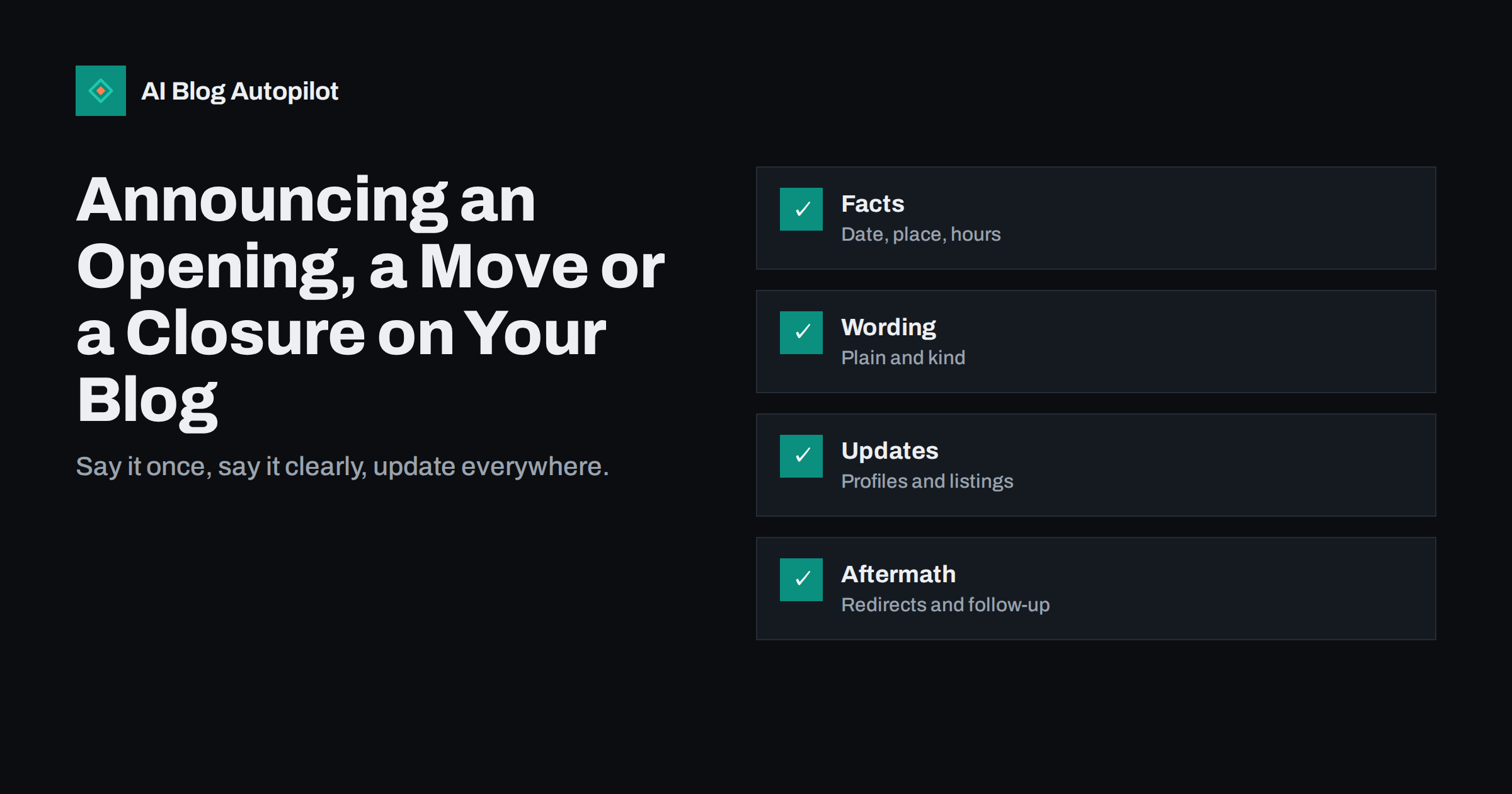
Short answer: when you open, move or close, publish one clear page with the date, place, hours and what happens next, announce it early, update your business profile, directories and social accounts the same day and keep the page live afterwards. For moves and closures, redirect old addresses so customers and search engines find the right place.
Changes to a business are exciting or sad, and they are also a practical problem. Customers need to know where to go, when and what to do with orders, vouchers or bookings. If they cannot find out, they will assume you have disappeared or go to a competitor.
This guide explains how to plan and write announcements for the three common cases: opening, moving and closing. It covers the wording, the checklists, the technical steps for websites and listings, and the follow-up that keeps your information accurate in the weeks afterwards.
Start with the facts
Before writing, collect the facts in one place. For an opening: date, address, hours, what is available, contact details and any launch events. For a move: the old and new addresses, the last day at the old place, the first day at the new one, what changes for customers. For a closure: the last day, what happens to orders and contracts, where customers can go.
Check every detail twice. A wrong date or address creates confusion that spreads quickly, because other sites and people copy it. Ask a colleague to read the facts aloud as if they were a customer and say what they would do next.
Decide what you can say and what you cannot. If a lease is not signed, a licence is not granted or a date might shift, say that dates are planned and give a way to confirm. Do not make promises that depend on others. The guide to event announcement posts uses a similar approach.
Announcing an opening
A new opening deserves an early, simple page. State what is opening, where, when and why people should care. Include a map or directions, parking and public transport, accessibility details and opening hours. Add a photograph of the place or the team, with a short welcome.
Publish early enough to build interest, but not so early that details change. A few weeks before is usual. Update the same page as details firm up, rather than creating several pages that compete. After the opening, change the wording from future to present so the page stays correct.
Consider a soft opening or a series of posts: building progress, meet the team, first products, opening day report. Each can link to the main page. Create your business profile on the main map services as soon as you can, since verification can take time. The guide to Google Business Profile updates explains the routine.
Prepare a short script for the phone and for the counter. Staff will receive the same questions many times: where are you now, when do you open, is the parking free, do you still do this service. A one-page cheat sheet with the answers keeps everyone consistent. Add a note to your voicemail and email auto-reply during the transition.
Announcing a move
A move is the most delicate announcement because customers may arrive at the wrong place. Put the news where they will see it: a notice on the website home page, a clear page, an email to customers, social posts and a sign at the old location. Repeat the date and address everywhere, using the same words.
Explain what changes and what does not. Do phone numbers, email addresses and opening hours stay the same? Will services be unavailable during the move? How will you handle orders, repairs, appointments and deliveries already in progress? Answers to these questions prevent a flood of calls.
Update your details across the web on the day. Business profile, directories, social accounts, supplier records and your own website’s contact page should all show the new address, and the old address should be marked as closed or moved where possible. Ask partners to update their links. See location pages for several branches if you have more than one site.
Think about the people behind the business as well. Staff, suppliers and regular customers will each want to hear the news in the right order. Tell employees and key partners before the public announcement, and give them a short summary so that they can answer questions consistently. Nothing damages goodwill like learning about a closure from a social media post.
If the closure is temporary, for refurbishment, illness or seasonal reasons, say so and give a reopening date or an honest “we will update this page”. Mark opening hours accurately on every listing in the meantime, since wrong hours are one of the most common complaints in reviews.
Announcing a closure
Closure announcements require honesty and kindness. Say what is happening, the last day and what customers should do now. Thank them sincerely and briefly, without drama. Customers care mostly about practical matters: refunds, vouchers, warranties, repairs, stored items and personal data.
Explain the arrangements clearly. If you are referring customers to another business, say why and make sure that business has agreed. If you are closing only part of the business, such as one branch or product line, state what continues. If the website will remain as an archive, say so.
Check legal and contractual duties, such as notice periods, consumer rights and data protection. If in doubt, ask a professional adviser. Avoid blame or speculation on the page. A calm, factual note preserves goodwill, which can matter if you start something new later. The guide to handling corrections shows how to keep a tone of respect.
Here is a short example for a move. “From Monday 3 March we are at 12 High Street, a five-minute walk from our old shop. Our phone number, opening hours and online ordering stay the same. If you have an order or a repair in progress, nothing changes; just collect it from the new address. Come and say hello, and thank you for your support over the years.” In five sentences it states the date, the place, what stays the same, what to do and a thank-you.
A closure note can follow the same shape: “Our last day of trading is Friday 28 February. If you hold a voucher, please use it by that date or contact us for a refund. Repairs in progress will be ready for collection by the 21st. Thank you for being our customers; it has been a pleasure.” Plain, specific and kind.
Wording that works
Lead with the news in plain words. A headline such as “We are moving to 12 High Street on 3 March” says everything. Follow with the essential facts, then the details. Keep sentences short and avoid jargon, euphemism and long introductions.
Use a tone that fits your brand and the news. Openings can be joyful, moves practical, closures sober. Do not use humour that could offend, and do not promote unrelated offers in a closure notice. Be especially careful with dates written as numbers, which can be read in different ways; spell out the month.
Write for people who skim. Use headings such as “What changes”, “What stays the same” and “What you need to do”. Put the date and address near the top. Provide a phone number and an email for questions and say how soon you will reply.
Update your website, listings and social profiles
Update your own website first: contact page, footer, home page, location page and any structured data that contains addresses or hours. Mark the announcement page with a clear date. Check that your site’s text, images and schema all say the same thing.
Then update external listings: your business profile, map services, directories, review sites, supplier and partner pages. Many of these copy each other, so correct the main ones first. Search for your business name and address and fix wrong results. The guide to business details in AI answers explains why consistent information helps assistants give correct answers.
Finally, social profiles: update bios, pinned posts, links and cover images. Pin the announcement for a while, then replace it with the new normal. Remember to update email signatures and printed material, and schedule posts around the key dates so that the message does not fade.
Keep a simple log of every place you changed. A list of the website, profiles, directories and partners that you updated, with dates, makes it easy to find what you missed when a customer reports an old address still showing somewhere. Revisit the list after two weeks and again after two months.
Redirects, old pages and the weeks after
If a move or rebrand changes web addresses, set up permanent redirects from old pages to the closest new ones. Do not send everything to the home page. Check that the redirects work and that no chains form. The guide to 301 versus 302 redirects explains which to use.
For a closure, decide what to do with the site. You may keep a simple notice page, redirect to a successor or remove pages after a period. Where information has permanently gone, a correct “gone” response can be appropriate. See when to return 410 Gone for the reasoning.
In the weeks afterwards, watch for confusion. Monitor calls, emails, reviews and search results, and answer questions promptly. Update the announcement with a short note, such as “We have now moved”, when the change is complete. After a few months, review the page and archive it if it no longer helps.
How AI Blog Autopilot helps
Business changes are easier to manage when the blog already runs on a steady rhythm. AI Blog Autopilot writes and shares articles on schedule, and you can pause your regular output around important news and post the announcement yourself. See the plans and try the three free articles.
Related reading
The bottom line
Collect the facts, publish one clear page early, update every listing on the same day, redirect old addresses and keep watching for confusion afterwards.
FAQ
How early should I announce a move or opening?
A few weeks before is usual, early enough to inform people but late enough that details are firm. Update the same page as things change.
What should a closure notice include?
The last day, what happens to orders, vouchers and warranties, where customers can go and how to reach you with questions.
Which listings should I update first?
Your own website, then your business profile on map services, then directories, review sites and social accounts.
Do I need redirects when I move?
If web addresses change, yes. Redirect old pages to the closest new ones with permanent redirects, not to the home page.
Should I keep the announcement page afterwards?
Keep it live and update the wording, then review it after a few months and archive it if it no longer helps.