ENEnglish
 LTLietuviškai
 DEDeutsch
 FRFrançais
 RUРусский
 ESEspañol
 PLPolski
 ITItaliano
 UKУкраїнська
 CSČeština
 PTPortuguês
 JA日本語
JA日本語 LVLatviešu valoda
 ETEesti
 HUMagyar
 IDBahasa Indonesia
 TRTürkçe
 HIहिन्दी
 ELΕλληνικά
 ARالعربية
 THไทย
THไทย VITiếng Việt
 RORomână
 MSBahasa Melayu
 BNবাংলা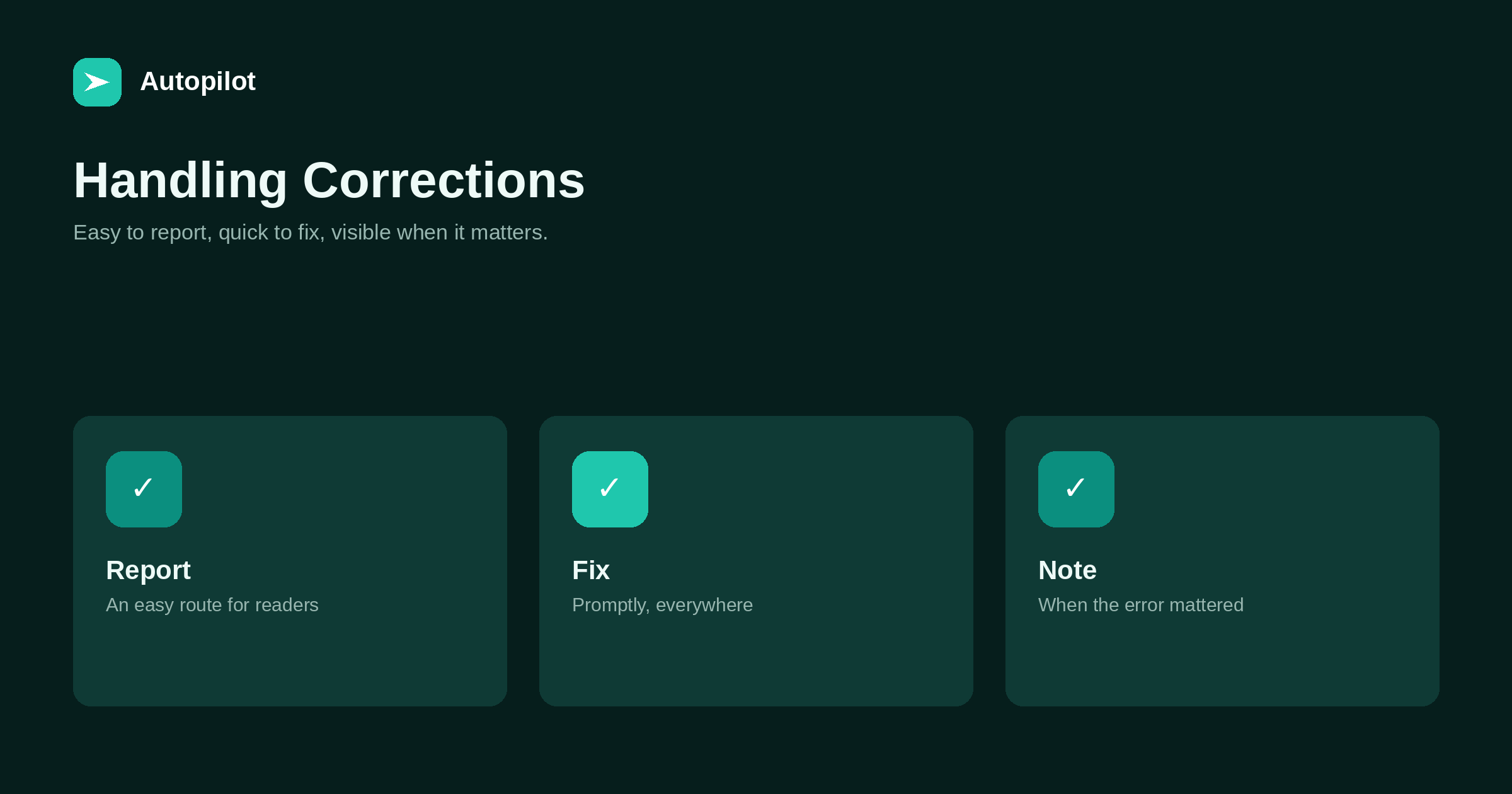
Short answer: make it easy for readers to report errors, respond promptly, and fix confirmed errors in the article itself. For small slips such as typos, just correct them. For errors that changed the meaning or could have affected a reader’s decision — a wrong price, rule, date or claim — add a short dated note saying what was corrected. Search your other articles for the same error, update the instructions or fact list so it does not recur, and thank the reader who reported it.
Every blog eventually publishes something wrong: an outdated price, a misremembered rule, a wrong date. What matters is how the error is handled.
Handled well, a correction builds trust, because it shows someone is paying attention and cares about accuracy. Handled badly — ignored, or quietly changed with no acknowledgement of a significant error — it erodes trust.
Make reporting easy
Readers will not report errors if it is hard to. Offer a simple route: an email address or form mentioned in the editorial policy and at the end of articles.
Monitor it and respond within a few days, even if only to say the report is being checked.
Decide what kind of error it is
Not every correction needs the same treatment.
| Error | Example | Treatment |
|---|---|---|
| Typo or formatting | A misspelled word | Fix silently |
| Minor factual slip | A wrong but unimportant detail | Fix, note optional |
| Material error | A wrong price, rule, date or claim | Fix and add a dated note |
| Fundamental error | The article’s main point is wrong | Rewrite or remove, with a note |
A material error is one that could have affected a reader’s understanding or decision.
Writing a correction note
Keep it short and factual, placed at the end of the article or near the corrected passage: Correction, 12 August 2026: an earlier version gave the wrong filing deadline. It has been corrected.
No lengthy apology is needed, and there is no need to repeat the wrong information in full.
Fix it everywhere
The same error often appears in several articles, especially on a blog produced at volume. Search the site for the wrong fact and correct every instance.
Check the FAQ sections, structured data, social posts and newsletters that repeated it, where practical.
Stop it recurring
An error found once is a sign of a gap in the process. Add the correct fact to the list of facts articles may state, or add the wrong claim to the forbidden list in the instructions.
quality control at volume covers turning corrections into instruction changes.
Update dates honestly
A material correction is a meaningful change, so updating the article’s modified date is appropriate. A typo fix is not. Article structured data covers keeping dates honest.
Thank the reader
A short reply thanking the reader who reported an error, and saying what was changed, turns a potential complaint into a positive experience. It also encourages more reports, which improves the blog.
Removing articles
Occasionally an article is so wrong, or so outdated, that correcting it is not practical. Remove it, or replace it with a correct version, and redirect the URL to the best alternative. For significant articles, a short note on the replacement explaining the change is courteous — deleting, merging or redirecting covers the mechanics.
Corrections on automated blogs
On a blog produced at volume with automation, an error in the instructions or source facts can appear in many articles at once. The search-and-fix step matters more: when one error is found, assume it may be widespread and check.
A list of the facts each article states — kept in the content inventory — makes this quick. Without it, finding every instance of an outdated price across hundreds of articles can take hours. A content inventory covers the column worth adding.
Keeping a corrections log
Record each correction: the date, the article, what was wrong, how it was found, and what was changed in the process as a result. A simple log shows patterns over time: which kinds of claim go wrong, which subjects need more careful review, and whether the process is improving.
Review the log quarterly alongside other quality measures. A falling number of material corrections is one of the clearest signs that review and instructions are working.
When a reader is wrong
Sometimes a reported error turns out not to be one. Reply courteously, explain with sources why the article is correct, and consider whether the article could be clearer, since a reader misunderstanding it may mean others do too.
Corrections to social posts and newsletters
If a material error was also shared on social networks or in a newsletter, a short follow-up is often appropriate, especially if readers may have acted on it. A brief note in the next newsletter, or a reply to the original social post, reaches people who saw the error but may never revisit the article.
Keep the follow-up proportionate. A minor slip does not need an announcement; a wrong deadline that could cost readers money does.
Corrections and structured data
If the corrected information also appears in FAQ answers or other structured data, update it there too, so what search engines read matches what readers see. Generating structured data from the same source as the visible text prevents the two from drifting apart.
Preventing errors at the source
Most corrections trace back to a small number of causes: an outdated fact list, a vague instruction, a subject reviewed by someone without expertise, or a claim nobody checked. The corrections log shows which cause is most common on your blog. Fixing that one cause usually removes most future corrections, which is far cheaper than correcting articles one by one after readers notice.
Corrections and trust
A visible corrections process does not guarantee rankings. It makes the blog more trustworthy to readers, and it shows the accountability that guidance on reliable content emphasises — experience, expertise and trust.
Related reading
If this was useful, these cover the questions that usually come next.
- Fact-checking before you publish — preventing errors in the first place
- An editorial policy page — where the corrections policy lives
- Quality control at volume — catching errors at scale
The bottom line
Offer an easy way to report errors and respond promptly. Fix typos silently, but add a short dated note for material errors. Search for and fix the same error across the site, update instructions or fact lists so it does not recur, update dates only for meaningful changes, and thank the reader who reported it.
SSS
How should a blog handle factual errors?
Fix them promptly, add a dated note for material errors, check other articles for the same error, and update your process.
Should every correction be noted on the article?
No. Typos can be fixed silently. Errors that could affect a reader’s understanding or decision should be noted.
What should a correction note say?
The date and a brief statement of what was corrected, without repeating the wrong information in full.
How do I let readers report errors?
Provide an email address or form in the editorial policy and at the end of articles, and respond within a few days.
Should I update the article date after a correction?
For material corrections, yes. For typo fixes, no.
How do I stop the same error recurring?
Add the correct fact to your approved fact list or the wrong claim to the forbidden list in your instructions.