ENEnglish
 LTLietuviškai
 DEDeutsch
 FRFrançais
 RUРусский
 ESEspañol
 PLPolski
 ITItaliano
 UKУкраїнська
 CSČeština
 PTPortuguês
 JA日本語
JA日本語 LVLatviešu valoda
 ETEesti
 HUMagyar
 IDBahasa Indonesia
 TRTürkçe
 HIहिन्दी
 ELΕλληνικά
 ARالعربية
 THไทย
THไทย VITiếng Việt
 RORomână
 MSBahasa Melayu
 BNবাংলা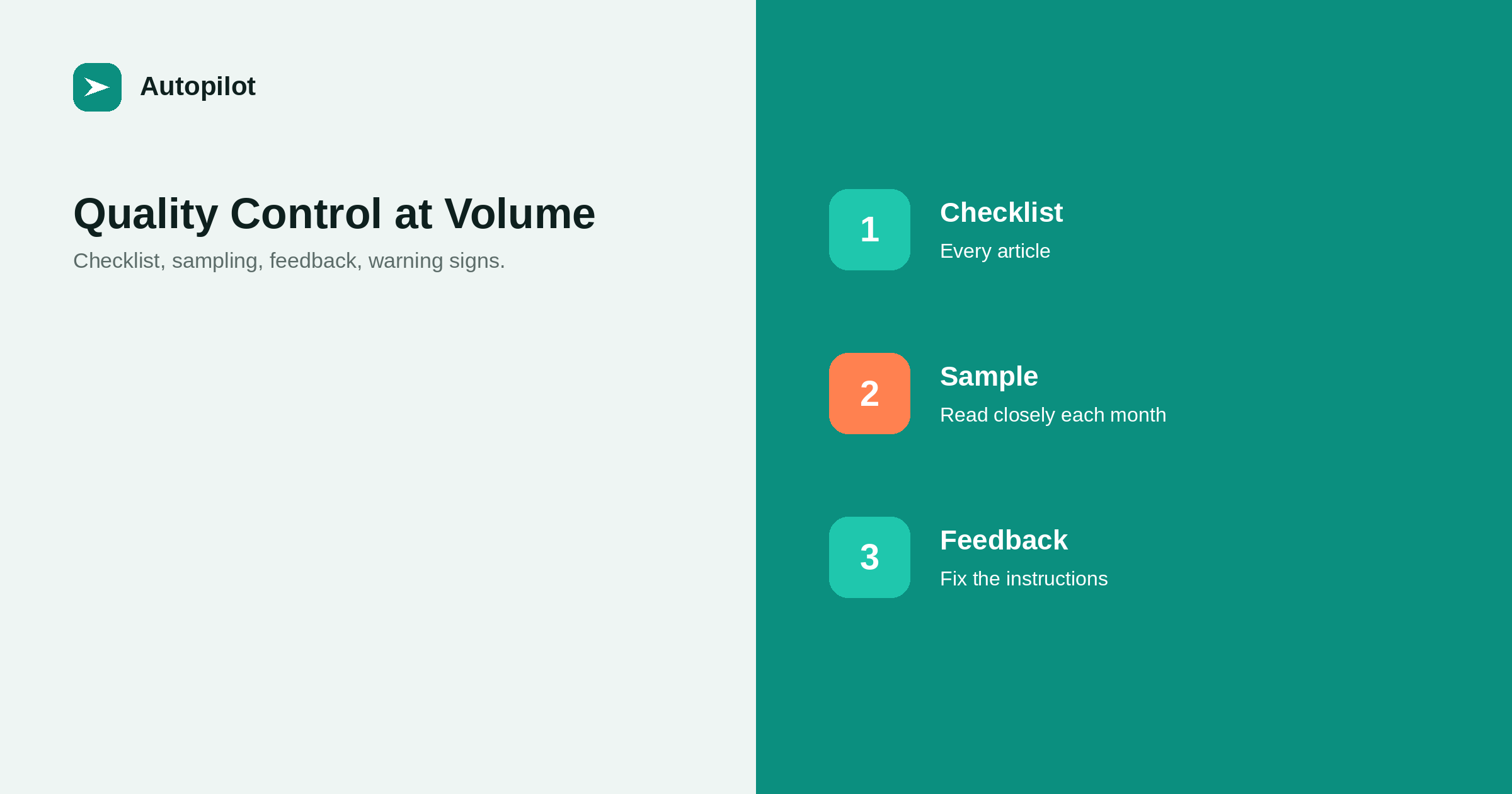
Short answer: at volume, quality control needs three layers: a short checklist applied to every article before or soon after publication, a monthly sample of articles read closely by someone experienced, and a feedback loop that turns every recurring problem into a change in the instructions. Watch for warning signs that volume has outrun review: a growing backlog, recurring errors, topic overlap, voice drift, and published pages nobody has looked at. When they appear, slow down until the process catches up.
At a few articles a month, quality control is simply someone reading each article carefully. At dozens a month, that one careful reader becomes a bottleneck, and the temptation is to read less carefully rather than to design a better system.
A designed system catches more problems with less effort, and it improves the output over time rather than just correcting it.
Layer one: a checklist for every article
A short checklist, applied to every article, catches the problems that matter most.
| Check | Looking for |
|---|---|
| Claims | Prices, dates, numbers, features: correct or removed |
| Answer | The question answered in the first hundred words |
| Structure | Descriptive headings, no empty sections |
| Additions | Something only the business knows |
| Metadata | Title, description, category, tags, image |
| Page | Renders correctly on a phone |
Ten to twenty minutes per article. editing a draft covers the review passes in detail.
Layer two: monthly sampling
Each month, pick a sample of published articles — five or ten, chosen at random plus any that performed unusually — and have someone experienced read them closely.
The sample catches what the checklist misses: subtle inaccuracies, weak reasoning, voice drift, articles that technically pass but do not help anyone.
Layer three: the feedback loop
Every problem found should lead to a question: what change to the instructions would prevent this next time?
A claim removed twice becomes a forbidden claim in the brief. A tone problem becomes an example in the voice guide. A structural problem becomes a rule in the template. Over months, the instructions improve and the checklist finds less — writing a brief an AI can use covers where the changes go.
Facts first
Of all checks, accuracy matters most, because errors in prices, rules and product details cause real harm and repeat across articles if not caught.
Keep a list of facts about your business that articles may state, with current values, and check articles against it. fact-checking before you publish covers the process.
Warning signs
Some signs mean volume has outrun quality control.
- A review backlog that grows each week.
- The same errors appearing repeatedly.
- New articles overlapping existing ones.
- Articles that sound alike regardless of subject.
- Published pages that nobody has opened.
When they appear, reduce volume until the process catches up. Publishing faster than you can check creates problems that take longer to fix later.
Risk-based review
Not every article needs the same scrutiny. Articles touching money, health, safety, law or your own pricing need full review by someone qualified. General explanatory articles on low-risk subjects can move to lighter review once months of evidence show few problems.
draft, approve or full auto covers setting review levels by category.
Checking the published page
Some problems appear only on the live page: a missing image, a broken table on a phone, the wrong category, a link to a page that does not exist yet. Open each new article, or at least a sample, on a phone after publication.
Recording quality
Track a few simple numbers each month: articles published, articles reviewed, corrections made per article, and problems found in the sample. Falling corrections per article mean the instructions are improving; rising numbers mean something has changed.
Who reviews
Reviewers need knowledge of the subject and authority to change or stop an article. A reviewer who can only fix commas cannot catch a wrong claim about how the product works; a reviewer who can find problems but not act on them becomes a source of notes nobody reads.
For specialised subjects, a subject expert reviewing a sample closely is often more effective than a generalist reviewing everything lightly. Combining the two — generalist checklist for every article, expert for the sample and sensitive categories — covers most needs.
Handling errors that get through
Some errors will reach publication whatever the process. What matters is fixing them quickly and openly. Correct the article, add a short note if the error was material, check whether the same error appears in other articles, and update the instructions so it does not recur.
A visible correction policy, linked from the footer, shows readers that errors are taken seriously. Disclosing how content is produced covers editorial policies.
Tools that help
Several checks can be partly automated: spelling and style against your guide, broken links, missing alt text, missing metadata, and structured data validation. Automating them frees reviewer time for the checks that need judgement: accuracy, usefulness and whether the article genuinely answers its question.
Quality across writers and tools
When articles come from several sources — different writers, an agency, automated drafting — compare their error rates in the monthly sample. One source consistently needing more corrections tells you where to focus: clearer instructions, more review, or a different source.
Share the findings with whoever produces the content. Most quality improves quickly once people see the specific problems their work creates.
A monthly quality meeting
Thirty minutes a month with the people who plan, review and publish is enough to go through the sample findings, agree instruction changes, and decide whether volume should rise, hold or fall. Keeping it short and regular matters more than making it thorough.
What quality control can promise
Good quality control makes articles accurate, consistent and useful. It does not guarantee traffic or rankings, which depend on much else. It does protect the business from publishing things it would not want to stand behind, which matters more as volume grows.
Related reading
If this was useful, these cover the questions that usually come next.
- Scaling from 4 to 30 posts a month — the process around it
- Editing a draft — the per-article review
- Fact-checking before you publish — the most important check
The bottom line
Apply a short checklist to every article, sample several closely each month, and turn every recurring problem into a change in the instructions. Put facts first, review by risk, check the live page, track corrections over time, and slow down when warning signs appear.
SSS
How do I maintain quality when publishing many articles?
Use a checklist for every article, a monthly close-reading sample, and a feedback loop that improves the instructions.
What should a content quality checklist include?
Claims, the answer near the top, structure, original additions, metadata and how the page renders on a phone.
How many articles should be sampled?
Five to ten a month is usually enough, chosen at random plus any that performed unusually.
What are signs that quality is slipping?
A growing review backlog, repeated errors, topic overlap, articles sounding alike, and published pages nobody has checked.
Should every article get the same review?
No. Sensitive subjects need full review; low-risk categories can move to lighter review once evidence supports it.
Does quality control improve rankings?
Not directly. It makes articles accurate and useful, which is the foundation, but rankings depend on more.