ENEnglish
 LTLietuviškai
 DEDeutsch
 FRFrançais
 RUРусский
 ESEspañol
 PLPolski
 ITItaliano
 UKУкраїнська
 CSČeština
 PTPortuguês
 JA日本語
 LVLatviešu valoda
 ETEesti
 HUMagyar
 IDBahasa Indonesia
 TRTürkçe
 HIहिन्दी
 ELΕλληνικά
 ARالعربية
 THไทย
 VITiếng Việt
 RORomână
 MSBahasa Melayu
 BNবাংলা
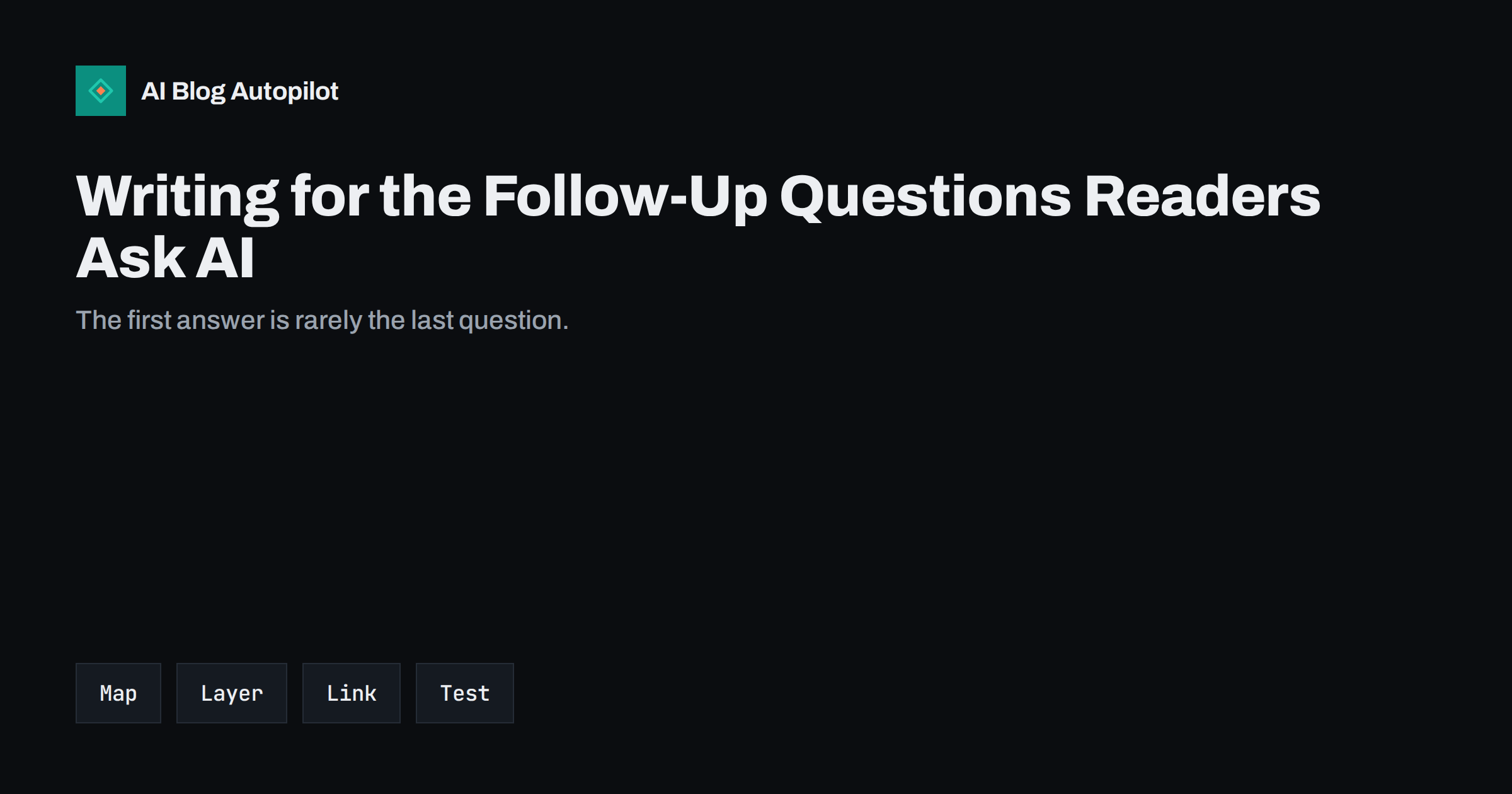
Short answer: people using AI assistants often ask a second and third question after the first answer, so a page that answers only the opening question loses the conversation. To write for follow-ups, map the questions a reader asks next, answer in layers with a short answer first and detail below, give each follow-up its own clear heading or page, link them together and test the chain by asking the assistant yourself.
Search used to be a series of separate queries. Chat-style assistants work as a conversation, in which each answer leads to a refinement: “and what about cost?”, “is that safe for beginners?”, “what should I do first?”. A site that anticipates these steps is more useful to the reader and gives an assistant more material to use. This guide shows how to plan for it without guessing about how any one system works.
How conversations differ from single searches
A single search is a short phrase and a list of pages. A conversation carries context: the assistant remembers what was said and the next question may be only a few words. The reader does not repeat “for a small bakery in a rented shop” in each message, and expects the answer to stay in that frame.
This has two consequences for a publisher. Questions become more specific as the chat goes on, so pages that cover a narrow point well have a chance of being useful at a later stage. And the assistant may combine information from several sources, so each page needs to be clear on its own, without relying on the reader having seen the page before it.
It is worth being modest about what is known. How assistants select and combine sources changes, and no publisher controls it. What you can control is the quality, clarity and completeness of the answers on your own site, which is also what readers want. Our guide to how AI search picks sources explains the general picture.
Map the questions that come next
Start from a topic you already cover and write down the first question a reader would ask. Then list the three or four questions that naturally follow. For “how much does a blog cost”, the next questions are likely to be: what affects the price, what is included, how long until it pays back and what can I do cheaply first.
Collect these from real sources. Customer emails, calls and chat messages show what people ask after the first answer. The “People also ask” boxes and the related searches show common continuations. Our guide to turning customer questions into useful blog topics describes how to gather them in a routine way.
Sort the follow-ups into types. Some ask for detail (“how exactly?”), some for limits (“when does this not work?”), some for comparison (“is it better than…?”), some for a decision (“should I?”) and some for the next action (“how do I start?”). A post that covers all five types for its topic is rarely thin.
Answer in layers
Put the direct answer first in a few sentences, and then add layers beneath it: the reasons, the steps, the exceptions and the examples. A reader who wants only the first answer gets it at once, and a reader who wants more can continue. An assistant that quotes a passage can take the opening paragraph without losing sense.
Use headings that look like the question a reader would ask next. “What does it cost?” and “When should you not do this?” are clearer than “Pricing considerations” and “Limitations”. Question headings also match the way people phrase follow-ups. See question headings for AI answers for more on this.
Keep each section self-contained. Define a term the first time it appears in that section, name the subject in full instead of “it” at the start, and give the number with its unit. A passage lifted out of context should still make sense. This is the same discipline as in answer-first writing.
Give each follow-up a home
Some follow-ups fit as a section in the same post, and others deserve a separate page. The test is the size of the answer: if it takes two paragraphs, a section is enough, and if it takes a full page with its own examples, make it a post. Splitting too finely creates thin pages, and merging too much creates long pages in which the answer is hard to find.
Link the pieces so that a reader, or a crawler, can follow the path. At the end of a section on cost, link to the post on what affects the price. In the post on choosing a provider, link to the checklist. Descriptive anchor text helps both people and systems understand what the next page offers, as described in anchor text for internal links.
A hub page that lists the questions on a topic with short answers and links is a useful starting point. It resembles an FAQ, but goes wider and links to detailed posts. Our guide to content clusters and pillar pages shows how to arrange such a hub.
Include the awkward follow-ups
The questions that readers ask last are often the ones that businesses avoid: the real cost, the downsides, the cases in which the product is not the right choice. If you do not answer them, somebody else will, and an assistant will use whatever it finds. Honest answers build trust, and trust is the reason people return.
Say who something is not for, and what the alternatives are. Give ranges and explain what moves a figure up or down. If a policy changes over time, say when the page was last checked. Readers and assistants both treat a page with clear limits as more reliable than one that promises everything.
Do not invent answers. If you do not know, say so, and point to where the reader can find out. A false answer in a chain of questions spreads quickly, and corrections are hard to make once an answer has been repeated elsewhere. See when AI answers are wrong about your business for what to do if that happens.
Test the chain in an assistant
Ask the assistant your first question and then the follow-ups you expect, as a customer would. Note which answers are correct, which sources are named and which of your pages appear. Where the assistant gets something wrong or leaves something out, look for a gap on your site: a missing page, a vague sentence or a fact that is hard to find.
Repeat with different phrasings and in the languages of your readers. Do not draw conclusions from one run, as answers vary between attempts. Keep a simple log with the date, the question, what appeared and what you changed. Our guide to how to check visibility in AI answers offers a routine that takes little time.
Use the results to update existing pages rather than to write more. Often a short addition, such as a limit, a definition or a worked example, fills a gap. Refreshing is cheaper than starting again, and it follows the advice in updating old posts for AI answers.
A worked example
Take a small accountancy practice that publishes a post titled “How to choose an accountant for a freelance business”. The first question is the title. The likely follow-ups are: what does an accountant do that software does not, what does it cost per month, what should I bring to the first meeting, can I change accountant later and what are the warning signs of a poor one.
The post answers the first question in a short paragraph and then gives one section to each follow-up, using the question as its heading. Cost has its own post with ranges and the factors that change them, and the first meeting has a printable checklist. Each section links to the next relevant page, and the FAQ at the end collects the short answers.
When the owner later asks an assistant the same chain of questions, the answers are more likely to find something specific to quote, and the owner can see at once which links in the chain are missing. The same approach works for a shop, a clinic, a software tool or a hobby blog: list the chain, answer each link plainly and join them with links.
Keep the reader first
The aim is not to produce text for machines. A page built around the real questions of a reader is easier for people to follow: it has a clear order, honest limits and next steps. Resist the urge to split content into many shallow pages in the hope of catching more follow-ups, and resist adding questions that nobody asks.
Measure what matters. Watch whether readers move from one of your pages to the next, whether they reach the contact or sign-up step and whether the questions that customers send to you become less repetitive. If so, your answers are doing their job, whether the reader came through a search box or a chat.
Review the chain every few months. New products, prices and rules change the questions that people ask, and a follow-up that mattered last year may be obsolete. Put the review in your calendar next to the dates when you refresh your most visited posts, and add a note of what you changed.
Keep a short list of questions that you could not answer. They are the best source of new topics, and they often point to knowledge that only your business has. Interview a colleague, check the facts and publish the answer once you are sure of it.
How AI Blog Autopilot helps
AI Blog Autopilot plans a month of articles from the topics, keywords, audience and tone you give it, and each article includes an FAQ section with FAQ markup, tags and SEO meta. Add your follow-up questions as topics and the plan covers the chain over several weeks, with each article linking to the others. See the pricing page for plans.
Related reading
- Question Headings That Help AI Answers Find Your Page
- How to Check Your Visibility in AI Answers
- Answer-First Writing: Put the Point at the Top
The bottom line
Plan for the second and third question, answer in layers, give each follow-up a clear home and link them together, include the awkward answers and test the whole chain in an assistant the way a real customer would.
SSS
What is a follow-up question in an AI chat?
It is the next question a person asks after the first answer, often short and relying on the earlier context.
Do I need a separate page for each follow-up?
Only if the answer needs a full page. Smaller points work as clearly headed sections in a single post.
Can I control which questions an assistant asks next?
No. You can only make your pages clear, complete and linked, so they are useful at whatever stage a reader asks.
How do I find likely follow-ups?
Use customer emails, chat messages, People Also Ask boxes and related searches, and test chains in an assistant yourself.
Should I write for assistants or readers?
Write for readers. Clear, honest, well-structured pages serve both.