ENEnglish
 LTLietuviškai
 DEDeutsch
 FRFrançais
 RUРусский
 ESEspañol
 PLPolski
 ITItaliano
 UKУкраїнська
 CSČeština
 PTPortuguês
 JA日本語
JA日本語 LVLatviešu valoda
 ETEesti
 HUMagyar
 IDBahasa Indonesia
 TRTürkçe
 HIहिन्दी
 ELΕλληνικά
 ARالعربية
 THไทย
THไทย VITiếng Việt
 RORomână
 MSBahasa Melayu
 BNবাংলা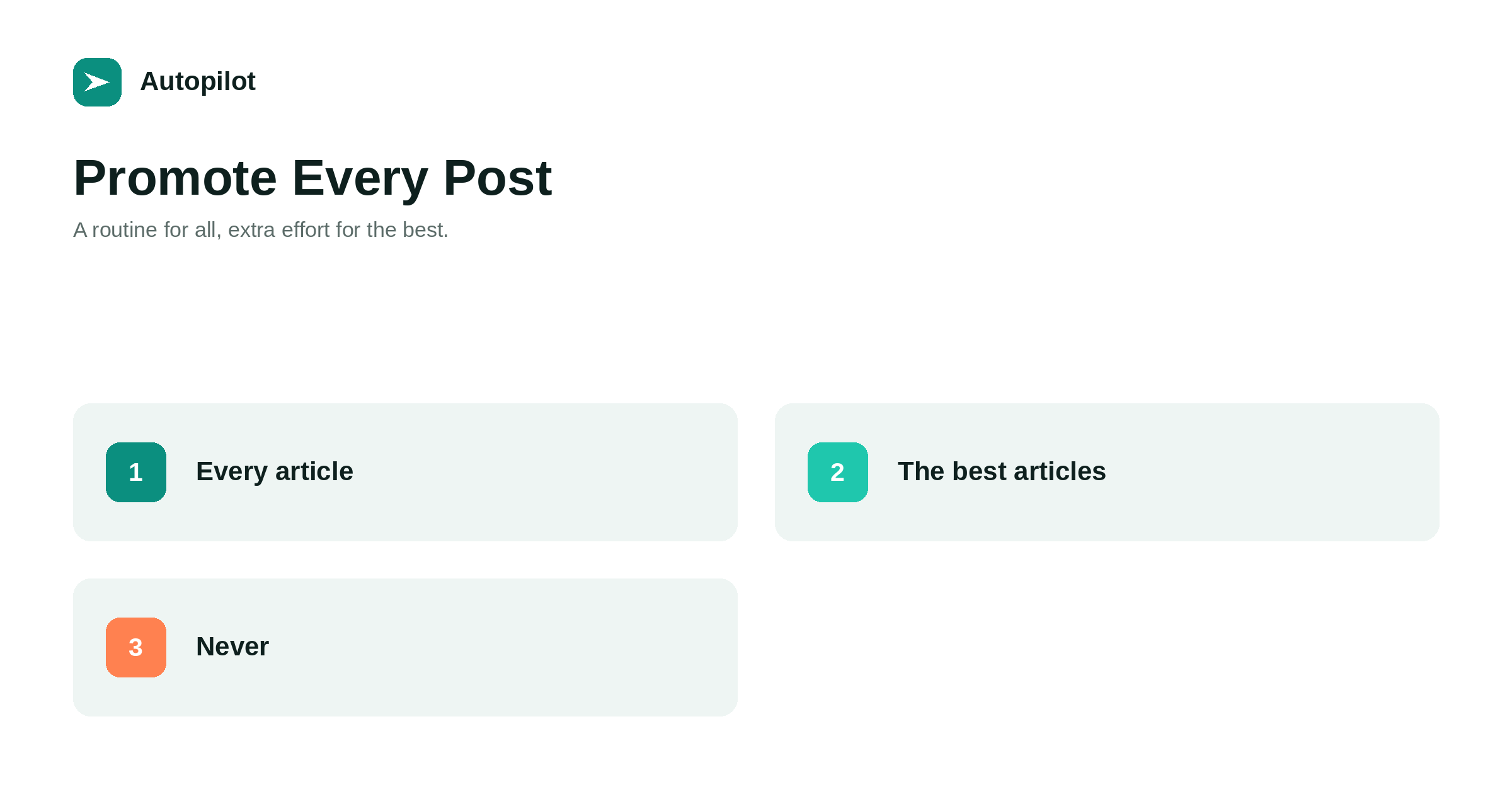
Short answer: every article gets a routine: share it to your social networks, link to it from two or three related existing articles, make sure search engines are notified, and give it to anyone in the business who answers the question it covers. Your best articles — those with original material or strong demand — get more: a newsletter feature, hand-written posts over several weeks, direct notes to people who would genuinely find it useful, and periodic reshares. Avoid dropping links into communities where you do not otherwise take part.
The usual pattern is that an article takes hours to produce and seconds to promote: one post on one network, then nothing. Most of the people it could help never learn it exists.
A promotion routine fixes that without much extra time, because most of it can be standardised and some of it automated. The real effort is reserved for the few articles that deserve it.
The routine for every article
Five steps, applied to every new article, most of which take a minute.
- Share to your social networks, with an image and an opening line that carries one idea — turning an article into social posts covers writing it.
- Link from existing articles. Add a link from two or three related articles that already get traffic. This is the most underused step and one of the most effective.
- Make sure search engines know. A sitemap handles this over time; IndexNow speeds it up for the engines that support it.
- Tell your colleagues. If sales or support answer this question, they should have the link.
- Check the page on a phone before any of the above.
Steps one and three automate well. Steps two and four need a person but take minutes.
Why internal links come second
A new article has no links pointing to it, no history and no audience. Your existing articles have all three.
A link from a related article that already gets steady traffic sends readers immediately, helps search engines discover the new page faster, and tells them how it relates to the rest of the site. It costs one sentence per link. internal linking as you publish explains how to choose the articles and write the anchor text.
This is also the only promotion step that keeps working indefinitely: every future reader of the old article sees the link.
Choosing which articles get more
Not every article deserves extra promotion. Choose the ones with a reason to travel.
| Signal | Why it deserves more |
|---|---|
| Original material | Something people cannot find elsewhere |
| Answers a frequent customer question | Your team and customers will use it |
| Strong search demand | Worth accelerating early visibility |
| A clear, arguable position | Invites replies and discussion |
| A useful table or checklist | People save and share these |
One or two articles a month usually qualify. Spending extra effort on those rather than spreading it thinly across everything gives far better returns.
Extra steps for the best articles
For the chosen few, add:
- A newsletter feature as the lead item — see a newsletter built from your articles.
- Two or three hand-written posts over the following weeks, each carrying a different idea from the article.
- Short personal notes to people who would genuinely find it useful: a customer who asked the question, a partner whose readers care about it, someone you quoted.
- Repurposing into another format where it fits — repurposing an article.
- Scheduled reshares over the following months, with a different angle each time.
Communities, carefully
Forums, groups and community sites can bring engaged readers, and they can also get you banned quickly.
The rule is simple: take part first. Answer questions, help people, follow the community’s rules. When a discussion comes up that your article genuinely answers better than a reply could, link it with a sentence explaining why. Posting links into communities where you never otherwise appear is spam, whatever the article’s quality.
Many communities forbid self-promotion entirely. Respect that; there are other channels.
Outreach without spam
A personal note to someone who would benefit from an article is legitimate. A mass email asking strangers to link to it is not, and it rarely works.
The difference is relevance and specificity. Write to a handful of people, say exactly why this article is relevant to them, and ask for nothing beyond reading it. If they find it useful, they may share or link it; if not, you have not wasted their time. digital PR for a small blog covers the more ambitious version for articles with genuinely newsworthy material.
Automating the routine
The routine steps that need no judgement — sharing each new article to each network with its image, notifying search engines, resharing evergreen articles on a schedule — should be automated, because they are exactly what gets skipped in a busy week.
AI Blog Autopilot shares every new article to connected social networks automatically; evergreen reshares are available from the Growth plan, as listed on the pricing page. That leaves your time for the steps that need a person: internal links, colleague briefings and the extra effort on your best pieces.
Knowing if it worked
Look at where each article’s readers came from in its first month: search, social, newsletter, internal links, referrals. Over a few months you learn which channels actually send readers for your kind of content, and can shift effort accordingly.
No promotion routine guarantees readers, links or rankings. What it does is make sure that no article fails simply because nobody was told it existed.
Related reading
If this was useful, these cover the questions that usually come next.
- Turning an article into social posts — the social part in detail
- A newsletter built from your articles — the channel you own
- Digital PR for a small blog — promotion for your very best pieces
The bottom line
Give every article the routine — share, link from existing articles, notify search engines, brief colleagues, check on a phone — and automate the parts that need no judgement. Choose one or two articles a month for more: newsletter lead, hand-written posts, personal notes and reshares. Take part in communities before linking to anything there.
SSS
How do I promote a new blog post?
Share it to your social networks, link to it from two or three related existing articles, make sure search engines are notified, and give the link to colleagues who answer the question it covers.
What is the most underused way to promote an article?
Linking to it from your own existing articles that already get traffic. It sends readers immediately and keeps working for as long as those articles are read.
Should every article get the same promotion?
Every article should get a basic routine. One or two a month with original material or strong demand deserve extra effort such as a newsletter feature and personal outreach.
Is it acceptable to post my articles in online communities?
Only where you already take part and the article genuinely answers a discussion. Many communities forbid self-promotion; respect that.
Can blog promotion be automated?
The routine parts can: social sharing, search engine notification and scheduled reshares. Internal links, colleague briefings and personal outreach need a person.
How do I know which promotion channels work?
Check where each article’s readers came from in its first month. Over time, patterns show which channels send readers for your content.