ENEnglish
 LTLietuviškai
 DEDeutsch
 FRFrançais
 RUРусский
 ESEspañol
 PLPolski
 ITItaliano
 UKУкраїнська
 CSČeština
 PTPortuguês
 JA日本語
 LVLatviešu valoda
 ETEesti
 HUMagyar
 IDBahasa Indonesia
 TRTürkçe
 HIहिन्दी
 ELΕλληνικά
 ARالعربية
 THไทย
 VITiếng Việt
 RORomână
 MSBahasa Melayu
 BNবাংলা
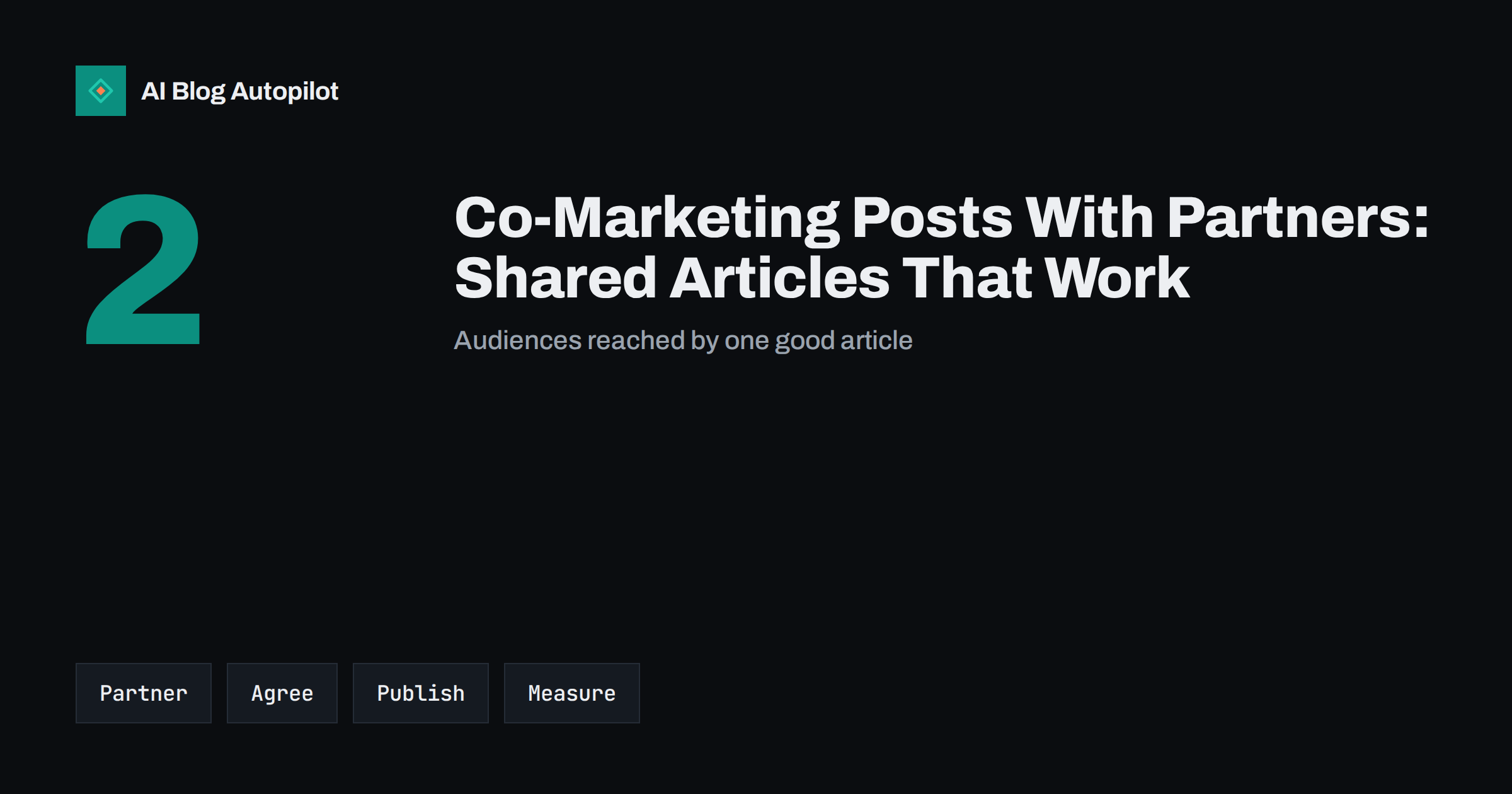
Short answer: a co-marketing post is an article produced together with a partner whose audience overlaps with yours but who does not compete with you. Both sides contribute expertise, both promote the result and each gains new readers and a credible link. To make it work, choose a complementary partner, agree roles, dates and rights in writing, publish the article in one main place to avoid duplicate content, and measure visits, leads and links on both sides.
Most small businesses already know people with whom they share customers: the accountant who works with the same freelancers, the web designer who serves the same shops, the supplier whose products fit your service. A shared article lets each of you use the other’s audience and shows readers that you work in a network of trusted professionals.
This guide explains how to pick partners, plan the content, split the tasks, handle the technical details and judge the results. It also covers the points that cause problems: unclear ownership, duplicate pages, unbalanced effort and promises that nobody can keep.
What co-marketing is and why it works
Co-marketing means two or more organisations working together on a marketing piece for mutual benefit. In blogging, the piece might be an interview, a joint guide, a comparison of how each of you solves a problem, a data study or a series of linked articles. Each partner brings something the other lacks: knowledge, data, audience or credibility.
For readers, the benefit is a richer article. A guide on starting an online shop written by a developer and a payments specialist covers more than either could alone. For businesses, the benefit is reach without an advertising budget, and links from a real, relevant site, which are among the hardest to earn.
It differs from sponsored posts and guest posts. A sponsored post is paid placement, and a guest post is one-sided content on another site. In co-marketing, both parties invest effort and share the outcome. The guide to guest posting: what still works and what does not explains the differences.
Think also about what you can offer. A partner is more likely to say yes if you bring a clear benefit: an audience they want to reach, a skill they lack or content that fills a gap in their library. Prepare a short proposal that states the idea, the benefit for each side, the work involved and the timing, in a few lines. A clear, polite and specific message is more likely to get a positive answer than a general request to collaborate.
Choosing the right partner
Look for a partner whose customers resemble yours, but whose service is different. Competitors rarely make good partners, since each fears that the other will win customers. Complementary businesses, such as a photographer and a wedding planner, an accountant and a bookkeeping app, or a gym and a nutrition coach, share an audience without a conflict.
Check the quality of the partner’s work and website. A link from a site with poor content, spam or a bad reputation will hurt you. Look at their blog, their social profiles, their reviews and their way of working. Talk to them first: a partner who answers promptly, keeps promises and shares your values will make the project easier.
Aim for a rough balance of audience size and effort. A partnership where one side has ten times the audience may still work if the smaller partner brings special knowledge, but it needs open discussion. Be clear about what each side expects to gain.
Start small. A single article or interview is a good trial before you plan a series or a bigger project. If it goes well, you can build on it.
Plan for editing and approval from the beginning. Allow time for each partner to review the text, for changes and for a final check of facts, names and links. A common cause of delay is that approval takes longer than writing. Agree who has the final say on each point, and set a date after which a lack of reply counts as approval, if both sides accept that rule.
Plan the content together
Begin with the reader. What problem do both audiences share, and what would help them? Choose a topic that is useful and not a thinly disguised advert. List the questions the article should answer and decide which partner will answer which part. A clear outline makes the work faster and the result better.
Choose a format that suits the content. An interview works when one partner has a story to tell, a joint checklist suits process topics and a data study works when both sides can share figures. Whatever the format, give the article real substance: examples, numbers, steps and a clear conclusion. The guide to interviewing experts for your articles offers tips on questions and preparation.
Agree the tone and the standards. Decide on the style, the spelling, how each partner will be described and what claims are allowed. Both sides must be able to support what they say, so agree to check facts and to remove anything that cannot be proven.
Agree roles, dates and rights
Write a short agreement, even if it is only an email that both sides confirm. Cover who writes which part, who edits, who approves the final text, the deadlines, where the article will be published, how it will be promoted and who owns the content. A page of clear points avoids most disputes.
Deal with rights explicitly. Who can reuse the text, and where? Can each partner publish a version on their own site, and under what conditions? How should the other partner be credited? If images, data or quotes come from third parties, make sure that each is cleared for use.
Agree on what each side will not do. For example, neither side will change the text after approval, publish confidential information or make promises on behalf of the other. Also agree what happens if one side wants to stop. A friendly exit makes the whole relationship stronger.
Respect competition and consumer rules in your market. If you offer a joint promotion or a discount, state the terms clearly, and if one partner pays or gives something to the other, disclose it as required. When in doubt, ask a professional adviser.
Publish without creating duplicate content
The same article on two sites may be treated as duplicate content, and search engines may show only one of them. The simplest approach is to publish the full article on one site, and on the other site a short summary with a link to it. Both sites gain traffic and links, and neither suffers from duplicates.
If you need the full text on both sites, use a canonical tag on one version that points to the other, as explained in the guide to canonical tags. Decide in advance which site is the main home, and consider the audience: the larger site, or the one that suits the topic best, is often the best choice.
Alternatively, write two different articles on the same topic, each from the perspective of its author, and link them to each other. This takes more work but gives each site unique content. Whatever you choose, make sure that each page links to the partner clearly and that the links use descriptive text.
Link attributes matter. A link that appears in an editorial context between real partners is usually normal. If money, goods or services are exchanged for the link, use the right attribute, as described in the article on nofollow, sponsored and UGC links.
Promote the article together
Plan the launch. Agree on the day and the channels: both websites, newsletters, social profiles and any groups where the topic fits. Prepare short texts and images for each partner, and tag each other in posts. A coordinated launch gives the article a stronger start than two separate announcements.
Keep promoting after day one. Share quotes, key figures or a short summary in the following weeks, and reshare the article when it becomes relevant again. The guide to how to promote a blog post after you publish it lists channels and tactics that work for small teams.
Use tracking tags on links so that each partner can see how many visitors came from their efforts. Share these figures openly, as a good partnership depends on trust. It also helps to learn which channels work best, so that your next project is more effective.
Think about the long term. A single article is a start, but a series can build a lasting relationship and a shared archive that both audiences recognise. Consider a regular format, such as a quarterly guide, a yearly study or a set of interviews, and agree a calendar that both sides can keep. Consistency builds recognition, and it spreads the effort so that no one is overloaded.
Keep the relationship healthy by saying thank you in public, sending traffic and leads when you can and sharing credit fairly. Partners remember who treated them well, and they often become the first people to recommend you when a customer asks for a name.
Measure and decide what next
Define success before you start: visits, time on page, sign-ups, enquiries, new links, mentions or newsletter subscribers. Check the results after a month and again after three months. Co-marketing often has a long tail, and the article may bring readers for years.
Ask partners for feedback and share what you learned. Did the process work? Was the effort fair? What would you change? A short review helps you decide whether to continue and how to improve.
Keep a list of good partners and projects, and give those who delivered value priority for the next idea. Over time, a small network of reliable partners becomes one of your strongest marketing assets.
How AI Blog Autopilot helps
AI Blog Autopilot keeps your own blog active with articles on your topics, with FAQ sections, tags and SEO meta, so that a partner who sends readers to your site finds a blog that is current and well organised. It also shares each article to your social networks. See the pricing page for plans and monthly credits.
Related reading
- Guest Posting: What Still Works and What Does Not
- Digital PR on a Small Budget
- Canonical Tags Explained Without the Jargon
The bottom line
Pick a complementary partner, plan a genuinely useful article, agree roles and rights in writing, publish without duplicates and measure the results together.
SSS
What is a co-marketing post?
An article created with a partner so that both sides reach each other’s audience and share the benefits.
Is co-marketing the same as a guest post?
No. In co-marketing both partners contribute and promote, while a guest post is one-sided content on another site.
How do I avoid duplicate content?
Publish the full article on one site and a summary with a link on the other, or use a canonical tag.
Should we exchange links?
Editorial links between real partners are normal. If anything of value is exchanged for a link, use the sponsored attribute.
How do we measure success?
Agree goals in advance, such as visits, enquiries and links, and compare results after one and three months.