ENEnglish
 LTLietuviškai
 DEDeutsch
 FRFrançais
 RUРусский
 ESEspañol
 PLPolski
 ITItaliano
 UKУкраїнська
 CSČeština
 PTPortuguês
 JA日本語
JA日本語 LVLatviešu valoda
 ETEesti
 HUMagyar
 IDBahasa Indonesia
 TRTürkçe
 HIहिन्दी
 ELΕλληνικά
 ARالعربية
 THไทย
THไทย VITiếng Việt
 RORomână
 MSBahasa Melayu
 BNবাংলা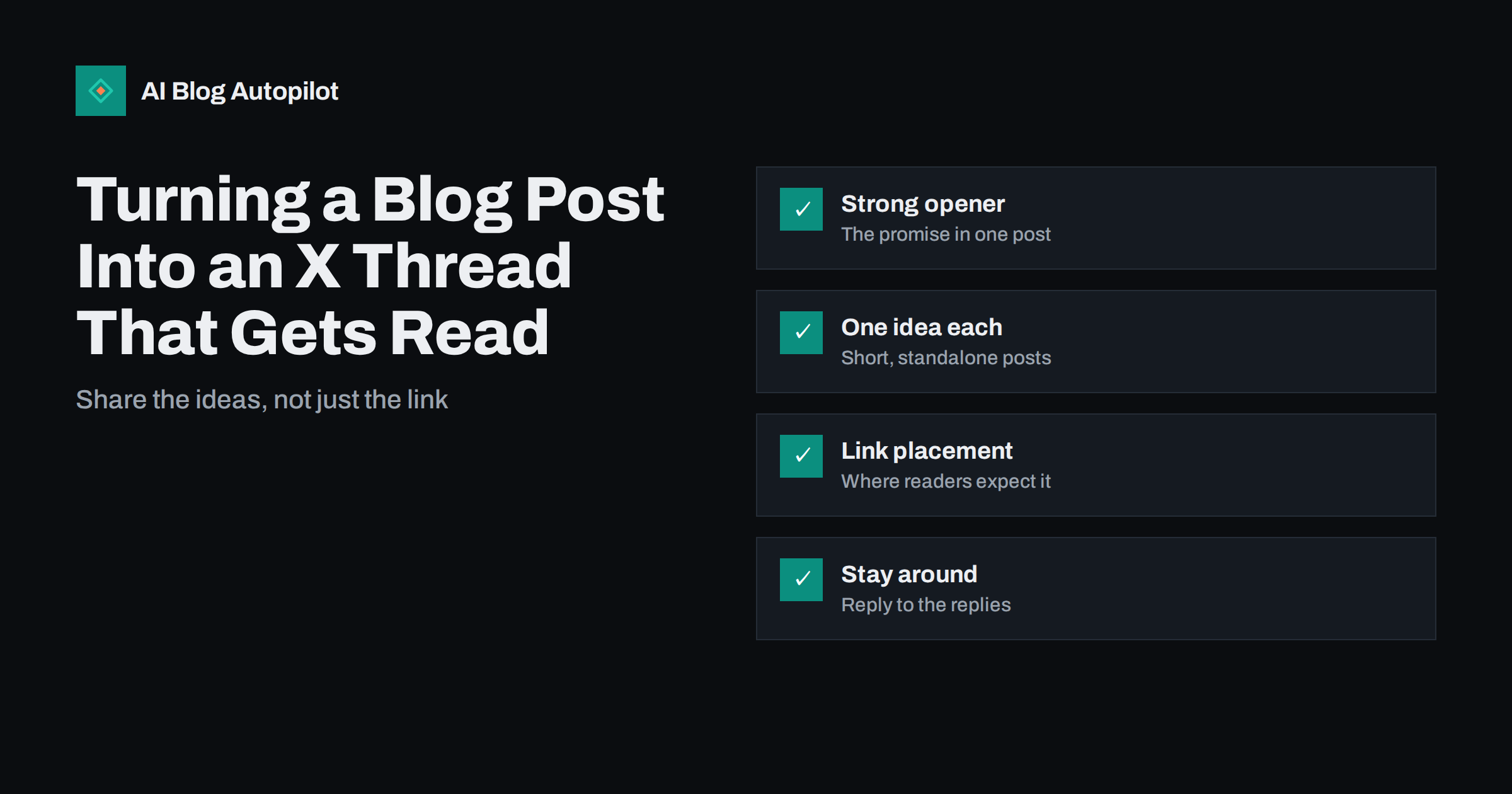
Short answer: to turn a blog post into an X thread, pick the article’s single most useful angle, write an opening post that states the problem or promise clearly, then add five to ten follow-up posts that each carry one point in plain language. Put the link to the full article where readers who want more will find it, usually at the end of the thread and sometimes also early on. A thread that teaches something works far better than a single post with a title and a link.
Sharing a blog post on X by pasting its title and URL rarely does much. The post competes with endless other content, gives nobody a reason to stop, and asks readers to leave the platform before they know whether the article is worth it. A thread solves that by delivering part of the value on X itself. People who find the thread useful follow you, share it and click through for the details. This guide explains how to build a thread from an article, step by step, and the mistakes that make threads fall flat.
Why threads work for blog content
A thread is a series of connected posts, each replying to the previous one, which readers can open and read in order. It suits blog content for a few reasons:
- It gives value before the click. Readers get the key ideas in the feed, which builds trust and makes the eventual click more likely.
- It mirrors article structure. A good article already has a promise, a sequence of points and a conclusion. A thread is the same shape in miniature.
- Each post can be shared on its own. A single strong point from the middle of a thread can be reposted and bring new readers to the whole thing.
- It invites conversation. Replies often contain questions and counterpoints that can improve the article or become new articles.
Choosing the angle
A 2,000-word article covers too much for one thread. Pick one angle that works on its own:
- The checklist: the article’s key steps or checks, one per post.
- The mistakes: common mistakes the article warns about, each with a short fix.
- The myth versus reality: a widely held belief and what actually happens.
- The single insight: one surprising or counter-intuitive point, explained in a few posts.
- The comparison: two options and how to choose between them.
Choose the angle with the audience in mind. Followers who are beginners respond to checklists and clear steps; experienced practitioners respond better to myths, trade-offs and specific insights they have not heard before. If you are unsure, look at which of your earlier posts drew the most replies, and use a similar angle.
You can create more than one thread from the same article over time, each from a different angle, which is a good way to keep sharing strong evergreen posts.
Writing the opening post
The first post decides whether anyone opens the thread. It should state clearly what the reader will get, in plain language:
- Name the problem or outcome: “Most blog posts fail in search for one of six reasons. Here they are, with fixes:”
- Be specific. A number, a concrete situation or a named audience helps.
- Avoid clickbait. If the opener promises more than the thread delivers, readers notice and do not come back.
- Signal that it is a thread, for example with a colon or a simple marker, so readers know more follows.
Write several versions of the opener and pick the clearest one. It is worth more time than any other part of the thread.
Writing the follow-up posts
Each post after the opener should carry exactly one idea:
- Lead with the point. The first words of each post should state it: “Mistake 3: the title promises something the article does not answer.”
- Add one line of explanation or example. Enough to make the point useful, not the full article section.
- Keep posts self-contained. Someone who sees only this post, because it was reposted, should still understand it.
- Use plain language. Short sentences, no jargon unless your audience uses it daily.
- Keep the order logical. Follow the article’s structure or order points from most to least important.
Five to ten follow-up posts is a comfortable range for most topics. Long threads lose readers, and the link at the end is seen only by those who stay.
Where to put the link
There is no single right place, and practices vary between accounts. Common approaches:
- At the end of the thread, in a final post that summarises and says what else the article contains: “The full guide has examples and an FAQ: [link]”. This is the most common choice.
- In the opener or second post, for readers who prefer to read the article straight away.
- Both, when the article is the main goal of the thread.
Many people observe that posts with external links get less reach than posts without them, so some keep links out of the opener. Platform behaviour changes, so check your own analytics: compare threads with the link in different positions and see which bring more clicks overall.
Visuals and formatting
Text threads can work on their own, but a few visual elements help:
- An image on the opener, such as the article’s featured image or a simple diagram, makes the thread stand out in the feed.
- A screenshot of a key table or checklist can carry a lot of information in one post. Add image descriptions so the content is accessible.
- Line breaks inside posts make them easier to read on phones.
- Use hashtags sparingly, if at all. One relevant tag is plenty.
The guide to turning an article into social posts covers other formats for the same article.
An illustrative example
Suppose the article is a guide to writing meta descriptions. A thread built from its “mistakes” angle might look like this:
- Opener: “Your meta description is often the first thing a searcher reads about your page. Five mistakes that make people scroll past, and how to fix each:”
- “1. It repeats the title word for word. Use the description to add what the title could not: the answer, the format, who it is for.”
- “2. It is cut off mid-sentence. Put the important part in the first 120 characters or so.”
- “3. It is the same on every page. Duplicates tell searchers nothing. Write one per important page.”
- “4. It promises what the page does not deliver. Clicks that end in disappointment help nobody.”
- “5. It is stuffed with keywords. Write for a person deciding whether to click.”
- Close: “The full guide includes examples and an FAQ on when search engines rewrite descriptions: [link]”
Each post stands alone, the opener makes a concrete promise and the final post explains what the article adds beyond the thread.
After posting
A thread is a conversation starter, not a broadcast. What you do after posting matters:
- Reply to replies, especially in the first hours. Questions and objections are opportunities to show expertise.
- Collect questions for future articles or for the article’s FAQ. If a question comes up repeatedly, the article probably needs a clearer section on it.
- Repost the thread later if it did well, for readers in other time zones or who missed it.
- Link the thread from related places, such as your newsletter, if it is a good summary of an article.
Measuring whether threads help your blog
X’s analytics show impressions and engagement per post. For blog impact, add UTM parameters to the article link so your analytics shows visits per thread. Compare a few threads with a few simple link posts for similar articles. You may find that threads bring fewer clicks per impression but more followers and replies, which matter over time. The guide to promoting a blog post puts X in context with other channels.
Common mistakes
- Pasting paragraphs. Chopping the article’s text into 280-character pieces reads badly. Rewrite each point for the format.
- A vague opener. “Some thoughts on SEO” gives no reason to read on.
- Too many posts. Twenty-five posts on a simple topic exhaust readers before the link.
- Selling in every post. A thread that turns into an advert loses trust; keep promotion to the end.
- Posting and leaving. Unanswered replies make the account look inactive.
- Inconsistent claims. A thread that simplifies so much that it contradicts the article confuses readers who click through. Keep the wording faithful to what the article says.
How AI Blog Autopilot fits in
AI Blog Autopilot shares every published article to your connected social networks, including X, with text written for each network and posted at its own time. Those automatic shares make sure every article is announced. Longer threads built from your best evergreen articles are a manual step you can add on top. See how Autopilot works and which networks it posts to.
Related reading
- Auto-Post Every New Blog Article to Social Media Automatically
- Repurposing an Article: One Piece, Several Formats
- Turning Blog Posts Into Carousels for LinkedIn and Instagram
The bottom line
A thread shares a blog post’s ideas instead of only its link. Pick one angle, write a clear opener, give each follow-up post a single point, place the link where interested readers will find it, and stay around for the replies. It takes more effort than a link post, and it usually earns more attention.
SSS
How long should an X thread be?
Five to ten follow-up posts after the opener suits most topics. Longer threads lose readers before the end, where the link to the full article usually sits.
Should I put the blog link in the first post of the thread?
It depends on your audience. Many people put it at the end, in a summary post, and some add it early as well. Test both on your account and compare the clicks with tagged links.
Can I turn every blog post into a thread?
Not every post suits the format. Articles with steps, mistakes, comparisons or one clear insight work best. For others, a single post with a strong summary and the link is enough.
Should a thread copy the article’s text?
No. Rewrite each point for the format: one idea per post, short sentences and a clear first line. Pasted paragraphs read badly and do not fit the post length.
How do I know whether threads bring blog readers?
Add UTM parameters to the article link in each thread and check visits by campaign in your analytics. Compare with simple link posts for similar articles, and also watch follower growth and replies.
Is it worth reposting a thread later?
Often yes, for a thread that did well. Readers in other time zones or who were offline will not have seen it, and evergreen topics stay relevant for a long time.