ENEnglish
 LTLietuviškai
 DEDeutsch
 FRFrançais
 RUРусский
 ESEspañol
 PLPolski
 ITItaliano
 UKУкраїнська
 CSČeština
 PTPortuguês
 JA日本語
JA日本語 LVLatviešu valoda
 ETEesti
 HUMagyar
 IDBahasa Indonesia
 TRTürkçe
 HIहिन्दी
 ELΕλληνικά
 ARالعربية
 THไทย
THไทย VITiếng Việt
 RORomână
 MSBahasa Melayu
 BNবাংলা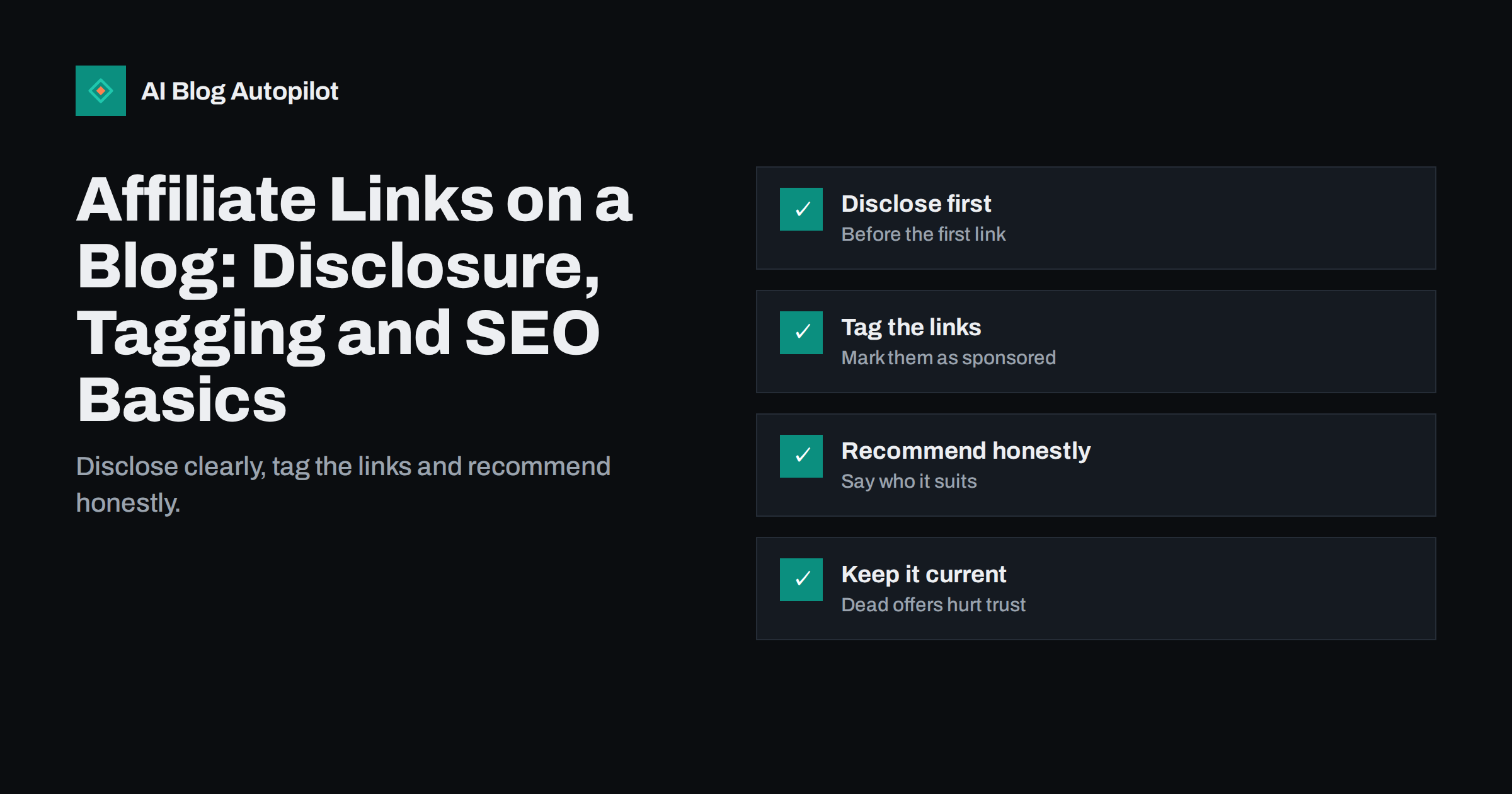
Short answer: affiliate links are fine on a blog if you tell readers plainly that you may earn a commission, mark the links with the sponsored attribute so search engines understand them, and recommend only things you have a real reason to recommend. Put the disclosure near the top of the page, not in a footer, write in a way that helps the reader decide, and check the links regularly because expired offers and dead pages make an article look neglected.
Many blogs earn a little money by linking to products and services and receiving a commission when a reader buys. Done carefully, it is a reasonable way to fund a blog. Done carelessly, it produces thin pages full of links that readers distrust and search engines may treat as low value. This guide explains how to handle disclosure, which link attributes to use, how to write recommendations that stand up, and how to keep a page of affiliate links healthy over time. It is general guidance and not legal advice, so check the rules that apply where you and your readers live.
What an affiliate link is and why it needs care
An affiliate link is a normal link with a code in it that tells the seller who sent the visitor. If the visitor buys, the seller pays the owner of the code a share. The reader pays the same price, but you have a financial interest in the click, and that is the reason for the care. Readers are entitled to know about it, advertising rules in many countries require you to say so, and search engines want to know which links exist because of a commercial arrangement.
The risk is rarely the link itself. It is the page around it. A page written mainly to carry links, with copied product descriptions and generic praise, gives a visitor nothing they could not get from the seller. A page built around a real question, with your own experience or testing and a clear explanation of who each product suits, is useful with or without links.
Disclose before the first link
Regulators in several places, including the United States and the United Kingdom, expect a clear and visible statement when you earn from links, and affiliate programmes often add their own wording requirements. Rules differ, so read the terms of each programme and the guidance for your country. A few habits are safe almost everywhere.
- Place it early. Put the statement above the first affiliate link, usually in or just after the introduction. A note at the bottom or in a footer is easy to miss.
- Use plain words. “Some links in this article are affiliate links. If you buy through them, we may earn a commission at no extra cost to you.” is clear. Vague wording such as “we may have partners” is not.
- Repeat where needed. On a long page or a page that readers may land on in the middle, a short reminder near a product box helps.
- Disclose on shared posts. If you share the article on social media with an affiliate link, say so in the post too.
- Do not hide it in a link. A disclosure that appears only after a click, or in a different colour that blends in, does not count as clear.
Disclosure does not reduce trust as much as many writers fear. Readers are used to it, and an honest statement tends to build more trust than silence that is later discovered.
Mark the links for search engines
Search engines publish guidance on how to qualify links that exist because of an arrangement. For affiliate and other paid links, the recommended attribute is rel="sponsored". It tells the search engine that the link is commercial, so that it does not count as an editorial vote for the seller. You can combine it with other values, for example rel="sponsored noopener".
- Add the attribute to every affiliate link, not just the first one. A plugin or a shortcode can do this automatically.
- Do not rely on redirects to hide links. Cloaked links on your own domain that redirect to the seller are common, and they are acceptable if they are tagged and if the destination matches what the reader expects. Do not use them to disguise what the link is.
- Keep the anchor text honest. Say what the reader will find, such as the product name, not “click here for the best deal”.
- Avoid affiliate links in places readers do not expect them, such as in the middle of an unrelated explanation or in navigation menus.
The page is judged by the whole picture. Correct attributes do not rescue a thin page, and a few affiliate links on a strong page rarely cause trouble.
Write recommendations that stand up
The quality of the advice is what separates a useful affiliate article from a doorway. Several practices make a difference.
- Say how you know. If you used the product, describe what you did and what happened. If you did not, say that the article is based on published specifications and reviews, and name them.
- Include drawbacks. Every product has limits. A recommendation without a single downside reads as an advert.
- Match product to reader. “Best for a small team”, “better for occasional use” or “not worth it unless you need X” helps a decision more than a ranking of stars.
- Compare fairly. If one option pays you more, that must not decide the order. Your readers will notice if it does.
- Link to alternatives, including ones that pay you nothing, when they are the better answer for some readers.
The same standard applies to roundup pages. A list of ten products with a paragraph each and a button is not a review. A list with clear criteria, tested details and honest verdicts can be.
Keep affiliate pages from becoming thin
Search engines have said repeatedly that pages of affiliate links with little original value are poor results. You can avoid that label by adding things the seller’s own page does not offer.
- Original material. Your own photos, measurements, screenshots, short notes from use, or a comparison table that you built.
- A decision aid. A short section on how to choose, with the questions to ask before buying.
- Context. Costs over time, setup effort, what to check before ordering and what usually goes wrong.
- Updates. A visible “last checked” date and a note on what changed.
If you can remove every affiliate link and the page is still worth reading, you are in a good position. If the page makes no sense without the links, it needs more substance.
Maintain the links
Affiliate programmes change terms, products are discontinued, prices move and offers expire. An article that links to a missing product or quotes an old price loses trust quickly. A simple routine keeps things in order.
- List your affiliate pages in a spreadsheet with the programme, the date you last checked them and the next check date.
- Run a broken-link check on those pages every month or two and fix or remove what fails.
- Review any price or feature you quote, or remove the number and link to the seller for current details.
- Remove products you no longer believe in rather than leaving them for the commission.
- Keep a copy of each programme’s terms, since they sometimes restrict how you can display prices or use images.
Treat these pages like any other content that can age. The same checks that find broken links on a blog will catch most problems.
Mistakes that cost trust
Most problems with affiliate pages come from a small set of habits. Checking your own pages against this list takes only a few minutes.
- Copying the seller’s description. Text taken from a product page adds nothing and may duplicate what is already online. Write your own summary in your own words.
- Fake urgency. Phrases such as “only today” or “limited stock” that you cannot verify mislead readers and, in some places, break advertising rules.
- Star ratings you made up. If you show a score, explain how you reached it. Marking up a rating for something you sell or earn from, in a way that does not follow the search engines’ guidelines, can lead to lost rich results.
- Burying the verdict. Readers want to know early which option you would pick and why. Put a short recommendation near the top and let the detail follow.
- Too many links per paragraph. If every second word is a link, the page looks like a catalogue. Link where it helps the reader act, and no more than that.
- Forgetting old pages. Programmes close and tracking codes stop working, which means you may keep sending readers to pages that no longer pay you or no longer exist.
None of these is hard to avoid. They come from writing for the commission instead of for the person reading.
How AI Blog Autopilot helps
AI Blog Autopilot writes full articles with a FAQ, tags and SEO meta, and it is instructed never to make up statistics, quotes or sources, which is important for any article about products. It does not know what you have tested or which programmes you belong to, so add your own experience and your own links, and place the disclosure yourself. If you prefer to read each article before it goes live, you can switch on approval. See the pricing page for plans.
Related reading
- Nofollow, Sponsored and UGC Links: Which to Use When
- How to Write Product Reviews That Readers and Google Trust
- E-E-A-T on a Blog That Publishes Automatically
- Broken Links on a Blog: How to Find and Fix Them
The bottom line
Affiliate links and a good blog can live together. Say clearly that you may earn a commission and say it early, mark the links as sponsored, and write recommendations that include real experience, drawbacks and the reader’s likely needs. Add original material so the page is worth reading without the links, and keep a schedule for checking prices, offers and dead links. Trust is the asset that makes the income possible, so protect it first.
SSS
Do affiliate links hurt SEO?
Not by themselves. Search engines expect them to be tagged as sponsored, and pages that consist mainly of affiliate links with little original value can rank poorly. A useful page with a few tagged links is usually fine.
Which attribute should affiliate links use?
The recommended attribute for paid and affiliate links is rel=”sponsored”. Some site owners also use nofollow, but sponsored describes the relationship more precisely.
Where should the affiliate disclosure go?
Near the top of the page, before the first affiliate link, in plain words. A statement hidden in a footer is easy to miss and may not meet the rules where you live.
Can I use affiliate links in social media posts?
Often yes, but the same disclosure expectations apply, and some networks and programmes have their own rules. State clearly in the post that it contains an affiliate link.
Should I recommend only products I have tested?
It is the strongest basis for advice. If you have not tested something, say how you formed your view and which sources you used, and do not imply first-hand use.