ENEnglish
 LTLietuviškai
 DEDeutsch
 FRFrançais
 RUРусский
 ESEspañol
 PLPolski
 ITItaliano
 UKУкраїнська
 CSČeština
 PTPortuguês
 JA日本語
 LVLatviešu valoda
 ETEesti
 HUMagyar
 IDBahasa Indonesia
 TRTürkçe
 HIहिन्दी
 ELΕλληνικά
 ARالعربية
 THไทย
 VITiếng Việt
 RORomână
 MSBahasa Melayu
 BNবাংলা
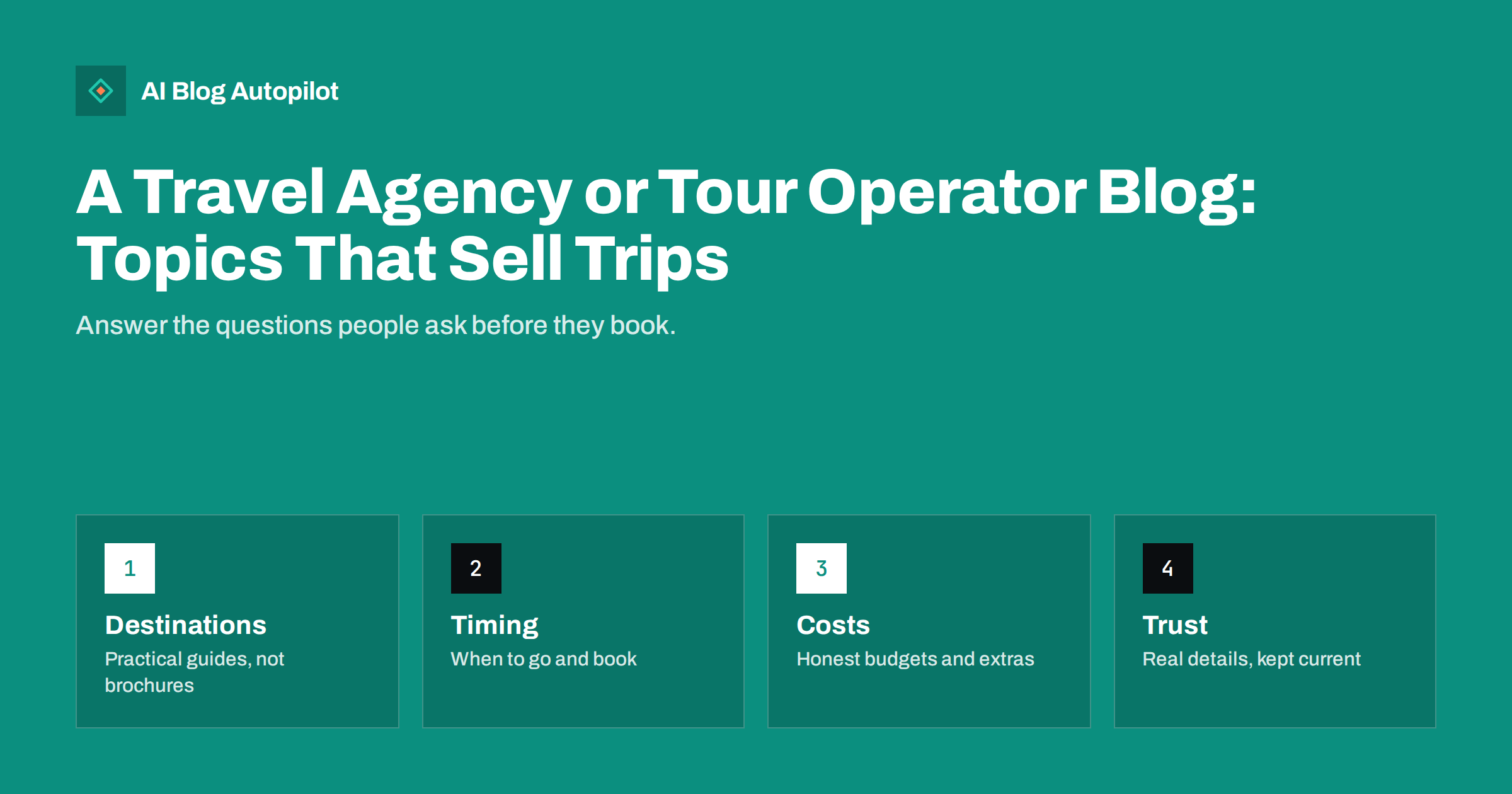
Short answer: a travel agency or tour operator blog should cover the practical questions people ask before they choose a destination, a date and a company: when to go, what it costs, what to pack, how a day on the tour actually runs, what the visa and insurance rules are and what happens when something goes wrong. Articles on those questions attract readers who are close to booking, and they support the sales conversation that follows. Brochure-style pieces about how beautiful a place is rarely do either. Write for the trip planner, keep every fact current and link each article to the relevant tour or enquiry page.
Travel is one of the most searched topics on the web, which is both the opportunity and the problem. Large publishers, booking platforms and tourist boards already cover the famous places in depth, so a small agency cannot win by writing another general guide to a capital city. It can win on the narrower questions that it actually answers for customers every week, on the destinations where it has real experience and on the honest details about prices, timings and conditions that bigger sites gloss over. This article lays out the topics that do that work, the ones to avoid and the routine that keeps a travel blog accurate.
Who reads a travel agency blog
Most readers arrive in one of three stages. The first group is dreaming: they have a season and a rough budget and are comparing regions. The second group has chosen a destination and is deciding when to go, how long to stay and whether to use an agency or book everything alone. The third group has decided to travel with you, or is close to it, and wants practical reassurance: what the itinerary really looks like, what is included, what to pack and what the cancellation terms are. The second and third groups are where a blog earns its keep, because those readers are a short step from an enquiry.
It helps to know which trips you actually sell. A company that organises small-group hiking tours has different readers from one that books family beach holidays or corporate travel. Write for the customer you want more of, not for a generic traveller, and let the tour pages and the blog support each other: the tour page states what is offered, and the blog answers the questions around it.
Destination articles that are not brochures
Destination content works when it is specific and practical. “Ten reasons to visit” articles are easy to write and easy to ignore. Articles that answer a planning question are harder to write and far more useful.
- Best time to visit a region, month by month, with weather, crowds, prices and local events, and an honest note on the months you would not recommend.
- How many days you need for a destination, with sample itineraries for three, five and ten days.
- Getting around: transfers, local transport, driving conditions, how far the main sights are from each other and how long the journeys really take.
- Where to stay by area, with the trade-offs between neighbourhoods rather than a list of hotels.
- Less-known alternatives to the crowded places, which only a company with staff on the ground can describe credibly.
- Accessibility and family notes: what is realistic with young children, older travellers or limited mobility.
Write these from your own experience and from your guides, drivers and partners, and say so. A line such as “our local guide recommends arriving before nine to avoid the coach groups” is more convincing than any adjective, and it is the kind of detail that large sites cannot produce at scale.
Cost, booking and timing questions
People searching for prices and booking advice are closer to buying than people searching for inspiration, and they are underserved because many sites avoid the subject. Give them clear, dated answers.
- What a trip costs: a realistic budget per person for a typical week, broken into flights, accommodation, food, activities and extras, with the date the figures were checked.
- What is included and what is not in a package or tour, explained in plain words, with the common extras people forget, such as airport taxes, tips, local tourist levies and single-room supplements.
- When to book for the best choice and price, and how far in advance peak dates sell out.
- Agency versus doing it yourself: an honest comparison that admits when booking alone is cheaper and explains what the agency adds, such as support during the trip, protection schemes and knowledge of local operators.
- Deposits, payment plans and cancellation terms, described generally and linked to your actual terms page.
- Travel insurance: what it typically covers, what it does not and why it matters, without giving advice you are not qualified to give.
Prices change, so every cost article needs a visible “checked on” date and a reminder to confirm current prices with you. Our article on writing cost articles covers how to present figures honestly and keep them current.
Practical preparation content
Preparation articles are read by people who have already booked, often with you, and by people who have booked elsewhere and will remember who helped them. They also reduce the number of repetitive emails your staff answer.
- Packing lists for specific trips, seasons and activities.
- Entry requirements, visas and documents, with a clear statement that rules change and a link to the official source for confirmation.
- Health and vaccination information, again pointing to official sources rather than giving medical advice.
- Money, cards, tipping customs and typical daily costs on the ground.
- Connectivity, SIM cards, plugs and apps that help.
- Etiquette, dress codes and local customs that visitors commonly get wrong.
- What a typical day on a tour looks like, hour by hour, so that nobody is surprised by early starts or long drives.
Preparation content is strongest when it is tied to the trips you sell. A packing list for “a week of winter hiking in the mountains we visit” is more useful and more distinctive than a generic travel packing list that thousands of sites already publish.
Trust, safety and what happens when things go wrong
Travel involves risk, and readers notice who is honest about it. Articles about delays, strikes, weather disruption, lost luggage, illness abroad and changes to itineraries show that you have handled these situations before. Explain what your company does in each case and what the traveller should do, and keep the tone calm and factual. The same applies to sustainability, overtourism and animal welfare: if you have policies, describe them plainly, and if you do not, do not pretend. Behind-the-scenes articles about how a tour is put together, how guides are chosen and how partners are vetted also build trust, as long as they stay concrete.
Topics to avoid or handle carefully
Some common travel blog topics cost time and bring little.
- Generic guides to famous cities that compete with huge sites and add nothing local.
- Staff holiday diaries with no planning value, unless they are reworked into practical advice.
- Industry news that is out of date in a week and irrelevant to customers.
- Copied content from tourist boards, suppliers or press releases, which is both a duplicate-content problem and a trust problem.
- Legal, medical and visa advice stated as certainty. Describe the general situation, date it and link to the authority responsible.
- Promises about weather, availability or prices that you cannot keep.
Also be careful with photos. Use your own or properly licensed images, caption them with the place and the month taken, and avoid stock photography that shows places you do not actually visit.
Keeping a travel blog accurate
Accuracy decays faster in travel than in most subjects. Opening hours, prices, entry rules, flight routes and even the names of operators change every season. A travel blog needs a maintenance routine as much as a publishing routine.
- Put a “last checked” date on every article with prices, rules or timings, and show it to readers.
- Keep a list of time-sensitive articles and review each one before its season starts.
- Ask guides and partners to flag changes they notice on the ground, and give them a simple way to do it.
- Link to official sources for visas, health and safety, so that readers can confirm the current position.
- When a rule or price changes, update the article and note the change at the top, rather than leaving the old version to mislead people.
- Retire articles about tours you no longer run, with a redirect to the nearest current trip or an honest note.
Seasonal timing matters too. People research summer trips in winter and ski trips in early autumn, so publish or refresh seasonal articles several months before the season, not during it. Our article on planning seasonal content explains how to build that into a calendar.
Connecting articles to enquiries
A travel blog should lead somewhere. Every destination or planning article should link to the tours or services you offer for that place, and the tour pages should link back to the relevant planning articles. Add a clear, low-pressure next step at the end of each article, such as a link to ask a question or request a quote, and make it easy to find your contact details. Track which articles bring enquiries, not only visits, so that you know which topics to expand. A small agency can also use articles in sales conversations: when a customer asks about the best month to go, send the article rather than typing the answer again.
How AI Blog Autopilot helps
AI Blog Autopilot plans and writes SEO articles for your WordPress blog from the topics, keywords, audience and tone you set, and shares each article to your connected social networks with its own text and timing for each one. For a travel business, give it the destinations and the questions your customers actually ask, and use approval mode so that your staff can check prices, dates and entry rules before anything goes live. Plans are compared on the pricing page.
Related reading
- Blog Strategy for a Local Business
- Planning Seasonal Content Without Scrambling Every Year
- Writing Honest Articles About What Things Cost
- Turning Customer Questions Into Blog Topics
The bottom line
A travel agency blog sells trips by answering planning questions: when to go, how long to stay, what it costs, what to pack and what happens when plans change. Write from real experience about the places you actually serve, date every fact that can change, point to official sources for rules and link each article to the trip it supports. Avoid generic city guides and brochure language, and keep a seasonal review routine so that the advice stays true.
FAQ
What should a travel agency blog write about first?
Start with the questions your staff answer most often: best time to visit your main destinations, what a trip costs, what is included and what to pack. Those articles bring readers who are close to booking.
Should we write general guides to popular cities?
Usually not. Large sites already cover them in depth. Write about the specific planning questions and the less-known places where your own experience adds something.
How do we handle visa and health information?
Describe the general situation, show the date you checked it and link to the official authority. Do not present rules or medical guidance as certain advice.
How often should travel articles be updated?
Review every article with prices, rules or timings before its season begins, and update it as soon as you learn of a change. A visible “last checked” date helps readers trust it.
Can blog articles bring bookings directly?
They bring enquiries when each article links to the relevant tour and offers a simple next step, such as asking a question or requesting a quote. Track enquiries by article to see which topics work.