ENEnglish
 LTLietuviškai
 DEDeutsch
 FRFrançais
 RUРусский
 ESEspañol
 PLPolski
 ITItaliano
 UKУкраїнська
 CSČeština
 PTPortuguês
 JA日本語
JA日本語 LVLatviešu valoda
 ETEesti
 HUMagyar
 IDBahasa Indonesia
 TRTürkçe
 HIहिन्दी
 ELΕλληνικά
 ARالعربية
 THไทย
THไทย VITiếng Việt
 RORomână
 MSBahasa Melayu
 BNবাংলা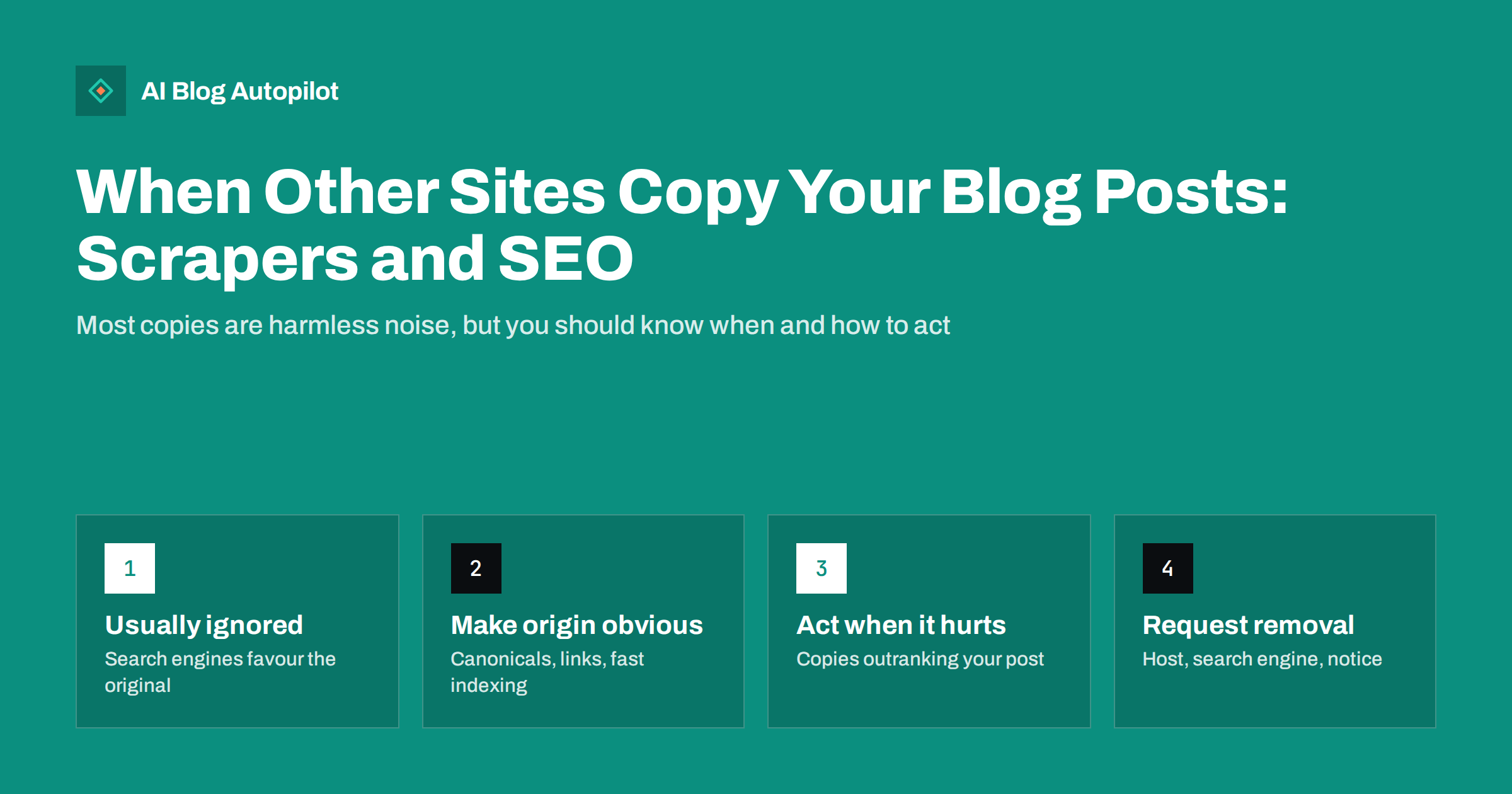
Short answer: almost every blog gets copied by automated scraper sites, and in most cases it does no harm, because search engines recognise the original and ignore or rank the copies below it. You can make your original easier to identify with self-referencing canonical tags, internal links inside posts, prompt indexing and consistent publishing. Act only when a copy outranks you, impersonates you or copies you at scale; then contact the host or site owner and use the search engine’s copyright removal process.
Discovering your article word for word on a site you have never heard of is unsettling. Sometimes the copy even carries your images and your internal links. Many blog owners assume the worst: a duplicate content penalty, lost rankings, stolen traffic.
The reality is usually less dramatic. This guide explains how scraping works, when it matters, how to protect your originals in search, and what to do when a copy genuinely causes problems.
How and why blogs get scraped
Scraping is the automated copying of web content. Scraper sites use programs that read feeds or crawl pages, extract the text and republish it, often with ads around it. Their business model is to collect small amounts of traffic from large amounts of copied content.
Common sources for scrapers include:
- Full-text RSS feeds, which deliver the complete article in a machine-readable form.
- Direct crawling of new posts shortly after publication.
- Aggregators that republish headlines and excerpts, sometimes with more than a fair amount of text.
Not all republishing is scraping. Some sites republish with permission, under a syndication agreement or a licence you chose. That is a different situation, with its own best practices, and is not the focus here.
Does scraped content hurt your SEO?
In most cases, no. There is no penalty for having your content copied by others. Search engines see duplicates all the time and try to show the version most likely to be the original or most useful.
Several signals help them identify your original:
- Your page was usually crawled and indexed first.
- Your site has a history, links and authority in the topic that scraper sites lack.
- Your page carries a canonical tag pointing to itself.
- Copies often contain links back to your site from your own internal links.
Search engines’ spam policies treat scraped content as low value. Google’s spam policies, for example, describe scraping without adding value as a form of spam, and its systems work to keep such pages from ranking.
Problems arise mainly in a few situations: when your site is new and has little authority, when copies are indexed before your original, or when a copy sits on a large, established site. In those cases, a copy can occasionally outrank you.
Making your original easy to identify
A few simple habits make it very likely that search engines treat your version as the source.
- Self-referencing canonical tags. Every post should have a canonical tag pointing to its own address. Some scrapers copy the entire HTML, canonical included, which then points search engines straight back to you.
- Internal links in the body. Links to your other posts, written as normal links in the article, travel with copied text. They show where the content came from and sometimes send a little traffic back.
- Prompt indexing. Submit an XML sitemap, keep it updated automatically and make sure new posts are linked from your home page or blog index. The faster your version is crawled, the less chance a copy is seen first.
- Consider excerpts in your feed. If scraping from your feed is persistent, switching the feed to excerpts removes the full text scrapers depend on, at some cost to feed readers.
- An attribution line in feed items. Some SEO plugins can add a sentence such as “This article first appeared on…” with a link, to every item in the feed.
- Consistent authorship. Author pages, bylines and a clear About page reinforce that your site is where this content originates.
Scraping versus permitted republishing
It is worth separating unwanted copies from republishing you might actually welcome, because the right response is very different.
- Scraping copies your content automatically, without permission, usually to surround it with ads. It adds nothing, rarely credits you properly and is not worth negotiating with.
- Unauthorised but legitimate republishing happens when a real publication, association or partner copies an article because they found it useful, without realising they needed to ask. These sites are usually happy to add a link and a canonical tag once asked, and the result can even benefit you.
- Syndication is republishing you agreed to, such as an industry site running your article with your permission. Good practice is for the republished copy to link clearly to your original and, ideally, to carry a canonical tag pointing to it, so search engines understand which version is the source.
Before sending any removal request, take a minute to see which of these you are dealing with. A friendly message to a legitimate site often turns a copy into a useful link, while a formal notice might damage a relationship for no gain.
How to find copies
You do not need to hunt constantly, but a periodic check of your most important posts is useful.
- Search an exact sentence. Put a distinctive sentence from your post in quotation marks and search for it. Copies usually appear immediately.
- Check your links report. Search Console’s Links report can show unfamiliar sites linking to you, which are sometimes scrapers carrying your internal links.
- Watch for pingbacks and referrals. Some platforms notify you when your links appear elsewhere, and odd referral traffic in analytics can point to copies.
- Use plagiarism checkers for important pages, especially if you depend on them for revenue.
When to act and when to ignore
Pursuing every scraper is a waste of time. They number in the thousands, many disappear on their own, and most do not affect you. Focus on cases that matter.
| Situation | Suggested response |
|---|---|
| Low-quality scraper site, your post ranks normally | Ignore it |
| A copy ranks above your original for its main query | Request removal; check your indexing and canonical tags |
| A site impersonates your brand or claims authorship | Request removal promptly; consider legal advice |
| A legitimate site republished without permission | Contact them; ask for removal or a canonical link and attribution |
| Large-scale copying of your whole blog | Contact the host and file removal requests with search engines |
How to request removal
When a copy is worth acting on, there are several routes. Start with the lightest one.
- Contact the site owner. A polite, clear message identifying your original and the copy sometimes works, especially with legitimate sites that republished carelessly. Ask for removal, or for a canonical tag and a visible link to the original if you are happy for it to stay.
- Contact the host. Hosting providers usually have an abuse or copyright contact. Look up who hosts the site and send a notice with links to your original and the copy.
- Use the search engine’s copyright process. Major search engines accept copyright removal requests, which can remove infringing pages from their results. In the United States this follows the DMCA notice process, and similar procedures exist elsewhere. Provide accurate details; false claims can have legal consequences.
- Report spam. Search engines also accept spam reports about scraper sites, which feed into their systems for dealing with spam generally.
- Get legal advice for serious cases, such as impersonation or copying that causes real financial harm.
Keep records: dates, URLs, screenshots and copies of your messages. If the issue escalates, a clear timeline helps. Removal requests can take days or weeks to be processed, so be patient before assuming a request has failed, and check the copy again before sending a follow-up.
What not to do
- Do not rewrite your original to make it different from the copy. Your version is the original; changing it can confuse matters.
- Do not disavow every scraper linking to you. Search engines already ignore these links in most cases.
- Do not block all bots aggressively to stop scrapers. Overly broad blocking can stop legitimate crawlers and tools too, while determined scrapers find ways around it.
- Do not send threatening messages you cannot back up. Stick to facts and recognised procedures.
- Do not spend hours on copies that rank nowhere. Time spent on your next article is usually a better investment.
How AI Blog Autopilot fits in
AI Blog Autopilot writes SEO articles and publishes them to your WordPress blog, then shares each one to your social networks. Because each article appears on your own domain first and is announced on your networks straight away, your version is typically public and discoverable before anyone copies it. The articles are ordinary WordPress posts, so canonical tags, feeds and sitemaps are handled by your site and SEO plugin as usual. You can see how publishing works on the AI Blog Autopilot home page.
Related reading
- Duplicate Content: What Counts and What Doesn’t
- Originality and Plagiarism on a Business Blog
- Canonical Tags Explained Without the Jargon
- RSS Feeds and SEO: What a Blog Feed Still Does for You
The bottom line
Being scraped is a normal part of publishing online, and search engines usually handle it well by favouring the original. Make your source obvious with self-referencing canonicals, internal links, fast indexing and, if needed, excerpt feeds. Ignore copies that do not matter, and when one outranks or impersonates you, contact the owner or host and use the search engine’s copyright removal process, keeping a record of each step.
FAQ
Will scraper sites copying my blog hurt my rankings?
Usually not. Search engines see copied content constantly and generally favour the original, especially when it was indexed first and comes from an established site. Problems are rare and mostly affect new sites or copies on large domains.
Is there a duplicate content penalty when someone copies my post?
No. You are not penalised because someone else copied you. Search engines try to show one version and generally choose the original. Your job is to make that choice easy with canonicals, internal links and prompt indexing.
How do I get a copied article removed from search results?
Contact the site owner or host first. If that fails, use the search engine’s copyright removal request process, providing the address of your original and of the copy. Keep a record of what you sent and when.
Should I switch my RSS feed to excerpts to stop scrapers?
It can help if your feed is the main source of copying, because scrapers lose access to the full text. It also makes the feed less convenient for genuine readers, so consider it mainly when scraping is persistent.
Can a canonical tag protect against scrapers?
It can help. Some scrapers copy the full HTML including your self-referencing canonical tag, which then points search engines back to your original. It is not a guarantee, since many scrapers strip or replace tags.