ENEnglish
 LTLietuviškai
 DEDeutsch
 FRFrançais
 RUРусский
 ESEspañol
 PLPolski
 ITItaliano
 UKУкраїнська
 CSČeština
 PTPortuguês
 JA日本語
 LVLatviešu valoda
 ETEesti
 HUMagyar
 IDBahasa Indonesia
 TRTürkçe
 HIहिन्दी
 ELΕλληνικά
 ARالعربية
 THไทย
 VITiếng Việt
 RORomână
 MSBahasa Melayu
 BNবাংলা
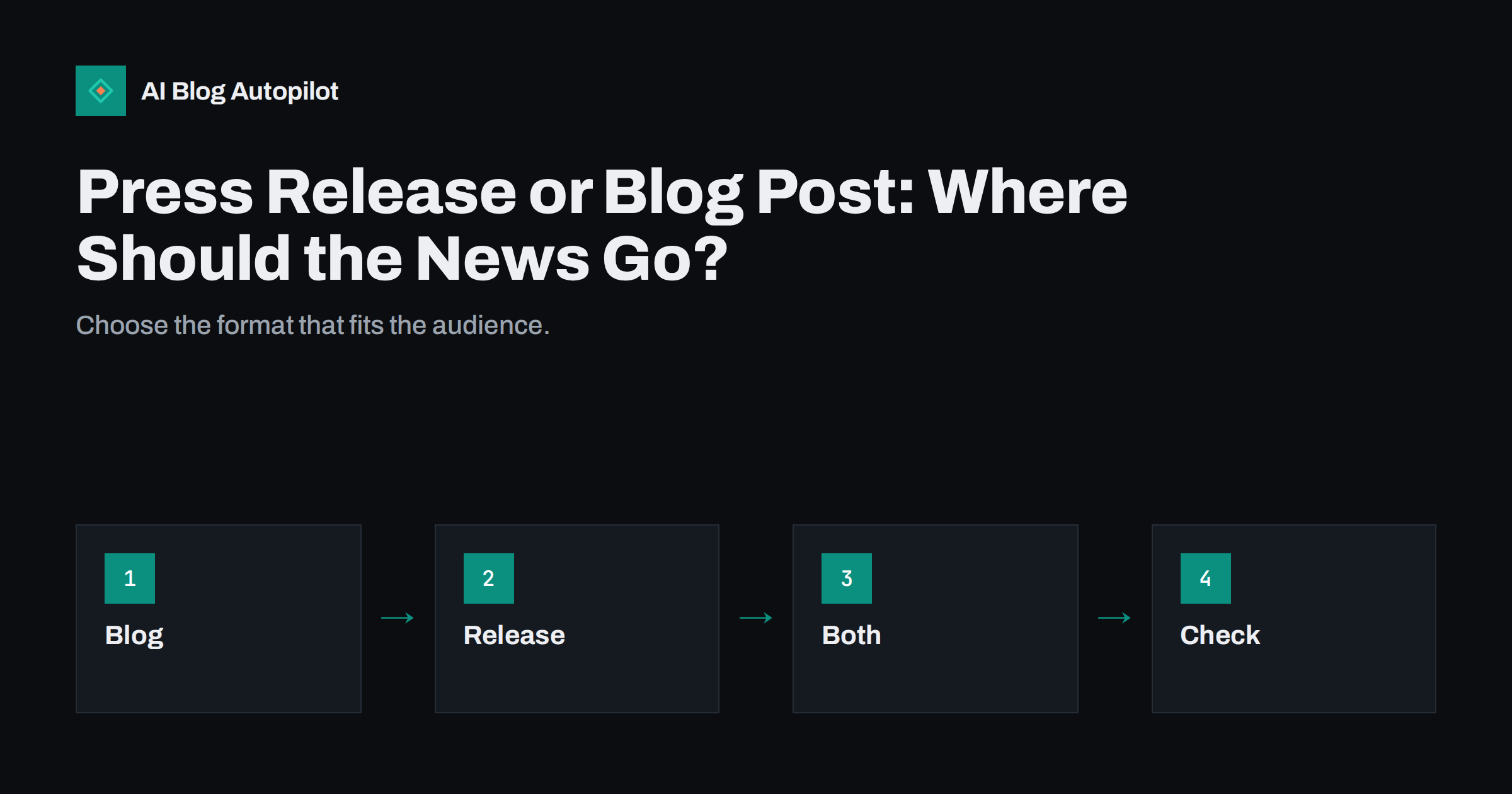
Short answer: put news on your blog when it is meant for customers, readers and search, and write a press release when it is meant for journalists, partners or investors who want facts in a form they can use quickly. Many announcements need only one of the two. When you do both, use the same checked facts, give each a different voice and keep the release on your own site as well, with a clear contact for the press.
Small businesses often ask whether a new product, a new hire, an award or an event deserves a press release. The honest answer is that it depends on who should read it and what you want them to do. A release is a tool for reaching the press, while a blog post is a page for people who already search for you or follow you.
This guide explains the difference, gives simple tests for choosing, shows how to structure each format and warns about habits that waste effort or risk your reputation.
What each format is for
A press release is a short, factual statement written for journalists and editors. It answers who, what, when, where and why in the first paragraph, adds a quote from a named person, gives background and ends with contact details. It is written in a neutral voice because a reporter will read it for facts, not for opinions or sales messages.
A blog post is written for your own audience. It can explain, tell the story, show images, link to related pages and invite a response. It has a voice, a title that attracts search, internal links and a clear next step. It lives on your site and can be found by search engines and AI assistants for years.
The two formats overlap, but their readers differ. A journalist wants to know if the news matters to their audience, and a customer wants to know what it means for them. If you try to serve both in one text, you usually serve neither well.
Think also about lifespan. A release is often used within days, while a good blog post may bring visitors for years. This difference affects how much effort each deserves.
Think also about tone. A blog post may say we are pleased, but a release should say what happened and leave feelings to the quotes. If you find that your release reads like a social post, shorten it and remove anything a reporter would have to rewrite. In the same way, if your post reads like a release, add a human voice, an example and a link to the next step.
When a blog post is enough
Most business news is for customers, not for the press: a new service, a change of opening hours, a price change, a new feature, a seasonal offer, a staff profile, a milestone or an update to a policy. A blog post, shared by email and social channels, reaches the people who care and costs little.
The article on product update posts explains how to write changelogs that readers actually read, and the guide to announcing a price change shows how to word an announcement that customers may not like. Both are blog formats and need no release.
Use a blog post when the story depends on detail or on your voice. Behind-the-scenes accounts, lessons learned, how-to guides and customer stories all work better as posts, and they gain from images and internal links.
Remember that journalists also read blogs. A clear post with a date, a named author and a contact link can be quoted without any release, so write each post as if a reporter might find it.
Prepare the supporting material before you send anything. A short fact sheet, two photographs with captions and permission to use them, a headshot of the spokesperson, a logo and a link to a page with more detail make it easy for a reporter to use the story. Test the links and check that images are not too large to open on a phone. A story that is easy to publish is more likely to be published.
When a press release helps
A release can help when the news is of wider interest: a significant launch, an opening or closing of a site, a large partnership, research with original data, a major award, a leadership change, a charity event or a community project. The test is simple: would an editor of a local or trade publication think their readers would care?
Choose the right outlets before you write. Local news, trade magazines, industry newsletters, podcasts and blogs each have their own interests. A small, well-targeted list of people who cover your field is better than a mass distribution to unknown addresses.
Offer something useful beyond the announcement: a photograph the press may use, a spokesperson, a short data summary or a local angle. Reporters need material and access, not adjectives. Original data is especially valuable, as the guide on original research posts explains.
Be realistic about the result. Most releases are ignored, and a link in a release rarely changes rankings. Measure success by coverage, replies and relationships rather than by links alone.
Read both texts aloud before sending. Check each name, title, date and number against the fact sheet, and ask a colleague who was not involved whether they understand the news from the first paragraph. If they cannot say what happened in one sentence, the text is not ready. Keep a record of the final versions with the date, since a correction may be needed later.
How to write each one
For a release, start with a short, factual headline and a first paragraph that contains the main facts. Add a named quote that says something useful, not a slogan. Include dates, places and figures that can be checked. Finish with a short description of your organisation and a direct contact, and keep it to one page.
For a blog post, start with the point that matters to the reader, then explain details, show what changes for them and finish with a next step. Use headings, short paragraphs and descriptive links. Add an answer-first summary at the top, as the guide on answer-first writing describes.
Keep the facts identical. Use one source of truth, such as a fact sheet with names, dates, figures and approved quotes, and write both texts from it. When the texts disagree, readers and reporters notice, and so do AI assistants that read both.
Avoid empty phrases such as world-class, revolutionary or leading. If a claim cannot be proven, leave it out. The article on claims you can back up shows how to support what you say.
Where to publish a release
Publish the release on your own site, in a press or news section, so journalists can find it and copy the facts. The article on a press or media page for a small business website explains what to include: contacts, logos, photographs, a fact sheet and past coverage.
Think carefully about distribution services. Sending a release to a service that spreads it across many sites may bring little value, and stuffing it with keyword links can be treated as a manipulative link scheme. Use plain links to relevant pages and nothing more.
Email the release personally to the few people who cover your area, with a short note saying why it may interest their readers. Do not attach large files, and do not send the same message to a long list in one visible address line. Respect requests to stop.
Mark embargoes clearly, and keep promises about timing. Trust with journalists is slow to build and quick to lose.
Common mistakes
The most common mistake is sending a release for news that is not news, such as a minor update or a routine event. This trains editors to ignore your name. A better habit is to send fewer releases and make each one count.
Another mistake is writing a sales page and calling it a release. Reporters remove promotional language, and a text that contains little else is discarded. A third is forgetting contact details, a date or a clear statement of what changed. Check each release against a short list before sending.
Do not copy a release across several sites as identical text, and do not publish the full release as a blog post without thought. If you republish, add context for your own readers and consider a link back to the original, as the article on content syndication without SEO harm describes.
Keep a short log of past announcements: what was announced, which format you chose, where it went and what came back. After a year you will have real evidence of which news deserved a release and which did not. This record also helps new team members decide quickly, and it prevents the habit of sending a release just because a competitor did.
A simple decision method
Ask three questions. Who needs to know? What should they do? Where do they look? If the answer is customers who follow you, write a post. If it is journalists or partners, write a release and publish it on your site. If both, write the facts once and then two texts.
Plan the order. Often it works best to publish the blog post and the release together, so that anyone who clicks from the release finds a fuller page. Share the post on your social channels once the news is public, and avoid announcing on social media before the press has the story if you have promised an embargo.
Review after a month. See which pieces brought visits, replies or coverage, and adjust your habits. Over time you will learn which kinds of news are worth a release and which are better as posts.
How AI Blog Autopilot helps
AI Blog Autopilot can write and publish articles on your chosen topics, with FAQ sections, tags and SEO meta, and share them to your social networks. Give it your fact sheet, and check names, dates and figures before each article goes live. See the pricing page for plans and monthly credits.
Related reading
- A Press or Media Page for a Small Business Website
- Digital PR on a Small Budget
- Product Update Posts: Writing Changelogs People Actually Read
The bottom line
Write a post for your audience, a release for journalists, base both on one set of checked facts and send fewer releases that matter more.
FAQ
Do I need a press release for every announcement?
No. Most business news is for customers and fits a blog post shared by email and social channels.
Does a press release improve rankings?
Rarely by itself. Judge it by coverage and relationships, and avoid keyword-stuffed links.
Should I publish a release on my own site?
Yes, in a press or news section, so journalists can find the facts and contacts.
Can I use the same text for the post and the release?
Use the same facts but write two voices. Copying the release as a post serves neither reader well.
What should a release always include?
A clear headline, the main facts in the first paragraph, a named quote, dates and a direct contact.